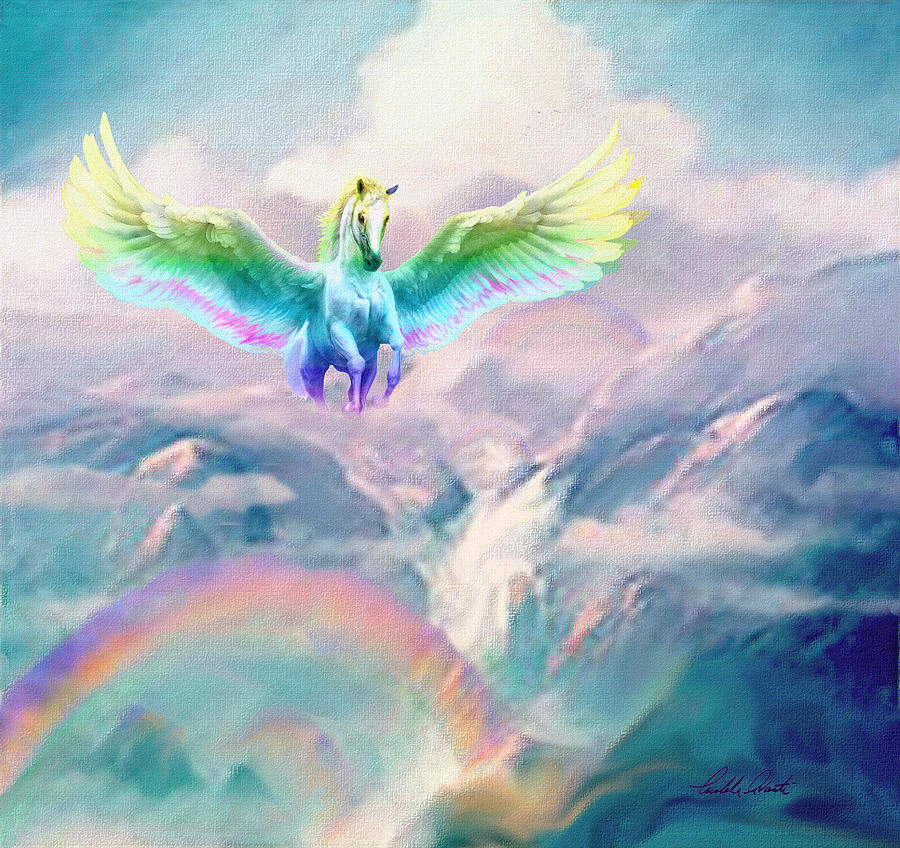
Blow high, blow low
Clouds above, clouds below
The divine horse sired by
The west wind flies in the sky
Across the Milky Way
Above the weariless sun
And waxing moon in wonders
With which the heaven is chimed
Blow high, blow low
Clouds above, clouds below
The divine horse sired by
The west wind flies in the sky
Across the Milky Way
Above the weariless sun
And waxing moon in wonders
With which the heaven is chimed

She untangles the threads
from Ariadne’s Ball
and spins them in strands
of lovely colors onto the Wheel
of Fate holding Pandora’s Box
she has purloined from gods
to weave them into a new fate.

As members of society and citizens of the world, we are one way or another connected to the past, present, and future. That is why history is a multidisciplinary study to understand human nature and learn lessons from the past. Listen to Winston Churchill: “Study history, study history. In history lies all the secrets of statecraft.” Watching our nation’s leaders on T.V., dividing the country into splinters of dissenters instead of embracing them as one people of the nation, makes me urge the current political leaders of our country to read about what it means to be an intelligent and influential ruler who knows a thing about leadership.
Roman emperor Hadrian was of history scholar, specialized in ancient Greek history and mythology. He was affectionately known as a “Greekling” and endeared and admired by the Greeks whose land he made in the Roman Empire. The Greeks’ love of the Roman Emperor was inscribed in the Arch of Hadrian built in AD 131, an archeological wonder with the 59 feet high structure made from marble from Mount Pentellicus used for the Parthenon, that read: “This is the city of Hadrian, and not of Theseus.” The Greek elation reached the pinnacle when their Roman ruler built the Temple of Olympian Zeus, Hadrian’s dedication to the king of Greek gods and goddesses’ splendor. He also made the legendary Library of Hadrian, containing 100 marble columns with halls with printed ceilings, alabaster walls, and great statues of the Olympians destroyed by the malice of fortune AD 267. Greek enthusiasm for their Roman emperor was no unreason for their willing submission to Rome’s rule, which they had once colonized. The site of the Temple of Olympian Zeus and the Arch of Hadrian in modern Athens
 The Temple of Olympian Zeus and the Arch of Hadrian
Hadrian’s fascination with Greece developed from his learning under the tutelage of his cousin Trojan became a foundation of Pan-Hellenism to turn Athens into a new cosmopolitan cultural center for the Roman Empire. By way of acculturation, Hadrian hoped to stabilize the Roman Empire’s fractious eastern part and effectuate the colonials’ ruling. Hadrian followed what the antecedent Roman poet laureate Virgil in the Aeneid to solidify Greece and Rome’s cultural link. In this fashion, he succeeded in ruling the colony with glad acceptance by the governed, who even declared him a founder of new cosmopolitan Greece, intent on cutting ties with the mythical ancient past.
Hadrian’s motto of Pan-Hellenism reminds me of Macedonian predecessor Alexander the Great’s Hellenism, both of which proved work in incorporating different cultures into a dominant culture with respect and benevolence. Both Alexander and Hadrian had an eye for beauty in arts embedded in cultures they annexed to the dominion and knew how to rule wisely and effectively. It was acculturation of the native cultures on both sides, the ruling and the ruled. Yet, Hadrian’s way of exercising sovereignty over Greece is more accommodating and welcoming, even if the intention was not free from political ambition. The ancient Athenian historian Thucydides confirmed that history is the ultimate record of the events by recognizing certain commonalities between the past and the present that transcends the subject of times and applying it to our present situation. If our current political leaders take a cue about social integration to the same vein’s present social conditions, it might help the country stratified by race and class.

The story of a half-bull and half-man monster known as the Minotaur epitomizes the primordial thematic perspectives of mankind juxtaposed along with the law of nature representing the mysterious force. It became a subject of belief tradition peculiar to its natural and cultural environs. The conflicting sentiments of reverence toward the awe-inspiring nature’s creatures and the ambition for domineering them as the ruler of the universe give birth to the bestial creature in the figure of the terrific Minotaur who was fated to be slain by the Athenian hero Theseus.

King Minos betrayed Poseidon by keeping his beautiful snow-white Bull, instead of sacrificing it to the expectant god, who, in turn, made his wife Pasiphae unquenchably infatuated with the Bull. She copulated with the beast by taking herself into the form of a hollow wooden cow designed by the Athenian architect named Daedalus. The result was the Minotaur kept in a Labyrinth by the selfsame designer of the wooden cow. The Minotaur showed no human feelings or emotions as the mythology did not treat him any more than a horrible bestial creature from the unnatural union of a woman and a beast.
A Bull in the ancient Greek culture was a chthonic animal associated with fertility and vegetation and also represented the sun and the might. In fact, the famous figure and paintings of bull-leaping are seen inside of the Minoan mausoleum in Knossos as first discovered by the eminent English archeologists Arthur Evans, who also found Linear A and B letters, the mother of the ancient Greek language, at the turn of the 20th century,

The perspective on the dog as the loyal canine companion collapses the millenniums between the ancient Greek’s time and ours. Even the Cerberus, the three-headed guard dog of the Hades look tamable with a piece of sweet cake, making it look less of a menacing beast necessitating the blood and flesh of man. This goes without saying that it was Argos, the paragon of the faithful canine, who recognized his travel-weary employer Odyssey after 20 years of absence from home and put forth what might think he had to approach him with a wagging tail. He died as his long-waited boss in incognito passed by him with his heart pounded by a surge of pathos dubbed in warmth. Of all the gods, goddesses, heroes, and even his family, it was Argos who showed genuine, artless unconditional affection to Odyssey and thus rendered his heroic owner all the more humane and sympathetic.

Speaking of loyalty, Laelaps, a Greek mythological dog that never failed to catch what it was hunting, also denotes how the ancient Greeks perceived the dog as their life companions. Laelaps was initially a gift to Europa from Zeus, then bequeathed to Minos, who gave it to his concubine Procris whose sister included Pandora. She gave the hound to her husband Cephalus as a token of her unbroken love for him Cephalus used the hound for hunting the Teumessian Fox that could never be caught. Then Zeus turned both of the animals into the stars as the constellations Canis Major (the dog) and Canis Minor (the fox).

Consequently, the use of the animals above in the thematic context in the Greek mythology evinces that mankind cannot exist alone as part of nature. Man finds his meaning of what it means to be a human and its purpose in life by rendering the values and precepts of natural law emblazoned in the human consciousness to the meta figures of the mythology. The mythological animals, whether wild, imaginary, or ordinary, are the reflection of the human traits interbred with imaginary creatures from the Elysium of Fancy. It became the substratum of a belief tradition administering to the modes of social behaviors in society, and thus developed into an organized religion by way of syncretism in the era of Christianity.

Up in the misty airy mountain yonder
Where trees and flowers never wither
The lunar beauty comes upon her
and covers her with a veil of silver
with a wreath of stars on her hair
In the luster of amaranthine glamor;
Then her eyes gather light and fire
Burning with felicity, rapture, or desire
Like a condensed colossal meteor
Wrapped in mystic eternal camphor
in serene brilliance of Moon’s Sphere
growing bright and glowing brighter;
Nymphs and fairies weave into the ether
The melodies of Aeolian harps sweeter
Softer than the milky way’s gossamer
Allaying the wild untamed waves of dander –
Her heart entranced with elevated Passion
Forgetting the nobility of exalted Reason.
P.S.: Fairie-tale is a fantastic means of translating an Author’s inmost feelings, deep-set emotions, and solipsistic philosophy smothered under the necessity of fulfilling demands placed upon daily tasks in existential life in the safest and, therefore, the most eloquent fashion the Author can rely on. As Edmund Spencer, William Shakespeare, William Wordsworth, and John Keats all used faeries as their faithful and wonderful subjects of their imaginative kingdoms, so do I take the liberty of doing the same as a way of escapism to the Otherworld where I can become all I want to morph into and enjoy what I covet without a moral qualm in the reign of religiosity. Here the subject of the poem is a maiden desiring of beauty which she believes to have been forfeited or deprived of by the callously whimsical play with her fate by the supernatural powers-that-be on a lark.

In the wilderness of the great ocean
Lies a secret script of the Fate of Man
Sealed in the silence of tidal motion
In dissimulation of the opprobrious plan
Harboring the secrecy of the Age of Man
That gods so have kept to themselves alone.
The Ages of Man, the Plays of Man
On the Stages of Acts in Humanity –
Those gods wrote and watched for fun
In the theater of Comedy and Tragedy
As the Wheel of Fortune decided what
Would be played the next, and whatnot.
The heart of the ocean sends a pulse thru me
Of the secret hidden in the watery main
With the sunny breeze that pushed Odyssey
To sail forth against the forces of the divine
To find and write a new Age of Man to witness
The victory between the Scylla and Charybdis.
P.S.: This is a poem written out of my existential crisis in the reflection of Herodutus’s theory of the Age of Man. I am not a fatalist but a believer of luck as Shakespeare was. I believe that time and chance are what ascribe to the fulfillment of your ends in life or for the nonce. Didn’t Thomas Alba Edison also corroborate that a genius is made of 1 percent of ingenuity and 99 percent of efforts? I want to embark on an Odyssey to claim my own destiny.


You must be logged in to post a comment.