Tag: history

  • Arthur Conan Doyle’s Search for Truth

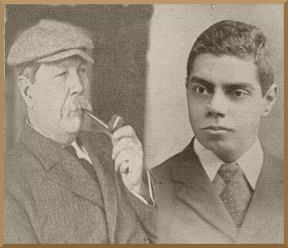
    Sometimes the truth is so strange and mad that you wish yourself dreaming when you awake. That is what Sir Arthur Conan Doyle must have realized when he got a letter from one George Edalgi. The story read springing from Doyle’s Holmesian stories. Britain’s beloved author, partly curious and mostly indignant at the case’s stupendousness, felt responsible for searching the truth as the creator of his alter ego, Sherlock Holmes. So Doyle met the client Edalgi face to face in a hotel in January 1907. 


    George Edalgi, the eldest son of Parsi-English vicar in the small mining village called Great Wyrley in England and former solicitor, served seven years of penitentiary servitude for the Great Wyrley killings of 1903 he claimed innocent. Edalgi’s case was an ipso facto example of miscarriage of justice on indubitably evident grounds of racially imbued personal vendettas against him and his family for who they were. The Edalgi family, despite Charlotte, the mother, and wife, being white, were regarded as heathen Indians encroaching upon the comfortable life of the English, or more precisely, the white privileges, which was the bastion of the eyes of the most villagers. Since the beginning of Reverend Edalgi’s vicarage, the family had been constant targets for racial slurs and hostility that perpetuated the peaceful family life. Even after George became a lawyer, the villagers continued to disrespect his presence, culminating in the notorious Great Wyrley killings of 1903 in which livestock, including horses and cows, were atrociously mutilated and left dead in horrible agony. As Wyrley was a closely-knit village of miners, the easy target for the blame goes for the Edalgis, especially for their eldest child George. He was a loner with distinctively ethnic physical features roving around alone in rumination on evenings. Any white person doing the same ritual would seem philosophical, sentimental, or poetic even, but it did not apply to George’s leisurely ceremony.


    Upon consulting George, who must have thought Doyle as the only person on the British Isles to listen to his truth, Sherlock Holmes’s writer has the hunch that the client could not possibly have committed such an abdominal crime for the following reasons. The trappings are so fitting to a conspiracy that they stink:

    1. George is noticeably near-sighted when reading. The animals’ mutilations indicate only good eyesight can perform such surgically precise cuts.
    2. The ethnic backgrounds of George and the cultural environment of the village are circumstantial evidence that the case is racially motivated from the beginning. If not, then the real culprit used George’s vulnerability to camouflage his crime.
    3. The police framed George for the killings, knowing the real culprit because of racialism led by the local aristocratic police chief GA Anson.

    Doyle’s real motivation for campaigning for George’s amnesty is curious speculation. Yet, it was the darkest night of the soul when Doyle answered the call for justice. He lost his wife Louise to tuberculosis while he was in love with Jean Leckie. Doyle took Louise’s death as a pang of his consciousness for seeing another woman at the time of her illness and regarded the letter from George as redemption of his soul to redirect the ship adrift after maelstrom. Whatever it might have been, Doyle was one of the most ardent campaigners for George’s pardoning to reinstate his legal career and restore his tainted honor. The fruition bears two tastes of the victory: the case led to the establishment of the Court of Criminal Appeal in 1907, and George was allowed to practice law again, which he did in London. However, the official government’s compensation for George’s time from the malice of injustice yielded nothing. Soon the case and the name George Edalgi became a thing of the past unless Arthur Conan Doyle chimes the bell with the forgotten.

    This story I read from a British history magazine makes me think of what an author should be. An author sees the corrupt humanity and ills that cause it, stands furious with the honest minds, and speaks to the corrupt minds amid the chaotic order of nature that goes against truths. Charlotte Bronte posited that an Author has a faithful allegiance to truth and nature. Bestselling or obscure, an Author represents humanity who can see what others oversee or trivialize in preference to magnitude in power and splendor in fame. In that light, Conan Doyle deserves special homage for his search for truth. That is why he is still a great author in posterity. 

  • ‘The Entity (1982)’ – film essay


    “The Entity (1982)” is an American film based on the real-life event of Dorothy Bither, who was habitually raped by evil spirits that followed her everywhere. In the movie, Dorothy is Carla Moran, a young, intelligent single mother of three whose life becomes a Circle of Hell incarnate on earth in which she becomes a sexual slave of the unseen unclean spirits. Despite the physical signs of attacks, her well-meaning but over-zealous psychiatrist Dr. Phill Sneiderman believes that her unhappy childhood and different anfractuous life experience generate the mind’s play. He then forces his belief into her with a superior sense of academic and professional pride, even if her children have witnessed supernatural powers are attacking their mother. Carla catches at straws in the form of parapsychology to set herself free from the demonic forces, even if the help is not entirely altruistic and may turn on a full circle of violation of her body, her heart, and her spirit.


    The film agrees to the truth on the supernatural essence of rape by portraying Carla as a woman of diligence, intelligence, and heart who goes to a secretarial school at night for a better future. Her love and affection for children are filled with kisses and smiles, even to her head-strong adolescent son. Her childhood memories and paths she treaded upon thus far might have been labyrinthine, but just because you have past wounds doesn’t mean you are stigmatized for the malady of the heart forever. Dr. Sneiderman’s attitude toward his patient Carla is reminiscent of the late Victorian and early 20th-century institutionalization of women with checkered lives, the victims of violence, into crudely primitive asylums where any sane person was sure to lose a reason before long. However, Carla rejects her telltale testimony to the supernatural terror to be nothing but a tale told by a lunatic woman, full of sound and fury that means nothing.


    ‘The Entity’ is a classic movie of supernatural phenomena in the ordinary surrounding of Los Angeles, CA. What makes this film classic in its pure literary sense is the absence of gory scenes accompanied by shrill screams of overtly acted characters who know what will happen to them. Nudity is present in the film not as gratuitous scenes of repertories of box-office horror movies but as realistic segments of what and how it happened all. I initially avoided watching this film by its thematic subject of rape and its naturally subsequent psychological narrative analysis as someone craving for a true supernatural story without frequent staccatos of blood splashes and big sharp tooth. It was a low hope for high heaven when the film was impressively indelible in my mind after I watched it last Saturday. If you prefer watching 70s and early 80s supernatural films over slash movies after the golden periods of the genre, ‘The Entity’ will entertain your sentiment and satisfy reason. And remember this: “There are more things in heaven and earth than are dreamt of in your philosophy.” Don’t forget that.

  • Around the World in 72 Days

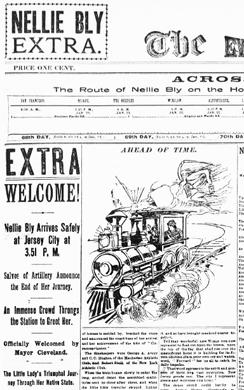
    The masts were solemnly lowered as the anchor was triumphantly docked in at a Hoboken harbor in New Jersey. Then there appeared a young woman with eyes of brilliance that glowed with joy and alacrity of departure from her race against the time. One hundred thirty-one years ago today was when one steely journalist named Nellie Bly broke the boundary of imagination and reality by completing her round-the-world race in 72 days at New Jersey. Bly’s phenomenal record was indeed transcendent of the realm of fictitious reality where Phileas Fogg, Jules Verne’s creation of gentleman adventurer, finished his globe-trotting in 80 days. The world record was not only a sensational media headline in her time but also a glowing manifestation of grit, resilience, and the power of the mind that Bly demonstrated on herself as a woman.

    Born Elizabeth Jane Cochran in 1864 in a small Pennsylvania mill town, Nellie Bly was her catchy nom de plume for the literary world, where she became successful. She was something of a frontier pioneer woman in investigative journalism and adventuring into unpathed areas of news reporting of the Dickensian world of crime and health bureaucracy, notably of the asylum at Blackwell’s Island in New York where she infiltrated as an undercover. However, a panoply of her achievements backfired when her pent-up yearning for holidays on a different shore agreed to a spectacular proposal by Joseph Pulitzer, the New York World owner, of the ingenious race-round-the world against the time. Bly’s decision to embark on the one-of-kind adventure was an apropos admixture of personal yearning to get away from the weight of reality and the publisher’s entrepreneurial aim to proliferate circulations.

    So there off, she embarked on the race with a trunk containing hygiene necessities, a few wardrobes, and some books to read, but without any weapon, not least because of her belief: “If you smile at the world, the world will smile at you.” She sailed across the Atlantic Ocean from New York, through Europe, the Arabian Sea, and the Far East, and then back across the Pacific to return to the homeland. During the voyage from Hong Kong to Japan, Bly heard that another contender emerged from the oceans’ edges: twenty-eight years old Elizabeth Bisland, the literary editor of Cosmopolitan, a rival publication of The New York World. Always achieving, always forwarding, Bly hastened to complete her race guarded by the goddess of fortune and blessed by Jules Verne, whom she met during the race in Europe and was able to trounce her rival journalist arriving five days earlier and Philias Fogg eight days.

    Bly was a supreme one of a kind, not most because she was a woman reporter who was some rarity. Instead, she was a person of indomitable determination, commendable work ethic, and insatiable curiosity, which were coveted attributes even to men of high aspiration. Bly demonstrated the Nietzschean will to power in her achievement by the epiphany of the noble soul to create capabilities to make the idea into an incredible and remarkable reality in the chapter of humankind’s history. Herodotus would have loved to record it.

  • Playing goddess fortuna

    Aristotle averred that man is a political animal by nature. Anyone uninterested in politics is either a divine being or a beast considering his contemporary volatile political situations in city-states due to the Peloponnesian War. He must have noticed that an unstable government naturally spawned the populace’s grunts, usually in matters of economic hardship and arbitrary measures of civil conduct. That was millenniums ago; you might say, at least not in the United States, some might say. Then why are the scenes of the disaffected ancient Athenians overlapping with those of the disappointed Americans now at the end of this Pandemic Year like an army of living ghosts in my mind’s eye?

    It all began with Covid-19 that showed politicians’ true colors, which are neither bright nor dark but only gray, grayer, and grayest. To add clarity to the grayness, the current tug-of-war in Capitol Hill regarding the Economic Impact Payment (“stimulus check”). The sudden news of the second stimulus check was a dim light of high hope for low heaven for most people whose livelihood depended on paychecks from work, social services, or other possible aid agencies. Then another beam of hope shone from the Congress that they would push for a higher amount of the stimulus check to be passed in the Senate. Woe betides anyone who believed in human kindness! The big wigs in the Senate thought that the increased amount of the check would be spent inordinately by people who would not need the monetary aid, such as the employed and others unqualified for whatever deemed unfit in the eyes of the moralists confusing coldness with principles.

    As the Pythagorean theorem does not formulate life, no one can expect the exact sum of need, subject to individual circumstances. As in other countries, our political leaders do not have the right to measure their political rhetorics with personal egos in the guise of moral rectitude. They should not dictate what people do with the government-issued pittance because that the first and foremost a sign of totalitarianism over individual freedom. Once the money is given, then it’s up to the donee how it is spent, come what may. Besides, the amount of stimulus check is not as generous as the senate majority thinks. It barely covers a month worth of food, transportation, and some utility bills in most households. But then, beggars can’t be choosers. People want it, and they want it now to get by. Does the Senate know about it? I doubt it.

    Those who regard folks in need of financial aid as the annoying mendicants mooching off others’ packets should know that the swift is not to victory, the strong not to wealth, but time and chance befall to all. The government should not play the role of the goddess of fortune blindfolded spinning the wheel of fortune, missing the wheel’s lucky compass to those in need of it.

  • My letter to the editor got published – again!

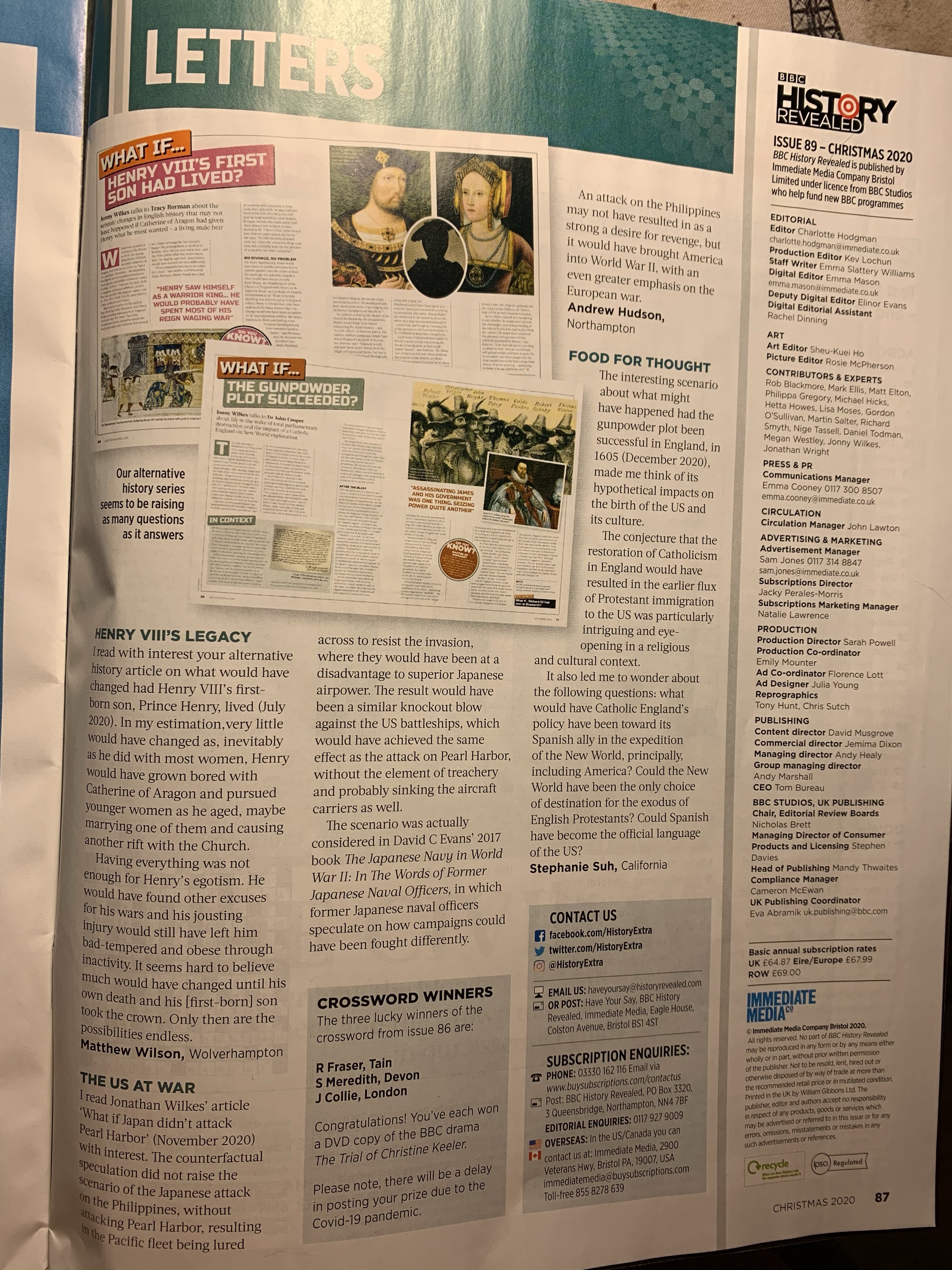
    Reading the history of ancient Greek, Egyptian, and Western Civilization, in general, gives me mental refreshment. It connects me to the people who lived before me, crossing over the boundaries of time and territories. So, it was a pleasant present after a day’s work when Mom handed over to me a Christmas issue of the BBC History Revealed magazine that had arrived at home. To my delight, I saw in the magazine my letter to the editor about my questions on the hypothetical consequence of the successful gunpowder plot, which is best known for the Guy Fawkes Day in the U.K. The following is the transcription of my published letter, which is titled “Food for Thought.” In fact, this is the 6th time that the magazine has published my letters! Wow!

    “The interesting scenario about what might have happened had the gunpowder plot been successful in England in 1605 made me think of its hypothetical impacts on the birth of the United States of America and its culture.

    The conjecture that the restoration of Catholicity in England would have resulted in the earlier flux of protestant immigration to the States was particularly intriguing and eye-opening in a religious and cultural context.

    It also led me to wonder about the following questions: what would Catholic England’s policy have been toward its Spanish ally in the expedition of the New World, principally, including America? Could the New World have been the only choice of the exodus of the English protestants? Could Spanish have become the official language of the States?”

  • ‘Word On The Street: Debunking The Myth Of A Pure Standard English’, by John McWhorter – book essay

    Word On The Street: Debunking The Myth Of A Pure Standard EnglishWord On The Street: Debunking The Myth Of A Pure Standard English by John McWhorter

    My rating: 5 of 5 stars


    Sometimes, the courage to express my thoughts in English as a second language meets with insidious challenges between the grammarian Scylla and fault-finding Charybdis, lurking in the safety of anonymity on social media to stalk the prey with perverted joy. So, it is only natural for me to find encouragement from the books reassuring me that the mastery of language does not equate with intelligence. So, it is no wonder that I have the pleasure of reading  Word on the Street, an invigorating narrative told in scholastic zeal and impressive erudition flavored with street-smart audacity. McWhorter, who belongs to the constellation of brilliant linguists, such as Samuel Johnson and Steven Pinker, talks about language in terms of social and cultural contexts, making the academic subject a hot topic of a Charlie Rose talk show.

    McWhorter takes his view against language relativism that language shapes thoughts. The possession of words does not determine the thought process to contextualize the mentalese. Therefore, slang, idioms, and parlance outside the elite group of society and the educated middle class are not denigrated as improper English. In this sense, Pidgeon English, the quaintly charming admixture of scattered English words and a speaker’s native language, is not a corrupt version of pristine English but a hybrid of languages born out of the ingenuity of the human mind and changeability of language in nature. Isn’t English a living proof of the incredible amalgamation of languages still undergoing evolution? Who would have thought that English of the underclass would shine as a lingua franca?

    What strikes me most about the book, which concurs to his fellow linguist Pinker’s point of view on language not as a touchstone for one’s cognitive ability, is that solecism in spoken and written language does not reflect the user’s less desirable trait of academic ineptitude. To put it more bluntly, just because your grammar is besotted with errors doesn’t mean you don’t know what you are saying, or forthright, you are less intelligent. Take Leonardo da Vinci, the Renaissance polymath, who had no fewer than six grammar books on Latin and Greek to grasp the syntax of the classical dead languages he was so hopeless to learn thanks to his lack of formal education. In fact, da Vinci’s writings are ridden with misspellings and amorphous sentence fragments, just as Leo Tolstoy, Jane Austen, and Emily Bronte showed in their manuscripts. So, did their imperfect language skills overrule their force of imagination and contextualizing it in words? Does this betray that language shapes thought? 

    McWhorter can transcend the demarcation of race in the communication of this extensive knowledge about the subject drawn from a wealth of learning and scholastic industry with urban wit and debonair guy attitude to his readers, academic or general. His intelligence freely crosses over time gaps, chasms between class divide across continents and oceans with a universal theme of words that we, as human creatures, have spoken thus far. And he tells it using full of scintillating metaphors, examples, and anecdotes, which helps the reader comprehend otherwise monotonously academic subject without pressure and enjoyably. Samuel Johnson said that the possession of knowledge is to share it, and the possessor of the knowledge shines when he applies the knowledge to the crowd of life. Well, Word on the Street shows it all.


    View all my reviews