Tag: history

  • Terror made him write: ‘Ghosts, Apparitions, and Poltergeists’, by Brian Righi – review

    Ghosts, Apparitions and Poltergeists: An Exploration of the Supernatural Through HistoryGhosts, Apparitions, and Poltergeists: An Exploration of the Supernatural Through History by Brian Righi

    My rating: 4 of 5 stars

    A ghost is really unfinished business. It was, it is, and it will be. The existence and belief of supernatural entities are universal in all human societies as regards the sense and sentiments common to all mankind. From the Far Eastern shore of Japan to the end of the Aegean Sea across a great divide of time, the forefathers of humankind revered, feared, or cherished the souls of the departed regardless of cultural and racial differences. Such human tendency of holding onto supernatural existence is, therefore, not an antediluvian pagan belief to be scorned or debased as a superstitious practice of the misty past but a natural phenomenon validated by historical eyewitnesses as presented in Ghosts, Apparitions, and Poltergeistsby Brian Righi.

    Although the title of the book may mislead you straightforwardly to the world of ghostbusters and mediums, it is anything but a sensational book about that sort of thing aimed for the jolt of psychedelic horror. Righi is both an erudite and refreshing writer well conversant with the ancient histories of the world and the related academic subjects, who treats the ghostly subjects of the book enlighteningly and entertainingly with the sap of a fresh-eyed academic, gripping the mind of the learned reader without losing the attention throughout the pages. He references Plato, Pliny the Younger, and the other ancient notables to corroborate the existence of supernatural strangers still roaming their once earthly abodes either not knowing they are dead or refusing to emigrate into the beyond for undying attachment to their life on earth. The method gives his stance on supernatural phenomena power of reality vested in the authenticity of truth.

    I find this book very much in accordance with my perspective on the souls of the dead, as it also corresponds to the Catholic belief in which the souls of the dead are officially revered in the fashion of feast days of saints and daily prayer for their deliverance from purgatory to heaven and asking them to pray for us to God. However, there is no prerequisite for reading this book as long as you want to know about why some of our once fellow-citizens of the terrestrial world are roaming about and living among us, seriously.
    View all my reviews

  • This I think.

    EXQiN_gWkAEqnA5

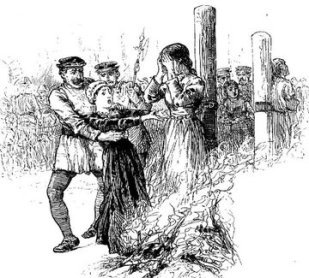
    “The concept of witchcraft as devil-worship by the church unleashed authoritarian control, & the denigration of women, many of whom were burnt at the stake, drowned, etc., simply for growing herbs or liking cats! For me, these are heroines & warriors.”

    I happened on the above-quoted tweet, which impelled me to unravel in me a thread of complex feelings about a common popular conception of witchcraft as institutionalized persecution of women of unique professions and different opinions and canozing them as martyrs of Feminism or Paganism.

    First of all, it wasn’t just that iconic ‘Men v. Women’ or ‘Christianity v. Paganism’ facade that dominated the thematics of witchcraft. Of course, religion played an important role in enforcing the authority of the church as the one absolute administrator of justice and punishing anyone who dared to defy it. However, when the Church itself incorporated paganistic esoterism in its rites of ceremony and mechanical device of prayer, it cared less about the divinity of a pagan deity that the cult worshipped, unless it openly threatened the dogmatic foundation of the teaching of the Church. Rather, it was more of a societal practice of giving a tight rein in communal harmony that allowed no misfits or outsiders or recluses. It was grudge-filled, insular-minded, and jealousy-driven vendetta against whom you wouldn’t particularly like or whom you would harbor a kind of animosity because the targeted subject looked unpleasing, unprepossessing, or simply ugly of introverted disposition.

    Women were the worse. Forget Community of Sisterhood. The Daughters of Eve can be both ecstatically passionate and formidably vengeful. A single unmarried woman, both young and old, living in the bliss of solitude, minding her own business away from the vociferous melee that she didn’t feel related was likely to be a lamb savagely herded by the hateful melee to the inquisitional slaughterhouse. Modus vivendi of social norms was the armor that would protect her from the arrows and spears of the public attack on sovereign individuality that we take for granted in our time.

    Witchcraft is neither synonymous with Feminism nor Liberalism, both of which as proverbial party ideology have beocme the dogmatic foundations of Arts and Huaminities. It’s not a grand unified campaign against smart women with peculiar religious belief when you contemplate the fact that greatness results from simplicity, which is the answer to all complexities. The inquisition of popular sentiment in practice overrides freedom of individuals asserted in theory. Albert Einstein knew exactly about the dualistic nature of humanity that would return to the basic animalistic instinct such as persecuting the innocent because of their individuality: “Two things are infinite: the universe and human stupidity; and I’m not sure about the universe!” For this reason, I dare to defy the notion that the persecution of witchcraft was synonymous with the denigration of women in general.


  • Why Magic was popular and why it dwindled – review

    Religion and the Decline of Magic: Studies in Popular Beliefs in Sixteenth and Seventeenth Century EnglandReligion and the Decline of Magic: Studies in Popular Beliefs in Sixteenth and Seventeenth-Century England by Keith Thomas

    My rating: 5 of 5 stars

    Mankind in the face of contemporary existential strains of life has often attributed its frailties to the development of certain religious beliefs, leading to the shaping of the anima mundi of the time it possesses. Such a symbolic interactionist perspective on history is perspicaciously excised in Religion and the Decline of Magic by Keith Thomas that shows us how collective splinters of folklore could influence the Modus Operandi of established religion.

    The pith of folklore is a reputed natural human tendency in dealing with daily life amid double jeopardy of whimsical nature and more capricious mankind that results in finding pain relief in the form of supernatural elements. Keith illustrates the social and cultural climates of 16th and 17th century England where the efficacy of magic was reputed to overwhelm the consolation of the Gospel in the recourse to the powerful being that could supposedly give the supplicants the immediate panacea to their existential malaise. This popular attitude toward the magical measure of putative healing betokens the reason why there was no active mass active involvement in radical social reform or political radicalism; it was their way of mitigating the rigor of their daily duties that life imposed. The concept of chance was a welcome method of diverting the rules of merit and reward in prosperous life that only a select few would and could achieve to the game of luck played by goddess Fortuna’s Wheel of Fortune. By trusting the work of pure luck, people would not jeopardize their self-esteem because fortune was beyond their measures no matter how hard they worked hard to obtain it.

    How the folk belief in magic influenced the established Christianity, particularly Catholicism, is the sine qua non of mesmerism of popular psychology and its portent efficacy of evangelization with a promise of magical healing. The church incorporated the magical elements of pagan belief to its rituals and doctrines of the catechism, such as transubstantiation and holy relics by reconciling the esoteric pagan knowledge with the orthodox Christian teaching. The investment of supernatural power through religious ceremony propitiated the minds of the low and high alike non-discriminately via syncretism until the reign of Queen Elizabeth I and the English Reformation that necessitated the emerging of new natural science and mechanical philosophy and the accordant mode of thinking ultimately debilitating the supreme power of magic and the magical elements used in the church.

    Keith is excellent in disabusing readers what might seem to be a trifle and pettifogging subject to advanced minds with his wealth of knowledge on the subject and human psychology narrated in plain language so that readers of all strata can access the secret garden of knowledge that he kindly invites us to visit and wallow ourselves in. This is my second time reading his work, and I am always amazed by his depth of erudition fabulously conflated with his witty remarks on events and vivacious descriptions of the period, all gleaned from his extensive research on the subject and keen scholarly observations thereon. This book is not a book of magical incantations, but about the power of the populace that made magic popular and unpopular as the seasons of mankind required new kind of belief system synonymous with the ethos of contemporary life.

    View all my reviews

  • In the temple of Ishtar

    tumblr_inline_p7h7p1ICiL1tnzgls_500
    The Babylonian Marriage Market by Edwin Long, 1875

    There she stands like a nameless flower

    Alone, away from a heap of roses in the garden

    of the temple of Ishtar, Goddess of love in armor

    and looks not with pride seen but with pain unseen


    Days have left, Years have passed;

    But the girl still roams around the temple

    Alone, apart from the beauty selected

    And consummated to a sacred couple.


    Alas, what is it not the thing called Pity

    When the wallflower unwanted, unsought

    Alone, as always, waits a cruel eternity

    Till she meets a beholder besotted sought?


    P.S. Ishtar is the Mesopotamian goddess of love, war, and fertility. It is said that in ancient Babylonia, every young female when reaching a certain age should go to the temple of Ishta and wait for a man who will approach and take her as a wife to home. The temple was used as an open market for marriage, which was considered a sacred means of attaining divine union between mortals in the presence of the goddess. However, as the unfortunate ones in love have always been the figures of lamentation throughout human civilization, the shy, unpopular girls had to wait in the temple for years to be selected. This poem is to feel the feeling of being unwanted and ignored in the meritocracy of beauty…


  • a league of their own

    2294848759_75990646f3_b

    Reading a section featuring a small, pleasant Q&A type of interview with a writer in The New York Times Book Review on restful weekends gives me a kind of voyeuristic fillip to be privy to the life of the writer; moreover, the usual question of whom to invite for dinner is the gist of such small pleasure. I’ve found it quite stimulating to think about my own list of people to have dinner with. Therefore, I have herein drawn up my own list of invitees to confabulate with. Here’s my list of guests:

    • Eleanor Roosevelt: The paragon of the First Lady of the United States with Intelligence that ministered to her moral character, she put her philosophy into action by actively participating in social services. Besides, Mrs. Roosevelt possessed a polished but common sense of humor and wits communicative to people of all social strata with her timeless adage: “No one can make you feel inferior without your consent.”
    • Joan of Arc: The Virgin of Lorraine, The Patron Saint of France… Such are the epithets of this patriotic French maiden who was burned alive on the counts of witchery and treason, which was of course conspiracy concocted by the French ecclesiastical dignitaries collaborating with the English against whom Joan of Arc fiercely and courageously fought to victory. She was neither a religious fanatic, nor a hallucinated mooncalf, nor a certifiable schizophrenic. She might be a simple peasant woman but a courageous, headstrong, and smart woman of faith who did not even protect her face during battles with the English amid the attacks of sharp arrows, axes, and lances. No wonder did Mark Twain praise the Virgin Knight forthwith: “Whatever thing men call great, look for it in Joan of Arc, and there you will find it.” Besides, her simplicity of faith excelled the pomposity of ecclesiastical knowledge by saying thus: “About Jesus Christ and the Church, I simply know they are just one thing, and we should not complicate the matter.” I can learn many things from Joan as a True Model Woman who embodied Intelligence, Femininity, Courage, and Faith.
    • Marilyn Monroe: Born as Norma Jean Baker, she was not a blonde bimbo whose physical attractiveness belied her ceaseless pursuit of knowledge concomitant with her pursuit of the meaning of life she desperately wanted to ascertain. Monroe enrolled in evening college courses in New York City when she had no schedules during the daytime. Behind her pretty persona of a movie star, there was a profound shadow of existentialist. Also, Monroe’s down-to-earth personality and kind nature would make her a lovely company striking up a convivial conversation at the table full of strangers.
    • Jane Birkin: Her bohemian look – that effortlessly sensual but charmingly delightful facade with simple French Chic style is always timeless and boundless, appealing to Womankind imbuing with a sense of emulation of the style. In fact, such qualities of Birkin had one time convinced me that she was French. She seems to wear sexuality like she’s wearing her favorite set of perfumes, which is never vulgar nor degrading. Once a shy English girl is now a sensuous cosmopolitan woman demonstrating admixture of art and individuality in the most fashionable way. She will be a delightful addition to my lunchtime table.

    In view of the above, my guests of honors are an eclectic company of women, past or present, surprisingly and strictly non-professional authors who make a living by writing only, although I did not intend it to be that way. Or maybe my preconception of professional authors – especially women – as highly volatile artists with inflated egos, dazzling intelligence, divine beauty, and impressive achievements might have played a vital role in excluding unconsciously any of them from my circle of companions. But so did Michelangelo; he was never befriended with his contemporary Leonardo Da Vinci, who in fact lambasted his untidiness as a sculptor in comparison with a baker. Nor did Michelangelo make friends with other famous artists. Instead,  he was a friend of some obscure artisan who helped around various artists by doing sorts of drudgery. It all boils down to the fact that having a good company of kindred spirits can do a favorable service to your soul, making you feel charitable and magnanimous, so much so that you can- to quote the swashbuckling Oscar Wilde- “forgive anybody, even one’s own relatives.”

    저장

  • ‘Jonathan Strange & Mr Norrell’, by Susanna Clarke – review

    Jonathan Strange & Mr NorrellJonathan Strange & Mr Norrell by Susanna Clarke

    My rating: 5 of 5 stars

    Magic and fairies are not the proprietary subjects of teenage novels or esoteric pagan reference books that are exclusive to a select few. They were part of a belief system kept by your distant and not-so-distant ancestors, learned or unlearned, which was a fountain of their norms and mores and acculturated even into a Christian organized religion. So much so that the world of supernatural was thus believed to be hidden in this world of terrestrial, enveloping the outer circle of the earth with a gossamer of ethereal air, thinning the boundary of corporeal and incorporeal. This system of belief has survived particularly in the British Isles, where Celtic mysticism has produced its fairy progenies and dispersed them beyond the watery boundaries of the Isles. Out of such British fairy progenies comes this wonderfully imaginative Jonathan Strange & Mr. Norrel by Susanna Clarke whose mission is to prove the world that there are more things in earth and heaven than are dreamt of in your rational impulse.

    The story is a fascinating hybrid of history, adventure, and fantasy all entertainingly interwoven in the magical tapestry of literature. It’s also a great house of imaginativeness built upon Clarke’s erudition of the subjects ranging from the rise and decline of English magicians to the changing social customs and values, all the marks upon her mastery of storytelling that will make you steeped in the pages after pages as if you were enchanted by her alchemy of words. Her characters are extraordinary, but their personalities are not far from the ordinary, which endows a sense of verisimilitude upon the story and leads you to a seemingly obvious path to the maze of her fascinating tale. It is Clarke’s own magic that creates this wondrous make-believe world of magicians and fairies who are indeed very much alive in her mind’s theater to which she invites you to join her in the bewitching festival via witchcraft of literature.

    Her vivacious creativity doubled with her alchemy of words accounts for a thick volume of the handy little book, which is also extraordinary for a customary semblance of a paperback. This also shows Clarke’s ability to record supernatural events and things in the ordinary subjects with her dazzling narrative skills and ingenious composition of plots seamlessly connected to one another that would have been an infelicity of redundant multiplication of stories as a result of insufficient creative ammunition. Which is to say that this book will take you from the rut of your ordinary reality to the world beyond where you can summon a fairy to your service and make a wish, especially at this epochal moment of time when you need something delightful to read.

    View all my reviews