Tag: history

  • Magical windows of the misty past

    The story of man and beast decorates the wondrous latticework of the enchanting casement of Greek mythology. The ancient Greek weavers of stories used their poetic license to mirror the human traits, both attractive and unattractive, through the figures of the beast in scintillating ways. The resultant mythology created an aura of mysteriousness wonderfully anchored in reality whose thematics were originated in, such as the following tales from Greek mythology that reflect the nature of humankind as mirrored in the perspectives on the natural elements of animals and the relations to it.
    Cretan_Bull
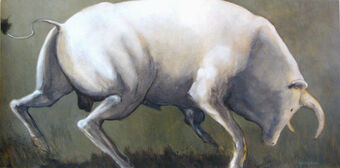
    The Cretan Bull
    • The Cretan Bull and the Minotaur 

    The story of a half-bull and half-man monster known as the Minotaur epitomizes the primordial thematic perspectives of mankind juxtaposed along with the law of nature representing the mysterious force. It became a subject of belief tradition peculiar to its natural and cultural environs. The conflicting sentiments of reverence toward the awe-inspiring nature’s creatures and the ambition for domineering them as the ruler of the universe give birth to the bestial creature in the figure of the terrific Minotaur who was fated to be slain by the Athenian hero Theseus. 
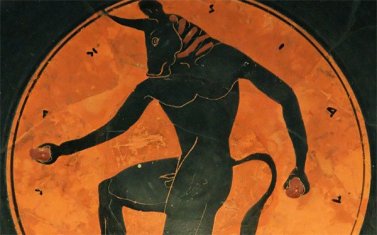
    minotaur
    The Minotaur

    King Minos betrayed Poseidon by keeping his beautiful snow-white Bull, instead of sacrificing it to the expectant god, who, in turn, made his wife Pasiphae unquenchably infatuated with the Bull. She copulated with the beast by taking herself into the form of a hollow wooden cow designed by the Athenian architect named Daedalus. The result was the Minotaur kept in a Labyrinth by the selfsame designer of the wooden cow. The Minotaur showed no human feelings or emotions as the mythology did not treat him any more than a horrible bestial creature from the unnatural union of a woman and a beast. 

    A Bull in the ancient Greek culture was a chthonic animal associated with fertility and vegetation and also represented the sun and the might. In fact, the famous figure and paintings of bull-leaping are seen inside of the Minoan mausoleum in Knossos as first discovered by the eminent English archeologists Arthur Evans, who also found Linear A and B letters, the mother of the ancient Greek language, at the turn of the 20th century, 
    Unknown
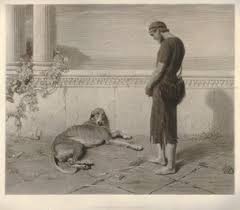
    Argos finally uniting with Odyssey.
    • The dog – the best friend of mankind

    The perspective on the dog as the loyal canine companion collapses the millenniums between the ancient Greek’s time and ours. Even the Cerberus, the three-headed guard dog of the Hades look tamable with a piece of sweet cake, making it look less of a menacing beast necessitating the blood and flesh of man. This goes without saying that it was Argos, the paragon of the faithful canine, who recognized his travel-weary employer Odyssey after 20 years of absence from home and put forth what might think he had to approach him with a wagging tail. He died as his long-waited boss in incognito passed by him with his heart pounded by a surge of pathos dubbed in warmth. Of all the gods, goddesses, heroes, and even his family, it was Argos who showed genuine, artless unconditional affection to Odyssey and thus rendered his heroic owner all the more humane and sympathetic. 
    Laelaps_web
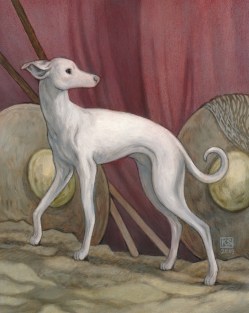
    Laelaps, the dog that never fails to catch

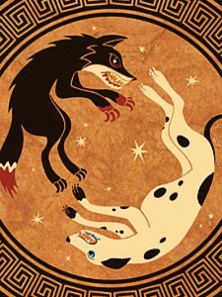
    Speaking of loyalty, Laelaps, a Greek mythological dog that never failed to catch what it was hunting, also denotes how the ancient Greeks perceived the dog as their life companions. Laelaps was initially a gift to Europa from Zeus, then bequeathed to Minos, who gave it to his concubine Procris whose sister included Pandora. She gave the hound to her husband Cephalus as a token of her unbroken love for him Cephalus used the hound for hunting the Teumessian Fox that could never be caught. Then Zeus turned both of the animals into the stars as the constellations Canis Major (the dog) and Canis Minor (the fox).
    12916666_f496
    The Eternal Catch-Me-If-You-Can between Canis Major (the Dog) and Canis Minor (the Fox)

    Consequently, the use of the animals above in the thematic context in the Greek mythology evinces that mankind cannot exist alone as part of nature. Man finds his meaning of what it means to be a human and its purpose in life by rendering the values and precepts of natural law emblazoned in the human consciousness to the meta figures of the mythology. The mythological animals, whether wild, imaginary, or ordinary, are the reflection of the human traits interbred with imaginary creatures from the Elysium of Fancy. It became the substratum of a belief tradition administering to the modes of social behaviors in society, and thus developed into an organized religion by way of syncretism in the era of Christianity. 

  • ‘A Journal of the Plague Year’, by Daniel Defoe – review

    A Journal of the Plague YearA Journal of the Plague Year by Daniel Defoe

    My rating: 5 of 5 stars

    The biblical cyclicity of history proclaims that what is happening now happened before because there’s no new thing under the sun. As I agree with the cyclical history theory, I prefer stories that confirm the continuity of human nature, which results in this felicitous book I came across on the Kindle store. The precedent epidemic scares and the response to them in Daniel Defoe’s A Journal of the Plague Year, a classic 1722 account of the Black Death that devastated England from 1664 to 1665, do not read no less different than ours. Defoe’s recounting of the plague successfully resurrects the spirit of the epoch as his narrator guides the reader to the places and scenes of the seismic event in the capacity of a charitable and knowledgeable guardian of posterity, making them surprisingly familiar with ours.

    It is a literary eye-witness account of what happened during the resurgence of the bubonic plague that had ravaged Europe hundreds of years earlier in the semblance of a nonfiction narrative. Even though Defoe was only five years old when the plague swept England, his fictional narrator feels very real and the account telltale as though it had been written it in the spirit of Veni Vidi Vici. So much so that the story seems more veritable than the counterpart of Samuel Pepys, whose narrative feels comparatively prosaic without the personal charm of the narrator. The reader will also learn that the 17th-century modus operandi of dealing with a pandemic is not that far from the current 21st-century preventive measures of social distancing, personal hygienic disciplines, and other relevant systematic societal restrictions.

    Defoe holds up a mirror to his posterity that shows what it was like during the epidemic scare and what the people from days of yore did to sail through such calamity as a wise and warm advisor to our current global pandemic situations. In fact, while I was reading the book, I was surprised by how similar the cautious measures decreed by the authority were then to our own now. In my opinion, this book replaces Boccaccio’s The Decameron as a must-read during the pandemic, because of its power of reality drawn on empirical oral accounts so close to the lives of the ordinary folk that we can relate to our own time.

    View all my reviews

  • ‘The Legend of Sleepy Hollow’, by Washington Irving – essay

    51phPvWhOmL._SX381_BO1,204,203,200_

    Shakespeare once said that ghosts were amiable, harmless in want of company to console their haunting loneliness, lost in the crossroads between this world and that world. But that is not the case of the headless ghosts – the angriest and most terrifying of all other specter ilks, evoking the most primitive sense of fear to the eyes of beholders by the sheer eeriness of the appearance.  Because they despaired and died in oft violent ways, the headless ghosts are putatively the most furious and vengeful with the domes of their souls forever lost. No wonder there are legends of headless knight riders prevalently existent in the universal world.

    Meet the famed headless nightrider of the Sleepy Hollow in New York. Originally hailed from a province of old Germany, he used to be a soldier fighting on the British side during the Revolutionary War who was decapacitated by an American cannonball. His battle buddies buried him without the missing shattered head. The residents of Sleepy Hollow believed that the soul of the unfortunate young German soldier risen from his grave by his supernatural ire burning with vengeance against the earthlings that killed him was restlessly riding his phantom horse at night furiously brandishing a Jack-o’-Lantern in a semblance of face made out of a displaced pumpkin as his a makeshift head, glowing in a flame of fury as to light his nightly way.

    The indelible image of the restive headless horseman is terrifically and vividly resurrected by the literary alchemy of the great American writer Washington Irving in “The Legend of Sleepy Hollow” in which the unlikely protagonist of a meek, naive, willowy school teacher of New England by the name of Ichabod Crane stumbles into his frightful encounter with the Horseman on his fateful night during his doomed journey home. Woe betided the unfortunate benevolent schoolteacher believed to be spirited away with the headless horseman to the legion of wandering spirits in between the world of the living and that of the dead till the eternity.

    Apart from the spectral elements of the story, Irving’s characters in the story convey the displaced post-colonial sentiments of unease for the present and uncertainty for the future in the chaotic aftermath of the war that was supposed to beget promptly promising bright outcomes to the post-colonials. The nervous semi-detachment from the old world’s cultural and political authority and the unsettled practical value of the war due to all kinds of border chicanery in the still socially volatile post-war valence of setting intersperse the story in the fumbling figure of naïve Ichabod haunted by the furious ghost of a fallen soldier from the war. The legend of Sleepy Hollow is Irving’s superb storytelling of the birth of a new culture begotten from its old motherland at its infant stage of building a national character afresh with its own cultural capital, such as folklore endemic to the new land of hope that Irving so cherished.

    The good teacher Ichabod Crane

    Flees from the Headless Horseman

    With all his gentle might in vain

    For the ghost rider outruns the man.

    Now the riders roam in the shadow

    Looking for recruits in Sleepy Hollow.

    P.S. This short essay on Washington Irving’s ‘The Legend of Sleepy Hollow” is my contribution to a weekly Twitter event whose theme for this week is ‘The Headless Horsemen”, which seems to prevalently existent throughout the cultures of our global village. What uncanny synchronicity is to come upon this subject matter since I am currently reading Irving’s eponymous book that also contains many other stories from his wonderful ‘Sketch Book’.  

  • Officially Haunted, Really

    2ddcc1fd40814bbf40437d087f498150

    Prologue: I wrote this post in March of this year upon reading an article about historic haunted places in the UK from a subscribed issue of ‘BBC History Revealed’. I wanted to contribute my knowledge about the Whaley Museum in Southern California in a letter to the editor. The new July issue arrived on my Kindle Fire this morning, and I saw my letter featuring therein. It was edited in the context, but only for the perfect perspicacity. The letter is, in fact, one of the fifth letters that have been so far published in the magazine. 

    Sometimes they either don’t know they are dead or wouldn’t accept it because of strong attachments to their once earthly abodes. You may think it’s a puerile imagining to believe in ghosts, but there are indeed more things in heaven and earth than are dreamed of in your philosophy. As someone keen on supernatural phenomena happening in the background of our ordinary landscape of daily life, it gave me a fillip when I came upon an article from my subscribed history magazine the other day about the historical capital punishments going horribly awry as though to use the grisly scenes of capital punishment as a reminder of societal retribution for an eye-for- an eye. It also reminded me of a story of the condemned whose ordeal of execution was so unbearably painful that he is still roaming around at his execution site as though with eternal lingering attachment to his earthly life.

    Here in Southern California, the story of James Robinson (aka Yankee Jim) who was executed for attempted grand larceny in San Diego in 1852, is something of haunted folklore that attracts tourists and ghost hunters alike. He was hanged on a gallows off the back of a wagon, but being a tall man with long legs, he resisted being killed by keeping his feet in the wagon but was at last pulled off. His body then swung like a pendulum until he strangled to death. And it was this very site of hanging that one Thomas Whaley, who happened to witness the execution himself, built his dream house where he and his family soon began to hear the unexpected phantom footsteps as if being made by the boots of a large man, walking noise, and the windows mysteriously unlatched and opened up. Lilian Whaley, the Whaleys’ youngest daughter living in the house until 1953 was certain that it was the ghost of Yankee Jim haunting their house. Now the Whaley House is the Whaley Museum, a California Historical Landmark located in Old Town, San Diego, California.

    However, ‘Yankee Jim’ still lives there because although unseen, his presence is felt and heard by visitors and staff at the museum. Never malicious or naughty, the ghost of the hanged man is said to rather shyly manifest himself by footsteps, markings on the wall, or opening and closing of windows. So much so that the Whaley Museum, along with the Winchester Mystery House, is certified by the US Department of Commerce that it is genuinely haunted. So if you live in Southern California, it’s worth visiting the Museum and Jim. I think I may pay a visit. The address is 2476 San Diego Ave, San Diego, CA 92110.

  • Feather of Two Truths


    02-ani-papyrus-anubis-bm07404g
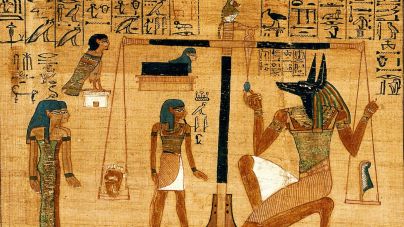
    Osiris and the Sacred Scale, courtesy of National Geographic

    The days on earth ended

    And the days in Afterlife began

    As the Final Judgment of Osiris,

    The Lord of the Underworld

    To weigh the sins of the man

    On the Scale of Two Truths

    Against the Sacred Feather

    In the Hall of Goddess of Truth

    Waited for him to say “Never!”


    The assisting gods recited

    The long line of sins on earth

    To which the man answered,

    “No, I had committed none,

    None of the sins from birth to death.”

    Then Osiris ordered the goddess

    To put the man’s heart on the scale

    And the Sacred Feather in her arms

    To be on the other side of the scale.


    The heart as light as the Sacred Feather

    Kept the Perfect Balance of the Scale,

    And the Supreme Judge decided to declare

    The man to be true of voice by the Scale

    And allowed him to enter in eternal bliss

    Celestial Garden among the Stars

    That never died but lived forever

    Sailing as his happy heart wished

    And filled with Eternal Euphoria.


    P.S.: This poem was based upon my reading of the ‘Book of the Dead,’ an ancient Egyptian guide to the Underworld instructing the dead what to expect, where to go, and how to behave when entering the Underworld. The ancient Egyptians regarded death as new life, the beginning of the Afterlife where the souls of the virtuous dead lived in a heavenly landscape that looked so much like Egypt on earth. The blissful afterlife was meritorious by the ruling of Osiris, the supreme ruler of the Underworld, who questioned the souls of the dead according to a long list of sins that mankind was prone to commit by nature and put their negation of sins on a test by putting each of their hearts on the divine scale to weigh against Maat’s Feather.” Maat was the goddess of truth, and as she put the heart on the other side of the scale, the balance would remain the same if the heart was free of sins. Only such a sinless, weightless heart would give the soul of the man a passport to Paradise. Fascinating. 

  • She-Ras, Xenas, and Wonder Women

    images
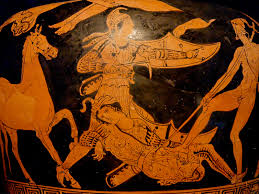
    Ancient Amazonians courtesy of google

    Before the mercantile empire of ‘Amazon’ amid the Sea of the Internet, there once was an eponymous band of fierce women warriors whose famed ferocity and fearlessness was enshrined in the Classical literature and history. It is said that they were real women soldiers living in ancient Eurasia with husbands and children who seemed to know something about how to maneuver the sphere of personal life and that of military commitments. The subject of this mysterious ancient militant women from this month’s National Geographic History intends to deconstruct such mysticism surrounding the factual evidence thereof and demystify the origin of the meta women fighters modern feistily feminists and politicians love to panegyrize.

    First, the origin of Amazonian warriors comes not from the Amazonian jungle who are believed to be scantily clothed with breasts deformed women prone to attack men without reason. They were, in fact, the female warriors among Scythian and other nomadic Steppe cultures across the Eurasian plain as embedded in Homer’s The Illiad, Herodotus’s Histories, and Plato’s Laws. The recent discoveries of 4 female corpses bearing combat-related injuries, such as slashed ribs, fractured skulls, and broken arms are claimed to be of the lost Amazonians prevalently seen among Scythian women riding to battle alongside their men.

    Notwithstanding the above archeological excavation and factual evidence, my personal sentiment toward the adulation of the female combatants is anything but the elevated opinions about them. Although Homer in The Iliad praises Amazonians for being the equals of valorous men, I wonder if he would have wanted to take one of them as his better half in reality. Plato in Laws recommends that boys and girls should be trained for horse-riding, archery, javelin-throwing, etc., which is very indeed commendable, but I opine that no every girl should be forced into such training because every girl is not of the same aptitude or disposition. Of all these complacently abstract perspectives on women soldiers, Herodotus seems to be only one who has a comparatively objective view on Amazonians not as a glorified tribe of female bravery but as a tribe of women freed from conventional conjugality. They were a group of shipwrecked women tended by local men with whom they moved to new lands and happily lived after while maintaining their own separately private lives as something of common law marriage couples.

    The modern perspectives on the Amazonians as a manifestation of gender equality in the spheres of domestic and public life exceedingly lionize the necessity of upending what is perceived as traditionally patriarchal gender roles peculiar to the biological characteristic of men and women. Needless to say, the word “Equality” is highly admirable and desirable, especially on the frontline of livelihood, but you can’t force everyone – that is every woman- to be as aggressive or belligerent as these ancient female warriors were in fighting everyday strains of life. Besides, I see there are more widespread issues of racism, classism, lookism, and agism than sexism in daily life because womanliness adorned with beauty and sex appeal armed with the art of seduction can work wonder in every place, helping her to achieve social mobility. Reading the article intent upon the historical evidence of these Amazonians makes me realize that the advocation of public sentiment in practice overrules the consideration of single individuality in theory.