Tag: life

  • Turkey and Thanksgiving

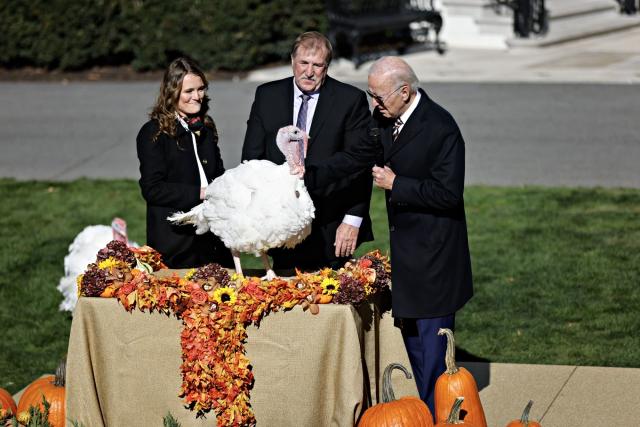
    This year’s lucky pair of turkeys that received a presidential pardon for not being sent to a slaughterhouse is Chocolate and Chip. The turkey symbolizes American festivity and character distinguished from all other birds of feathers, such as the eagle, the dove, or even the phoenix. So then it’s only natural to find out why the turkey has become the signature bird of the Thanksgiving holiday on Thanksgiving day.


    Benjamin Franklin, the amiable and ingenious American polymath founder, associated a virtue of morality, bravery, and strength with the natural characteristics of the turkey native to the American continent. He proposed that the bird be an emblem of the New Country. While the mystical implication of the bird with the New World has traditionally embodied in the cultural context of the pilgrim’s attributes to the nation’s founding in search of religious freedom from the Old World, the real stories about the American bird encompass the endorsement from the historical figures. George Washington proposed a Thanksgiving in 1789 as a day of “public thanksgiving and prayer,” which was chimed by Alexander Hamilton’s acclimation: “No person should abstain from having turkey on Thanksgiving Day.” But the Thanksgiving tradition began in 1863 when President Lincoln proposed the last Thursday in November as a “day of thanksgiving and praise to Almighty God, the beneficent Creator and Ruler of the Universe.” The regular Thanksgiving dinner menu culminated with one Sarah Joseph Hale, a magazine editor. She wrote Lincoln to urge celebrating the day with roast turkey, savory stuffing, gravy sauce, and pumpkin pie in memory of her beloved New England style of feast staple.
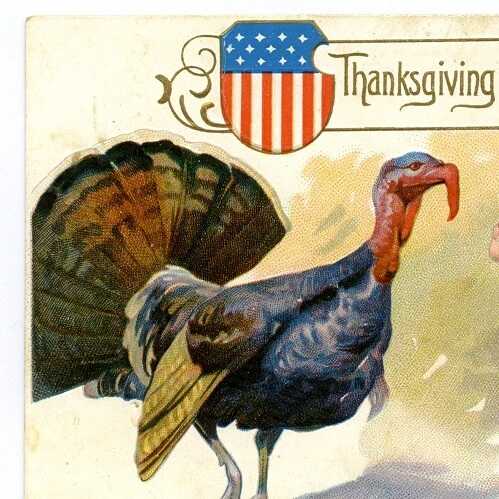
    Patriotic Turkey: Detail from a vintage Thanksgiving greeting card.


    In Europe, the turkey was a poor man’s fanciful feast because it resembled the peacock, a dish fit for the rich. The turkey occupies a dinner table alone as if it could stuff all the hungriest souls for days and nights. I agree with Benjamin Franklin that the turkey is a fit bird to become a bird of national symbol. The eagle may look regal and lofty, but it has no ingenuousness particular to America, which will always be a young country that is still growing and will grow as long as the tradition continues from generation to generation. Happy Thanksgiving.

  • Beggars can’t be choosers?

    Have you ever felt why you are here facing the ugly realities of life, enduring insults right in front of you after you are invited? I have, and the experience is still so fresh that if I don’t manifest it in writing, the grief will knit up the overwrought heart and bid it shatter to pieces, which has already been cracked, broken, then repeated. Job interviews are arguably the most tricky and adrenaline-inducing passage of livelihood for which some introverts have to give in at the expense of our fairy-like stealth, Sanity. You can either win or lose at the impression on the interviewer, who is more often than not less cultivated, let alone understanding humanity, no matter the social status. But then, you should not let your dignity and Sanity be ripped off or broken apart because you deserve a good one.

    It all started when I got first called in for a zoom interview last Thursday. It was for the position of part-time legal assistant at a small family law office in Downtown Los Angeles (not to be confused with Downtown Abbey, LOL). The office proprietor, an old man lawyer, was a typical lawyer who must have inspired Shakespeare to exclaim, “Kill all the lawyers!” It was not so much a job interview as an immigration or any bureaucratic interview, I gather, because of the following: 

    (1) His question of whether I had any family member or friend with divorce experience is irrelevant, knowing that I had no experience in divorce law. When I said no, he cast a doubtful glance at me;

    (2) After the zoom interview, what was the need for a second interview in the office for a part-time position in such a small law office?; 

    (3) I referred him to my blog as writing samples at his request, but he never gave me feedback on them;

    The interview reminded me of a police interrogation I am familiar with by watching British and American procedural detective TV dramas. He questioned me and observed my facial expressions to find faults. He was cross-examining me with the questions he had already concocted in his petty lawyer mind and insulted my sensitivity. He seemed to be of a typical victorian/Edwardian bourgeoise (not even peerage) would-be employer pleased with himself for being so rich, so successful by his so clever lawyering. 

    I am seeking employment to make a living, but I don’t want to work for/under such a rude and unpleasant employer. I wasted my time on earth because of yet another traumatic experience of failing humanity. What change has been improved since the labor movements in the tacit relationship between the worker and the employer when I cannot speak my mind because ignoring it in the oblivious land of forced amnesia will make me fall apart, and I can’t take it anymore? And it didn’t end on that day. He dared to inform me of my not being hired the next day at NIGHT. Thank God for not giving me the job. And I wish it was all just a nightmare, and that’s all.

  • Rainmaker

    The wandering
    Rainmaker
    A stranger
    To her power
    Invokes ever
    A benevolent rain
    Of inspirations
    On an arid terrain
    Of imaginations
    That are blocked
    In the Acheronian
    Wilderness barren
    Of wordlessness.

  • solitude in crowds

    The feral boy
    Wolf raised
    Man-cub Mowgli
    Knew the play
    Of jungle law
    In the animal
    Family of freedom
    Under nature’s rules,
    Whereas the poor
    Orphaned boy Kim
    Found no friends
    In the city of man.

  • My Cat Toro and Samuel’s Hodge

    Toro is a very fine cat indeed

    Since I don’t like the word “pet,” I won’t say it when I refer to my two-year-old tabby, tom Toro, a family member. Toro pays a portion of his rental fee and is a controller of rodents in our dilapidated humble apartment we long to escape. But that’s another story, and this story I am going to unravel is for Toro.

    Toro before entering the clinic

    It was that time again to get Toro’s annual physical exam, also required for his Hills prescription Urinary care food. So we took a trip to the vet at Little Tokyo, and all’s well that ended well. His weight was steady at 11 pounds, the same as the last year (what an excellent dieter he is!). He got his FVRCP, FelV, and nails done and was proven generally healthy. What a relief because I had been concerned about his taking more naps than usual and tired expressions with half-cast eyes. The doctor told me that it was customary for cats to show such symptoms as they grew bigger. So albeit my mom thinks that I am overly concerned about Toro’s otherwise fine status quo, aren’t we all concerned about the general well-being of our flurry fur babies?

    Samuel Johnson and Hodge

    It all makes me think of the story of Samuel Johnson and his cat Hodge. Samuel Johnson, one of the greatest men of letters from 18th century England and the author of A Dictionary of the English Language, had his beloved sale-furred cat Hodge, who was immortalized in literary works and as a bronze statue outside his guardian’s once resident abode. We first come to know of Johnson’s cat Hodge thanks to his lawyer friend and biographer James Boswell’s Life of Johnson. Johnson used to go out to buy Hodge’s favorite food, oysters. He refused to let his loyal and faithful Jamaican-born master-servant Francis Barber because he felt that it would be degrading to Francis to do such errands for him. But I like to think that it was more affection toward Hodge, whom he called thus: “He is a very fine cat, very fine indeed.” When Hodge was nearing to cross the rainbow bridges due to his old age, Johnson would get valerian, an herbal painkiller extracted from the flower to lessen his fur baby’s pain. But the end of Hodge wasn’t lost in the inner circle of the ether, for his life was memorialized in ‘An Energy on the Death of Dr. Johnson’s Favorite Cat’ by Percival Stockdale, published in 1778:


    The general conduct if we trace
    Of our articulating race,
    Hodge’s, example we shall find
    A keen reproof of human kind.

    Samuel Johnson is one of my most admirable literary persons because of his humanist rules of thought articulated in his mastership of the English language. Hence it gives me a feeling of kinship with his love of Hodge. His affection for Hodge felt genuinely caring and familial, which was never mawkish or superficial. So, likewise, my cat Toro is a muse of my writings: whimsical, independent, intelligent, and affectionate. Sometimes, I wonder if Toro is really a little boy bespelled a tom. Well, what more can I say? Toro is a very fine cat, very fine indeed.

    Hodge’s bronze statue was inaugurated in 1997 by Sir Roger Cook, the then-Lord Mayer of London. Note the oyster at his paw as his eternal token of Johnson’s affection.
  • Live, Die, Repeat, Repeat…

    Life is still beautiful, even if it deceives you.

    I wanted to find the Church’s stance on reincarnation and, above all, what the Bible said about this seemingly endless shapeshifting until the purification of the soul is complete, so to speak. What about the Christian belief that we live only once and have no return of life?

    According to “A Concise Dictionary of Theology,” reincarnation is the belief or metempsychosis (“animate afterward”) that the soul preexists its embodiment. After death, the soul exists in a ghostly state before animating one again, a body of the same in a different state, which sounds a lot like a demon or malevolent spirit possessing the body of the living. It is this very belief in resurrection and official rejection of the preexistence of wandering souls without corporeal substance that denies reincarnation itself. By maintaining an endless series of chances, the doctrine of reincarnation reduces the seriousness of God’s grace and, most importantly, human liberty exercised in one life that is ended by once-and-for all death.

    Furthermore, in the Catechism of the Catholic Church, death is the end of man’s earthly pilgrimage. When the single course of our earthly life is completed, we shall not return to other earthly lives as “it is appointed for men to die once” [Hebrews 9:27]. Christianity defends the duality of the body and the soul. However, reincarnation defends dualism that both beings exist separately and that the body is simply an instrument of the soul; existence by successive existence as an altogether different body is repeatedly assumed each time one recycles life. Thus reincarnation denies the idea of the resurrection of the body, as evidenced by the resurrection of Christ, and most primarily rejects the Christian doctrine of salvation. Therefore, there is no reincarnation after death.

    I feel much better now than before. While I succumbed to the belief in reincarnation, I couldn’t accept the thought of my present life as punishment for my wrongdoings in my past lives. To think that I have to live in a miserable state of discipline until my subsequent due recycling puts me on the verge of lunacy in the form of murderous headache for which I recently found myself in the ER. Viktor E. Frankl, the survivor of concentration camps during World War 2 and the founder of Logotherapy, urged us to trust that there is meaning in suffering, which helps us lead to our purposes in life. Samuel Johnson, one of the most significant 18th-century English men of letters and the author of A Dictionary of the English Language, describes life as progress from want to want, not from enjoyment to enjoyment. Forget the arguments about the religious dogma dictating an institutionalized belief for mass mind control. Or it so, then so be it. After all, reincarnation is also another offshoot of mysticism developed into religious thought. Then I will follow the light that gives me a sense of hope. And for this reason, I proclaim that my body and soul are inseparable and that I live only once, and that’s it.