Tag: life

  • ‘Tiny Habits: The Small Changes That Change Everything’ by B.J. Fogg

    My rating: 4 of 5 stars
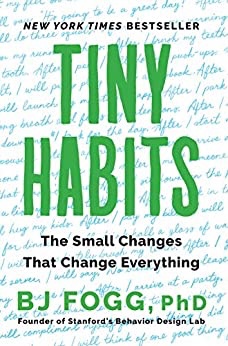

    When you feel that something important about your approach to your current life isn’t working, you should adopt a new way of sailing your ship at life’s sea. Hence, following my read of Aristotle’s Way by Edith Hall, I continued pursuing the answer in Tiny Habits by BJ Fogg, a self-help book based on Aristotle’s dictum that virtue is a habit in 21st-century parlance.

    Fogg’s approach to habit-forming practice is categorized into small steps that require no intellectual, or philosophical commitments, as in the case of new year’s resolutions. He refers to motivations and willpower as “fair-weathered” friends who hooray and holler at our resolutions to change at first but disappear into the lost memories of the first initiation when our souls plunge at the lowest later. Instead, we must befriend “Aspirations” and “Outcomes” as faithful friends who will help us build a Behavior Design that best matches our disposition and lifestyle by which we can realize our affirmation as the functionary of noble ideas. For example, if you want to save $500 as an emergency fund, you can start by curtailing your Starbucks visits or bringing your lunchbox to work, rather than saving a lump sum of money from your paychecks; as the saying, “Drop by door fills the tub.” Fogg refers to such small practice as the principle of “Golden Behavior,” which you can do when you feel like calling it a day, even on your most challenging day.

    Notwithstanding the noble intentions and the greatness of simplicity in Fogg’s guide to habit-forming, some carbuncles I find incongruent in his examples of his successful people who are comparatively well-off business owners or professionals. Of course, that is not to avert his excellent idea that the simple is the best. Still, I hoped to find examples of everyday working-class people struggling to make their lives better who have fewer resources, such as seeking help from a person like Fogg, a Behavior Scientist at Stanford University. Maybe I could inadvertently judge his study results only with limited information based on my reading. Still, I only wish that he would include a broad social spectrum of subjects in the advantage of Golden Behavior. But then I could be a captious reader feeling left out of the selected successful achievers.

    In all fairness, the book is worth reading if you are especially keen on Aristotle’s way of happiness, which I regard as personable and approachable, compared to Plato’s metaphysical way of interpreting how to live a perfect life. But let’s forget about the ancient Greek school of philosophy. Still, Tiny Habits do matter.


    View all my reviews

  • ‘Thinking Fast and Slow’ by Daniel Kahneman – book review

    We are not always right in what we believe. What we see with the eyes may not be the truth but in the likeness of truth as our instinctual response to sensory stimuli is swifter and mightier than the wise arbitrator of reason. Whether you like it or not, we procrastinate diligently assessing what the senses tell us, bypassing the voice of reason and judgment. Using automatic and biased instinct is a mental shortcut to make a judgment call in one fell swoop, sans inconvenience of time and cognitive analysis. Socrates knew it, Plato portrayed it, Aristotle acknowledged it, Shakespeare saw it, and now in our time Daniel Kahneman, an Israel-American psychologist and economist interpretes it in this book.

    Kahneman illustrates our intuition, or sense, as System I and mind, reason, as System 2. System 1 activates the images stored in a mind’s cabinet when prompted to evaluate the stimuli. There are three factors contributing to this design of instant machinery of thinking without an assistant of reason: available information, time constraints, and limited cognitivity. The system is highly biased, touchy, and impatient like a quick-tempered, spoiled celebrity. It is tuned to subjective truth inured to sensory perceptions about our surroundings and ourselves with quick fixes without consulting System 2, the voice of reason, the superego, which strives for objective truth. But such a dichotomy of Sense and Reason has always been observed and acknowledged, as I introduced earlier in this writing. For example, Plato alluded to the Chariot of Two Horses, of which one is noble and logical, and the other impulsive and recalcitrant. But the difference between Plato and Kahneman is the applicability of the mind-system to the principle of economic activities and consequences.

    The book is a steady bestseller, readable to all ranges of readers who want to search for the cause of their mental malaise and existential vertigo. What might have been a reiterating modern interpretation of how the mind works proves to be a piece of practical advice on how to overcome emotional trauma and live a purposeful and gainful life as thus: 1) When the signs of ill-judged biases arise from within, slow down and ask for reinforcement of the spirit of System 2. In doing so, we must acquire such skills to dominate the hubris of System 1 in a regular steady environment that provides an adequate opportunity to practice and rapid and unequivocal feedback about the correctness of thoughts and actions. If you still prefer a mental and physical shortcut to put the aforesaid into more effortless locomotion, how about taking the simple advice from Socrates?: “When unpleasant, depressive thoughts begin to cast on you, breathe deeply once, then bring a smile to your face.” Too trivially mundane? “Of course, you have to make it a habit,” quibbled Aristotle to support his teacher.

  • Dauphin and Queen

    The dauphin ascends to the throne
    With a poise, he reigns there
    And calls for absolute power
    To claim his supremacy alone.
    The queen sees the revolt
    And with sweets to the sweet
    Wields the magic flurry wand
    And spirits him away to the beyond.

  • as if it were a dream

    My heart is longing
    Though my mind is confused.
    My soul is tired of sighing,
    My spirit is revolted,
    Time flows rapidly,
    Woes disappear slowly,
    I’m tired of repining,
    Will the universe conspire
    To reset it all anew
    As if all of this were a dream
    In the likeness of truth?

  • Untitled

    Is anyone out there? Although I feel like a lonely gauche scientist who incessantly sends a life signal to an extraterrestrial being across the galaxies, I am again sending another life signal in writing to express that I am still alive. So, if any accidental reader stumbles on this blog, welcome.

    I once read that magic is the power of manipulating nature without knowing the source of the force. If so, then the magic I once possessed is lost, making me good for nothing. But, as observed by Francis Bacon, I am talking about the faculty of cognition that affects linguistic abilities for speech that makes a ready person, reading a full person, and writing an exact person. The satisfaction of reason, the power of expression aspiring to development of the spirit, which gave me a content elbow room, vanished into the curtains of the past, leaving me to fend for provisional existence of survival in the most primitive way. It reminds me of Viktor E. Frankl’s memories in concentration camps, where many of the inmates dissipated into the hopelessness of abandoning themselves in the stupendousness of tragedies.

    I always think of my life as an inspiration fit for a documentary film about a working-class immigrant single woman who painstakingly tries to preserve a sense of purpose in life with a grasp on intellectual aspiration. Doing so makes her compare to the burgeoning careers of her peers, who seem to be of a higher station in life than she. I am not trying to play a typecast role of proverbial fatalist or unreconstructed defeatist caviling at the happiness of others as a result of their hard work and abilities to do wonders. That would be a callous and sordid a priori judgment for her unfortunately cursed life. Didn’t Shakespeare also say that our lives are governed by our stars? Didn’t Cicero believe that our lives can be read by avian augury? Come to think of it, Francis Bacon and Isaac Newton also believed in and engaged in alchemy craft. The commonality of the examples described above illustrates that there are more things in heaven and earth than are dreamt in your philosophy about the world, whatever it may be.