Tag: literature

  • ‘Furious Hours: Murder, Fraud, and the Last Trial of Harper Lee’, by Casey Cep – review

    Furious Hours: Murder, Fraud, and the Last Trial of Harper LeeFurious Hours: Murder, Fraud, and the Last Trial of Harper Lee by Casey Cep

    My rating: 5 of 5 stars

    The theory of “When the legend becomes fact, print the legend.”might have been a rule of thumb in the Wild West, but that was anathema to Harper Lee, the Pulitzer Prize-winning author of To Kill a Mockingbird, which has become an epoch-defining classic in the canon of American literature.With her restive independent spirit that knew no compromise with tampered artistic sensibilities, Lee labored and waited until she found satisfactorily truthful narratives on her own, no matter how much time it would take. This journalistic trait of authorship combined with intellectual conscience could have been a reason that Lee, despite criticism of being a one-hit wonder, chose not to chase successive fame and discontinued what might have been her next best oeuvre called The Reverend. Casey Cep discovers Lee’s unfinished work and brings it to life and offers an unbiased portrait of one of the greatest American writers in this ambitious Furious Hours.

    Furious Hours is composed of three parts: Reverend Willie Maxwell, Attorney Tom Radney, and Harper Lee. Reverend Maxwell was a black provincial Baptist preacher accused of killing five of his family members allegedly by means of Voodoo magic for insurance money in the 1970s. Into this courtroom drama entered a clever and magnanimous Alabaman lawyer named Tom Radney, who helped the reverend to be acquitted of the murder charge, but later found himself defending the killer of his former client. It was an irony of Fate, tragedy and comedy of a drama called life. The trial of the murder of the reverend was also a reprisal of the courtroom drama of To Kill a Mockingbird, where a black dependent was represented by a liberal white attorney. This real-life scenario in her beloved native Alabama piqued Harper Lee’s curiosity, and she decided to write a book called “The Reverend” by attending the trial herself. Cep introduces the elements of the trial in the discourse of the backgrounds of the trial as though she traveled back to the time and witnessed it all like an intelligent, observant time traveler.

    Although Furious Hours is primarily about the forgotten case of the Reverend that was something of an OJ trial of the day in the context of regarding a black defendant and white legal bureaucracy, its linchpin behind the facade of the drama is Harper Lee, who thrived at the expense of Nella Harper Lee, an ambitious intelligent writer who moved from a big house in Alabama to a rent-controlled apartment in the New York City to pursue a literary career. It seems to me that Lee was disillusioned with the glamor of the city literati scene that looked priggish and stuffy. Her peers dismissed her book as a one-hit wonder and criticized it for being a lesser of serious literature. Notwithstanding this asinine and supercilious criticism, Lee did not conform to public demand of the next bestseller by declaring she had “said what I wanted to say and I will not say it again.” Lee was in fact a writer who wanted to write a book with universal themes of human life, not bound by a vocation of regional specialty of “Southern” cultural backgrounds littered with sinful racism. She was a writer struggling to live up to her literary principle and personal conviction that her contemporaries did not appreciate. Maybe that’s why Cep introduces Lee in the last of the three parts of the book in the sense that a fashion designer always walks the runaway last in a fashion show escorted and applauded by models, staff, and spectators.

    Furious Hours is a fine act of literary ventriloquism fused with Lee’s story-telling voice in Cep’s own narrative, which results in this ingenious creative nonfiction. It is a wonderful collaboration of two writers, a predecessor and a successor, bound by the magic of literature, transcendent of time and space, just as Leonardo da Vinci’s “Grand Horse” was superbly completed by Nina Akamu centuries later. This book will have more admirers of Harper Lee’s literature and new admirers of Cep’s feat of narrative skills that grasp the attention of the reader cap-a-pie.

  • Will to meaning – chapter 9

    01_art-56a0382a3df78cafdaa089cc

    All strange and terrible events were welcome, but comforts she despised. And there was nothing left remarkable beneath the visiting sun. It was just her wish that was father to the thought; the thought that the man would be interested in her and talk to her. But it was just a foiled dream, vain hope, blind passion, and cruel deception. Iris was left all alone again. Francis Bacon regarded anyone delighted in solitude as a wild beast or a divine being, and Iris wanted to think of herself as a divine being because she could not bear to accept the fact that she was left out of warmth and love of humanity, and that she was perching on the brink of social isolation as a recluse. It was safe that way to protect her already bleeding heart and bruised soul from the acknowledgment of reality. The world had never seen so perilous and cruel to Iris, who began to doubt that human nature was selfish and violent.

    Sitting at her desk at home, Iris was watching the chariot of Apollo moving toward the grand horizon to return to his celestial palace. She wanted to put her soul into the world of writing, but the words became all hodge-podge in bottomless chaos. Now all the forces of darkness were unleashed from an abyss of her inner world and trying to infest her mind with all lies that began to gnaw it till she collapsed in despondency. The age-old self-consciousness felt renewed and resuscitated, egged on by the diabolic echo that everything was set to work against her and that all things would end in naught. Her intention to write was about to be erased from a tablet of her mind, as well. ‘What good will it be when my writing will always reverberate with sighs and more sighs because it is not as polished as her admiring writers?’ Then all of sudden, Voice of Reason began to speak, breaking the silence of gravitas: “Iris, let nothing disturb you, let nothing disparage you because you are indeed a good writer who writes the language of the heart and the mind. Forget the supercilious rabble raving about immaculate textual aspects of writing, for they are blind to see the essence of writing that possesses the soul and the mind of the writer. Remember Tolstoy, who was himself poor at grammatical respects of writing. So was Jane Austin, who was a weak speller. Focus on opening up the treasures kept in your Wunderkammer in writing.”

    Whether it was just an imagination or a last thread of will to write was open to a myriad of questions. But Readers, that was what sprang from her mind when Iris wanted to surrender herself to the end of hope, to the abandonment of everything she had tried thus far, and to the killing of her near-forsaken self. And yet, it alleviated acrid heartaches that tormented her like a huge carbuncle and saved her from falling into a bottomless pit full of fire consuming her everything to ashes without mercy. Iris wanted to preserve a sense of purpose and a tenacious grasp on her hopes, thinking that present fears were less than horrible imagining. Then she ceased to die.

  • grand fanfare for the heart

    Sometimes, life surprises us with its unexpected in-between amuse-bouches when all seems drab and dreary. So here was something bright and cheery for my routine existential life; my letter to the editor of  BBC History Revealed was published in this month’s issue. AWESOME!

    I was reading it on my Kindle Fire on the train and was delighted to read my own writing in print. It was written following my reading on celebrities who had fought in wars featuring on the June issue of the magazine. The original letter is as below, but the last paragraph was omitted in print.:

    Dear Editor:

    Although it isn’t about a celeb served in WWII, I would like to stretch the time and the theater of war to further and farther because the following celeb is worth noting.

    James Garner was an excellent actor as well as an exemplary citizen. His major roles in “Maverick” and “The Rockford Flies” commanded his screen presence carved in the American television firmament with his rugged good looks and no-nonsense parlance that embodied proverbial American machismo. But what the public eyes saw in the actor was a reflection of his virtues: Garner was a decorated Korean war veteran, a recipient of Two Purple Hearts for his selfless service, valor, integrity, and honor demonstrated as a US Army private assigned to a combat team which sustained heavy casualties. In fact, Garner sustained several wounds on his face and hands resulting from shrapnel and a mortar round. Nevertheless, he was a fearless warrior in its true sense and threw himself against the showers of bullets to save his wounded battle buddies and to accomplish his missions with all his might. After the war, Garner pursued his career in acting and began to star in a number of war movies, such as “The Great Escape”. James Garner was a man of respect and honor.

    Thank you for your reading! By the way, I am a subscriber to your magazine living in California. I enjoy reading every issue thereof during my lunch hour and commute to and from work on the train.

    I am planning to get hard copies of the magazine as a keepsake and for distributing them to my family and friends. I am also glad to know that a magazine like BBC History Revealed featured my humble, imperfect writing. It is my opinion that a British magazine knows how to educate the public with universally interesting topics in plain English and witticism with a general reader in mind in comparison with its hyper intellectual transatlantic counterparts.

    I am writing this on my Blog, so that I can remember in writing that it happened and that my writing was communicative to the editor despite my textual foibles. Nevertheless, I have the temerity to write in English to speak of Reason and Taste for its being a lingua franca, a modern-day equivalent of Akkadian. With timeless adages of George Orwell, Ralph Waldo Emerson and Kurt Vonnegut as patient and encouraging ethereal guardians, I write for sheer egotism of making my soul grow and expressing myself to the world, come what may. For this reason, I want to pat myself on the shoulders 🙂

    hrev

  • two by two – Chapter 8

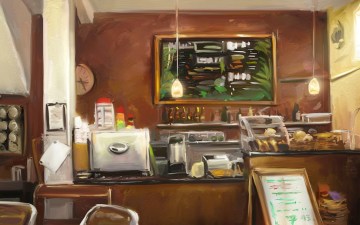
    chameleon cafe_small

    He wanted to talk to her but didn’t know how to begin. He did not want to look overtly anxious, and yet he was obviously anxious. Part of it was his urge to find out if she was the right one that matched his gossamer imago, and more of it was his untamed machismo that even his arete, the harmonious combination of moral integrity and physical discipline, could not surmount. In the age of Amazonian resurgence of matriarchy on the crest of #MeToo campaign, the subject matter of indomitable feat of virility could be highly volatile, incriminating even. But Hector was being none other than a man himself and going against nature would turn him into a closet monster or a spectacular hypocrite.  Besides, Hector was an artist who was unafraid of following his heart according to the True North of Nature. He belonged to the race of the untethered, the bold and the beautiful, and he knew it. All of it, all that he had was working toward his wish to speak to her, the mysterious woman sitting three seats away from him.

     When it reached the zenith of the urge, Hector couldn’t hold it any longer, and it finally erupted from his lips: “Excuse me, miss. I forgot to bring a pen with me. Do you have a spare one by any chance?” It was the best excuse he could think of because the woman was writing in her notebook. She seemed startled at first by a strange man’s request for a pen, but soon her fear of a stranger relented at his polite manner handsomely juxtaposed with his sonorous voice and beautiful eyes that radiated both warmth of the soul and allure of the flesh. Iris was always sagacious of people’s characters, which was her gift and curse of the Fates, and she saw genuineness in this strange but beautiful man’s eyes in an aura of charisma, a mythological power ascribed to the Olympians and select hybrids of mortals and immortals. In a phantasmagorical display of the Greek heroes and gods, Iris was filled with mysterious confidence that gave her a status that fuses the capricious power of a fairy with the sensuous charge of femininity. She finally fished in a pen from her pencil case and gave it to him. “Thank you, Miss. These days people do not seem to carry around a pencil case.” Hector thought that he talked too much and instantly regretted it. But it was a reflex of his heart that knew better. It was working slowly, the kindling of the amber that was beginning to grow. No, my dear reader, it wasn’t that usual playboy’s antics, that sleek glib of a smooth operator because Hector wasn’t the sort. Nothing namby-pamby about Hector’s sensitive nature, nor the supra-abundance of the embryonic courtship that might not even develop with fanfare. But nothing could be further from the truth – the truth that both Hector and Iris were votaries of aesthetic pleasure, the cult of Psyche and Eros, the seekers of Eleusinian Mysteries in their own rights.

    Iris wanted Hector to go on, to take her on, to lead her on. Despite her instant bestowal of confidence, she was still wrapped up in her own clock of anonymity and invisibility like a fairy who was visible to the mortal eyes when she wanted to. A fairy whose sentiments were different from the mortals and who could be both impish and angelic according to her whims and caprice. For a fairy by nature was amoral and could fashion in whatever forms she would prefer. Thenceforth, Iris was lamenting that a fairy at the time of her birth did not bring her a gift of beauty that could captivate a man of her heart. Surely, she was told beautiful, sultry even, but her resemblance to Cassandra was the sine qua non of her solitude, although she would like to insist that it was her voluntary choice. The grace and the harmony of her features would make a beholder think that they were aesthetically proportioned, yet she wasn’t exactly a Helen of Troy for whom Paris, the prince of Troy, left his nymph companion in distress and for whom thousands of ships launched to win her love. Alas, poor Iris! I knew her, my dear reader. I commiserated with her spiritually. I should have cast glamour spells on her so that she could be instantly gorgeous at that time. But would it be a kind of beauty she really wanted?… I wondered. I questioned: then, would Iris- a lesser beauty, a confused fairy, and a distressed Cassandra- make this mysterious man interested in her soul until they became two by two and about what went they to? In this fey meditation, her spirit was pivoting ecstatically from the mind’s castle and swiveling in wonderment. Iris was secretly invoking the power of all the fairies in the limine spheres, the slice of seacoast between low and high tides, deepening foliage between field and forest, and the slope-land between plains and mountains.

  • deer hunter – chapter 7

    in-birreria-guido-borelli

    5:15 PM to Florencia. Iris looked at her iPhone clock and felt secured because the time was working nicely with her wish to stay longer until the train departed. The cappuccino was still pleasantly warm in her hands, and she loved the aroma that enveloped her tall slender figure like a shimmering halo of rainbow sunshine. The iridescent mist of instant euphoria was clothing her with a veil of poised status that fused mysterious confidence with graceful humility. Emboldened by this sudden transformation, Iris pulled herself out of her glass castle and lifted her beautiful deep liquid brown eyes to the outside the world of her own. Into the sea of her diamond eyes, the images of love and beauty were cast like magical apparitions, bewitching her senses and sensibilities which were otherwise harnessed like a pair of tamed horses. Iris felt that she could forgive all and love all at that moment of euphoria. It showed that a cup of good coffee could do wonder to anyone as it had done to Johannes Sebastian Bach, Albert Camus, Napoleon Bonaparte, Jonathan Swift, and Ralph Waldo Emerson.

    In this caffeine-induced euphoria, Iris did not know she was radiant with her pretty smile. The smile was her most prized jewel. When she smiled, she was sweets to the sweet. It was like a flower blooming around an oasis in a desert, and everyone liked it. It’s as rare as a pearl found in a clam, and it’s this rarity of her smile that kept herself distant from the melee who demanded of her frequent smiles. And who would have known that her pearly smile would have caught the sight of Hector? Yes, it was Hector, the mysterious man with a Byronic face and Olympian physique sitting three seats away from Iris, the smile enchantress. Reader, you should understand that Iris was usually a skillful driver of her Chariot of Mind, keeping a tight rein on the always recalcitrant Horse of Appetites. But at that moment, Iris’s chariot was shaking, and the impudent horse was not responding to her stern command to behave. The harder and more she hit the horse with a goad, the more and harder the horse rebelled against the pain until it became mad with a wild cry of agony. It was the cry of the restrained nature. For the nature of the impudent horse was to act according to its beastly desire, the primal cry of the wild. The ancient Greeks regarded love involving man and woman as the most passionately sensual emotion in which only Eros dominated because it was primarily physical, encompassing carnal pleasure. Was it that Eros and Eros only that reigned in Iris’s entertainment of this rebellious chariot of the mind with the wild cry? Iris did not think so and liked to believe it wasn’t. After all, Iris was chaste, and she believed that she would live as a living goddess like Artemis or Athena, independent of men, of children, flying outside the boundary of marriage and attachment.

    Hector was watching this curious woman all along. He did not know why, but something was telling him that she was different from other women whom he had known and lived with. She looked both woman and girl in her tall thin body. She was beautiful with her chiseled face and large dark brown eyes that looked rather serious and dolorous. Her high-bridged straight nose gave her an impression of a patrician woman whom no one could easily be jovial with. The beauty and the grace of her were not in want, and yet she wasn’t exactly the fairest of all the women he had met. Besides, there was a touch of beyondness to her, which was oddly attractive with her rather sophisticated urban demure. The graceful estrangement emanating from this unknown girl/woman reminded him of a deer that lost a track of her kind in a deep forest. Or did she look like a she-wolf voluntarily detached from the pack? Whatever it was, he was hooked on it and wanted to know more about it. It was in her, and she was in it. He wanted to be in it, willingly and madly. Was it an illusion or just a whimsical mood of a bored artist? Hector was all for the adventure, and he’s up for it like Odyssey in preparation for his adventures between the sea and the devil.

  • Have my say @ bbc history revealed

    I wrote this letter to ediotor of “BBC History Revealed” during my lunchtime today upon reading an article about the Wild West. A prospect of its publication is beyond the pale, outside the boundary of even the slightest hint of flattering hope and vain wish. Yet, I was egged on by to express my opinion on it as a new frontier-woman in California with the literary advice from Henry David Thoreau and Horace Greeley that the West is where we can start anew because of the Pacific Ocean, a terrestrial version of Lethe, the river of forgetfulness.

    Dear Editor:

    The article about the Wild West in this month’s issue was particularly interesting, since I am a recent immigrant from the East to the West: the restive nature, the swashbuckling gunslingers, the outrageous outlaws and the ruthless vigilantes were all embroidered on the popular Hollywood-generated image of the West that became something of a  factoid to people living outside the West.

    Even though the U.S. Census Bureau declared in 1890 that no more western frontiers were left to conquer, I believe that the culture and ambiance of the West remains here in California. As someone who lived many years in New Jersey and the New York City before moving to Camarillo, the most distinctive characteristic of California is its unsullied beauty of nature in replacement of the skyscraper jungle as I see every day on the commuter’s railways.

    Surely, there’s no more John Wayne, Clint Eastwood, Gary Cooper, or Paul Newman with Robert Redford walking in the streets. Yet, the spirit of eternal youthfulness is still nuanced by a combination of its beautiful rusticity of nature and a diversity of people interacting with the special aura surrounding the land.  For this reason, the West has not lost its charm with its continuous saga of immigrants in search of better future and the timeless beauty of nature.