Tag: literature

  • what i liked about “Upstairs, Downstairs” (TV Series) – review


    upstairs-downstairs

    A long time ago, somewhere in London there lived two families under one grand roof: one lived in downstairs, and the other upstairs, all behaving according to their modus vivendi that seemed only natural to accept without a shadow of doubt to contest. It was the time when a lady would require a parlor maid to groom her in her boudoir and a butler would act in the capacity of a superintendent of a household as well as a messenger incognito for his master. But to dismiss those β€œgood old days” as an obsolete oppressive social institution is to deny the memories of those cherished in their everyday lives as portrayed unforgettably in a British television drama series, β€œUpstairs, Downstairs” (1971).

    This is not like the overhyped β€œDownton Abbey” in the sense that the plot of the story involves these two opposite classes (the benevolent master and the content servant) in a very fashionable mansion. Contrarywise, this classic series of β€œUpstairs, Downstairs” is rich with feelings and thoughts that make the viewer empathetic to the characters and absorbed into each episode for the reason that they touch upon the heart of the viewer, let alone the fine performance of the cast and the elegant screenplay attuned to all.Β  On the point of purely subjective note, the character of Rose Buck, an excellent parlor maid who is beautiful both inside and outside is what gives to the ethos of the drama: she is all humanity, showing compassion toward the eccentric but tragic footman Alfred who was shunned from others. Notwithstanding her goodness and beauty, Rose is unlucky with her personal life, ever finding herself out of reach of love like the forlorn nymph Echo. Her character is universally appealing regardless of time, ethnicity, and class. And Butler Hudson may seem prejudiced and stuffy, but he has a heart, too. In fact, he’s a good father figure: stern but fair, strict but kind. No one in Downstairs is sacked coldly, come what may.

    The residents of Upstairs are not your proverbial snobbish English aristocratic family whose haughtiness and zero regard for their subordinates are something to be enshrined in the temple of Marxism; the Bellamy family, headed by the magnanimous and highly respectful viscount Richard Bellamy, who was originally a son of a country parson, were all too human, woven into intricate relationships of love and loneliness, betrayal and misunderstanding. To put it in a nutshell, the Bellamys are a paradigm of noblesse oblige. No wonder Butler Hudson and his Downstairs family show such a high, heartfelt regard for the family like they are their real family.

    If you are accustomed to the splendid British manor scenes that typify your image of the classic British class distinctions, then you might find this drama rather antiquated and boring as a period drama. But those of you who value stories and characters, not to mention fine scripts, this will feast your senses and sensibilities. What’s more, you don’t have to be British to enjoy this excellent drama that fuses historical backgrounds as factual grounds of each episode with interesting and empathetic characters with stories to tell which we could relate to one way or another. Good dramas are contemporaneous with any period of times, theirs and ours.Β 

    Author’s Note: Since the acquisition of a Kindle Fire, I have been wallowing in the enjoyment of quality TV shows of the past. People ask me why I am hooked on the dramas or comedy shows of the bygone eras before my coming to the world. But as I firmly believe that pathos of humankind are transcendent of time and universal in every culture, my sensibilities channel me to the dramas that know no boundary of zeitgeists. I am open to all good TV shows so long as they are worth the viewing.Β 

  • “Bad Ben-The Mandela Effect” by Nigel Bach – review

    Bad.Ben_.4.The_.Mandela.Effect.2018-poster-frontThe smashing success of The Blair witch Project has spawned its eponymous genre of films with its proprietorial low-budget production consisting of indie directors, unknown (or low-profiled) actors/actresses, limited gadgetry, simple scripts, and straightforward plot to evoke an arch of Realism in Reality in touch with the everyday life of the ordinary. In European films, this neo-realism has already been constituted by the works of Lars von Trier in Dancer in the Dark, the Dardenne Brothers in Rosetta, and Vittorio de Sica in The Bicycle Thief. Maybe it’s because the New World is innately rebellious to anything coming from the Old World for the reason that it is simply too sophisticated to appreciate its artistic sensibilities developed through the flight of times. Whatever it might be, now is different. American Cinema Paradiso has never been so teeming with many an ingeniously creative realistic film made by ambitious directors who are not shy to translate their imagoes or imaginative world on screen in a way that makes it look real as impressively illustrated in Nigel Bach’s Bad Ben–The Mandela Effect.

    The genre of the film blurs on the boundary of comedy and horror. In fact, it delivers the sensuous kicks of laughing and shuddering, putting the viewer on the pleasure roller coaster ride. To begin with, the undeniably irascible bold-headed β€œTom Riley,” played by Nigel Bach, who also produced and directed the film, with his thick southern New Jersey accent and the accordant β€œdon’t mess-with-me” attitude is a great subject of comical caricature resembling none other than himself. Then there are the possessed satanic dolls that are more irritable than horrible because they get on Riley’s nerves. Even the profane language Riley employs to covey his frustration and to provoke fear in the evil dolls is not offensive but risible. Besides, the setting of the house, which is also the actor’s real house, renders the plot of the film a sense of verisimilitude, an illusion of watching a non-fiction documentary film based on a real event.

    The real gem of this strangely attractive film is how the plot is unfolded with a wicked deception of the eyes and the ears of the audience even without special effects or ingenious editing. How a man like Tom Riley – the porky bald-headed fiftyish curmudgeon- can commend a screen presence would have been a challenge, had it not been for Bach’s natural way of delivering his lines without overtly dramatic emotions  and his elliptical plot of a plausible story of an everyday man experiencing the supernatural in everyday life. In fact, from the moment Riley gets to his new proud and really beautiful house of dream bought at a sheriff’s sale, we take the plot of the film for granted with a foregone conclusion until it gets us to the surprising denouement thereof with the kind of sensation and sensibility that Riley experiences over and over again. In this manner of empathy, we are in Riley’s parallel universe whether we like it or not during the whole film, come what may.

    It is both fun and worthwhile to watch this one-man act without boredom for what is worth. It is a motion tessera elliptically put together by bits of Child’s Play, Paranormal Activity, and Twilight Zone studded with crude American sense of humor and practicality of the storytelling that does not impart preposterously and pompously supernatural ambiance. Other acerbic reviews of the film notwithstanding, this film deserves of applaud for its ingenuity to employ a modern theatrical version of ventriloquism, fusing Riley’s amusingly jagged story telling voice with the director’s own impetuous gushing of the realistically uncanny atmosphere he tries to create without elaborately intricate scripts or other fantastic cinematic bells and whistles.

  • [updated] cheery sunday

    Mr. Fred Holstein (hereinafter “Fred”) visited his good friend Mr. Paul Collie (hereinafter “Paul”) on this beautiful Sunday afternoon. Paul had a pretty garden in his backyard, and being a good friend of his, Fred even helped him water the home-grown vegetables. After their joint labor, Paul and Fred had a good time with their favorite snacks at the garden. In fact, Fred’s new jokes were so funny that Paul fell out of a chair. Then they parted merrily before the sunset. Tolstoy would have enjoyed himself if he had joined them at the garden, for it was his kind of nice restful time.

    Author’s Note: Since downloading the video from the app seems to take forever, I have included its Youtube version in my Blog.

  • white canvas


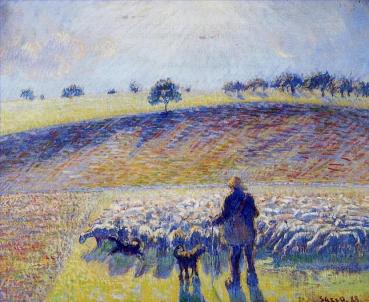
    6-shepherd-and-sheep-1888-Camille-Pissarro
    6 shepherd and sheep (1888) by Camille Pissarro

    Life is a canvas; I am a painter,

    Drawing the scenery of everyday

    With the feeling of unbound duty

    To see the beauty of it all hidden under

    A veneer of reality, come what may.

  • small simple sweet

    A merry heart goes all the day, warding off evils of everyday existential life. The Bard said, “Frame your mind to mirth and merriment, which bars a thousand harms and lengthens life.” Which also strikes the biblical chord of “Refrain from anger. Turn from wrath. Do not fret; it leads only to evil.” It all fits Sally’s way of fulfilling demands placed on her daily tasks in life and enjoying small pleasures in the simple and sweet novelty of it all.

    Author’s note: with my new iPhone, nothing is impossible πŸ™‚ I hope to make a short film, using a series of stop motions, in future.

  • The Good Stars in Aquarius

    aquarius-constellation-with-triangular-background-vector-15771570

    Celestial streams of Independence, Intelligence, Trustfulness
    Became the Stars of Your Destiny constellated across the northern skies
    Shining thru the cold wintry night as the radiant meteor diamonds,
    Crowning you with the magical powers of mystic Aquarius.

    Author’s Note: It’s a poem dedicated to all whose astrological sign is Aquarius πŸ™‚