Tag: literature

  • ‘A Summer of Hummingbirds’, by Christopher Benfey – review

    A Summer of Hummingbirds: Love, Art, and Scandal in the Intersecting Worlds of Emily Dickinson, Mark Twain, Harriet Beecher Stowe, and Martin Johnson HeadeA Summer of Hummingbirds: Love, Art, and Scandal in the Intersecting Worlds of Emily Dickinson, Mark Twain, Harriet Beecher Stowe, and Martin Johnson Heade by Christopher E.G. Benfey

    My rating: 4 of 5 stars

    The Greeks called it Ethos, and the Germans named it Zeitgeist. The world has always seen and experienced epoch-making changes of guiding ideals or beliefs that particularize ideology of an era under the cataclysmic reconstructions of social modus operendi, cultural trends, and memes. Something like that happened in the mid-late 19 century post-Civll War America, and it was something of American Renaissance. Emily Dickinson saw it as a flash of a hummingbird’s flight into a route of evanescence – of the antebellum social arrangements, hierarchies, puritanical morality, and intellectual formations, all of which seemed unseemly and even contumacious in a dawn of new era. So Christopher Benfey presents in this beautifully ethereal book his sensitive and illustrative script of Post-Civil War American literary scenes in which the likes of Emily Dickinson, Harriet Beecher Stowe, and Mark Twain are played on the same epochal screen, using the image of a hummingbird as a cross-cutting medium to interweave the lives of the American intelligentsia.

    Benfey draws on his unparalleled knowledge of the American literary intelligentsia with a tender and intelligent contemplation on action and thought in the culturally sophisticated realms of East Coast America in the aftermath of the Civil War. For instance, he introduces the reader Reverend Henry Ward Beecher, a brother of Harriet Beecher Stowe, a passionate collector of expensive paraphernalia, whose Byronic-like charm and charisma led him to a famous scandal involving a love affair with the wife of his friend and parishioner. But Benfey sees the reverend as breath of a fresh air in the stuffy Protestant tenets of mortification of sensualism, which is only a friori natural to God-given human nature. In fact, Beecher substituted the drab and dreary Calvinist doctrines of predestination and infant damnation with the love of nature, the tender love, and mercy of God who created Beauty to be realized and appreciated, not to be despised and avoided. Besides, Charles Darwin’s Evolutionism manifested a perfection consistent with the Christian views: that all living things evolved into their most advanced forms meant the perfect beauty made in the Image of God. Indeed, such perceptions of God and his creations bespoke liberalization of Protestant moral codes that often yielded to perverted acts of unnaturally repressed desires. It was a leap into a new world of “fluidity and flux”.

    All this seemed to conspire to reckon the moment of new arrival of intellectual zeitgeist with a divine revelation or a sibylline prophecy in this book, which is why it is deemed a contemporary nonfiction that reads like a classic fiction. Rich in detail and vivid in description that successfully resurrect the period, it is a riveting tale of the American literary legacy to be told with Benfey’s poetic use of simple language with a fascinating take on the felicitous subject worth the reading. The book embroiders on the lives of the American literary celebrities of the time by interconnecting their lives with the gossamer threads of contemporary providence or fortuity in one way or another, willed or unwilled, when a pre-Civil War mindset and post Civil War necessities still clashed. Nevertheless, Americans after the war came to see a new substratum of social order and diverse directions in all aspects of life, fittingly found in the figure of a hummingbird, an indigenous bird of the American continent, that is uniquely American. IT was also a time of Transit of Venus, as the new tone and sensibility for new era became dawned on the American social and cultural horizon. This book is a tessera elegantly and delicately put together by Benfey’s appealing narrative and approachable scholarship in a mosaic of American Art.

  • Jay’s Angels – fiction

    lacwkrr-ladies-e1545975174648
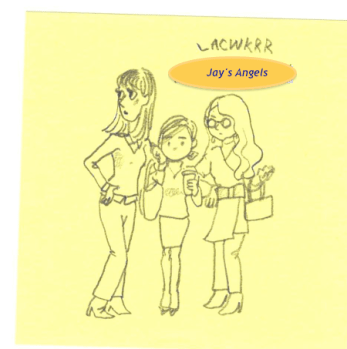
    Move over Charlies Angeles. Here come Jay’s Angeles. (from l to r: Stephanie, Gwen and Monica): Illustration by Gwen B.

    Director/Writer/Producer: Stephanie S.

    Illustrator: Gwen B.

    Ambiance Coordinator : Monica K.

    Stars: Stephanie S. (Legal Assistant), Gwen B. (Accountant), and Monica K. (Legal Assistant)

    Synopsis: Three ladies who are recently hired at a downtown LA law firm by a top notch  lawyer Jay C. sometimes get together during lunch hour to share their flattering hopes for their futures, remote but not that far-fetched anticipations of meeting white knights on steads, picky valuations of Mr. Rights, and other simple vignettes of their romantic adventures in Love El Dorado, all under the pretext of helping Stephanie to morph into a seductive la femme fatale, so to speak, to elevate her status to that of Irresistible Aphrodite in Pantheon of Love.

    The Ladies get kick out of their funny raillery about all and sundry, ranging from a best face washer to their erstwhile significant others or would-have-been, from the pros and cons of their de facto bosses to their next best wishes and wishful thoughts about their better tomorrows. But who can deride their maiden dreams as pettifogging idleness indigenous to womanhood when they are hard-working women fulfilling everyday demands placed upon their daily tasks from within and without?

    Mind you that due to their innately highly whimsical and capricious nature laced with covert extraordinary spiritual prowess, they sometimes change themselves into the Witches of the Biltmore. So it’s a league of their own, and it’s members exclusive, and it’s highly selective. But don’t you let them scare you away, my dear reader, for they are also mortals whose blood is red and hot and heart is warm and pumping. They are Jay’s Angels.


    Author’s Note: Working in office requires lots of social skills: diplomacy, adaptability, modus vivendi, persona, euphemism… It requires a sense of humor, a handmaid to productivity imbued with can-do attitudes and stoicism to accept misfortunes and fortunes as they are – but with lovely smile all for the love of yourself – . Be it ever so naive or gullible, but one thing is certain that although my life at present is attuned for the office life as my primary reality for livelihood, which is why I lag behind my list of to-read books, this new kind of reality has called my attention to its adventurous digression from my textual existence rooted in reading the worlds of others. No, that does not mean that I trade myself for recklessly rash frolics, but it might help me to widen a social horizon to encounter a panoply of unknown characters, as piped up by  Shakespeare thus: “There are more things in Heaven and Earth than are dreamt of in your philosophy.”

    저장

    저장

  • ‘The Open Boat,’ by Stephen Crane – review

    The Open Boat and Other StoriesThe Open Boat by Stephen Crane

    My rating: 4 of 5 stars

    Four men in a dinghy adrift on a sea for 30 hours. The tempest of waves and a great shark occasionally circling around the perimeter of the boat. And the men rowing endlessly as if it were their only tangible way of protesting against their fates. It all happened in reality because the author Stephen Crane himself experienced the ordeal as one of the four men from the sunk SS Commodore off the coast of Florida en route to Cuba, where Crane had been sent as a war correspondent. The short story of the Open Boat is as realistic as it can be based upon a factual event the author himself was fatefully partaken in.

    The four survivors of the vessel were aggregates in a dinghy bound by a remote hope of finding a rescue crew in the middle of the ocean that moved them with terrible grace of waves. The men were a captain, a cook, an oiler, and a correspondent, who was the author himself. There was a subtle brotherhood of men built in the boat who took care of each other. Crane surmised that the captain’s heartfelt devotion to the safety of the motley crew resulted in comradeship, which the author himself had always regarded as a hypocritical concept of men until then.

    There were indeed moments of despair as their drifting became protracted, and the author saw this as nature not regarding human as important. He would jeer at any signs of nature in any deity form because thinking of the captain and the two other seamen who had worked so hard on the sea in such distress was the abominable injustice.

    Stephen Crane was a great American realist writer who later influenced Ernest Hemingway. Born in 1871 as a ninth child of Protestant Methodist parents in Newark, NJ, his literary talent began when he wrote his first poem at the age of eight. Although brilliant, Crane was not academically inclined, so he left University of Syracuse and became a kind of itinerant writer. It is said that Crane was a naturalist writer who emphasized observation in the portrayal of reality based on scientific principles of objectivity and detachment applied to the story of human characteristics. However, in my opinion, he was more of a realist writer who focused on objective, truthful presentations of details of the ordinary lives influenced by Gustave Flaubert and George Eliot. In this story, Crane’s use of vocabulary was pithy and straightforward with elegant expressions of emotions and feelings that so appropriately described the situations in which the characters were trapped.

    After Crane’s untimely death at the age of twenty-eight in a Black Forest sanitorium in Germany, Crane’s works began to gain their long overdue acclaim, one of which was this story of the sunk vessel and his own experience thereof. Stephen Crane’s works should deserve wider readership because he’s the first and foremost American writer in Realism literary movement who paid attention to the lives of the ordinary by being the experience of living among the ordinary and writing the existential presentations of the ordinary lives.

    저장

  • Ah, Bartleby! Ah, Humanity!

    3-10-2017_bartleby_scrivener_2

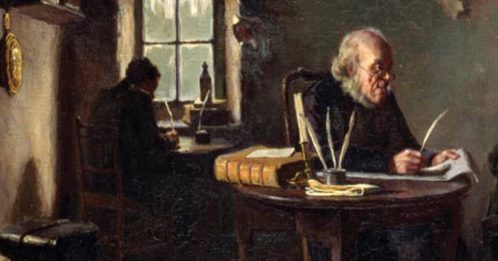
    It was more than 10 years ago when I first read Herman Melville’s Bartleby, a short story about an unwonted young man employed as a scrivener by a Wall Street lawyer. At that time, Bartleby stroke me as a very eccentric, imprudent worker who had the temerity to reject his boss’s orders. He was just a mentally deranged man with only a few words, other than “I would prefer not to do …”

    But now I see him different. Since I re-read the story this afternoon, I have felt bottomless sympathy for Bartleby. Mixed with pathos and sprinkles of humor in the narrative of his benevolent former employer, the figure of Bartleby evokes springs of human compassion and humanity itself. And my feelings for this tragic scrivener amount to what the narrator felt about his former employee.

    I am not intent on “analyzing” the psychological aspects of Bartleby and his former Wall Street lawyer boss. And I think not that even the writer Melville himself had such psychoanalytical views on these characters in mind when he wrote the story. To me the story itself shows what made a sensitive man like Bartleby to such demise in the eyes of a compassionate man – and a decent employer seldom found these days. Loneliness, Hopelessness, Sorrow, and Reality of Death all packaged in written forms burned in flames stagnated the humanness in the forlorn scrivener. The Death of Humanity, that is. Having worked in the Office of Dead Letters at Washington would suffice it. Surely, there is no doubt that Bartleby was mentally disturbed, but who would hate or even despise him for his malaise?…

    Then readers might object to the premise that it’s only a fictional story in which no such characters will/would exist in reality. But I think not so. As a matter of fact, I have always believed that fictions are always built upon factual elements of human life to a certain degree. Dismissing stories as creations of imaginativeness seems to miss the fundamental truths laid under changes and choice of our human life with a bit of creative imaginations. Ditto Stephen King, who has once said that the stories are artifacts that are not really made up, but that are based upon preexisting objects we discover.

    The tall, lean, pallid and lugubrious image of Bartleby the Scrivener still lingers in my mind… Having dealt with tons of letters from those who died in despair, those who died hopeless, and those who died suffocated by insurmountable sufferings, Bartleby had lost his own sense of existence, feeling utterly dispirited, pessimistic, and lethargic in performing demands of his duty. It was the loss of meaning of life that made him passively resistant to all the ordinary functions of daily life which all seemed insignificant to him. The life itself was nihilistic and hence non-existential to Bartleby. Humanity in the expressions of feelings and emotions meant nothing to him; it had ceased to exist in the form of dead letter attesting to existential horrors, which had led the authors to death, which had taken the poor Bartleby as the witness thereof.

    Thus, the lamentable outcry of the narrator still deeply reverberates in my mind even after I closed the book: “Ah, Bartleby! Ah, Humanity!”

    P.S. This is my bygone writing about Herman Melville’s classic short story of “Bartleby, the Scrivener” that I had written prior to the inception of my blog.

  • ‘The Library: A Catalogue of Wonders’, by Stuart Kells – review

    The Library: A Catalogue of WondersThe Library: A Catalogue of Wonders by Stuart Kells

    My rating: 5 of 5 stars

    Libraries are more than boring stockpiles of books gathered, nondescript depositories of books collected frequented by socially gawky individuals we love to call “nerds” or “misfits.” They are symbolic fortresses of our human cultural progresses as collective enterprises. In fact, libraries are precious repositories of our cultural wealth and knowledge inherited from the forerunners of the Humanities with prescient intentions to preserve the intellectual and spiritual prerogatives of the mankind for the posterity. Any book lover sees this magnificence of libraries, and that is the motif of Stuart Kells’s The Library: A Catalogue of Wonders, a vivacious, jocund presentation of histories and development of libraries and an uplifting rhapsody of bibliophile – love of books. What’s more, this book is not a product of armchair thesis of a library as an anthropological institution, but of an empirically telltale account of cultural, aesthetic, literary, and social phenomena dedicated to preserving the writings of Mankind based on Kells’s actual visitations to the libraries he presents to us.

    To begin with, Stuart Kells wears many hats in this book: a teacher, a guide, a book-collector, a historian, and a confirmed book-lover. But most of all, the image of him as I follow his narrative is that of a cross between a teacher and a tour guide with erudition and bonhomie. Like peripatetic Aristotle communicating to the minds of his students in the ancient Greek Lyseum, Kells invites the reader to saunter with him in his own mental library of snippets from a variety of literature and history that merit their substratum of textual human cultural artifacts bestriding the shelves of the Humanities ranging from the classical to the contemporary, all in the loving and caring custodianship of the author whose love of books is so deep and passionate that it’s almost physical. It’s personal, historical, academical, and magical in a way that imparts a sense of flitting in the phantasmal reverie of the world of libraries, now and then, existing and extinct, and  real and imaginary, to the reader.

    We travel along with Kells playing the role of a likable and knowledgeable cicerone from the Library of Alexandria to the Italian monastery of Bobbio in the Middle Ages that was said to house 666 manuscripts, Germany’s Wuttemberg State Library possessing a 17th century portrait of Vlad Dracul, aka Dracular, and the Abbey Library of Saint Gall, aka St. Gall’s Library, in Switzerland, which is now a UNESCO world cultural heritage site holding more than 400 manuscript volumes produced before the year 1000. And before we know it, Kells also brings us to the fantastic libraries of the famous Hobbits, also known as a race of bibliophile with personal libraries at home, however small the size might be, and the medieval monastery library in Umberto Eco’s The Name of the Rose, where lightheartedness of the atmosphere contributes to the joy of knowledge and the elevation of the mind and soul. Although Kells’s Australian identity tells of the superiority of J.R.R. Tolkien’s Mathom House, a wondrous library of literary paraphernalia, over the Italian Eco’s monastery library, it’s altogether a magical sightseeing of the mystical libraries conjured up before our eyes by the imaginativeness of Kells, and we can decide which of these fantastic libraries appeal to us.

    To conclude, the book is an axiomatic compendium of world’s famous libraries throughout the western civilizations, smartly studded with tidbit information on eccentric librarians, book-collectors/booksellers, and historical figures in between the chapters serving as a kind of delightful intermissions introducing a subject of each new chapter with provocative anecdotes and vignettes, which are pleasingly digressive rests from the tour of the libraries. It’s really a bright book, not a heavy-duty one with lots of footnotes and scholastic priggishness that the reader may expect a book of this subject matter to be. Notably, Kells’s interpretations drew on his impressively eclectic knowledge of these extensive sources as a respectful book-trade historian, but he wears his learning lightly and writes with a general reader in mind. And I believe that just as the famous English poet Samuel Taylor Coleridge often kissed the books of the Dutch philosopher Desiderius Spinoza, out of Kells’s passions for books and possession of the knowledge of multidisciplinary studies comes his love child in the form of this jolly, easy-to-read book.  In the end, the reader will come to love this book for simple, pure pleasure of reading and may kiss the book.

  • Fairy summoning in the Florentine Renaissance period

    41a59389f2e8e71b94e50f9d1ae7d39a--vintage-fairies-vintage-artwork
    A supernaturally pretty fairy deludes men’s hearts.

    There are magical elements in religion, and there are religious facets to the practice of magic, as succinctly summed up by Sir Walter Raleigh: “The art of magic is the art of worshiping God.” That’s how I feel and what I see during my Dutiful Sunday Morning Masses, the ancient rite of the Church, a perennial panoply of syncretism with its splendid paraphernalia of prayers and the liturgical ceremony of rites and mechanical recitation of prayers; it is the melding of religions or beliefs of the similar elements but of different origins. Hence, to come upon an article in the recent issue of BBC History Magazine about an academic study by a certain British scholar of the existence of fairies in the context of the validity of cultural and historical artifacts gave me an uncanny pleasure.

    Dr-Faustus
    The famous Dr. Faust, summoning Mephistopheles for his service

    In fact, Religion (that is, Christianity) and Magic (in the forms of divination and sorcery) are not to be seen as polar opposites and antithetical systems of belief because they are interdisciplinary agencies of attempting to seeking and offering a panacea to our dilemmas – physical, metaphysical – competing for supremacy in propitiation. Such mysteriously syncretic elements of the two different agencies of beliefs became the academic subjects of intellectuals, such as Francis Bacon and John Aubrey who accepted the potentialities of physiognomy as an infallible guide to predicting one’s character and argued for the validity of non-Christian practice based on certain intellectual bases therein. With this in mind, you would not be surprised to learn that fairy summoning rituals were all the rage in the Renaissance period (15th~17th centuries), indiscriminately practiced by all strata of society, learned or ignorant, rich or poor, Christian or pagan. The author of the article informed the reader that the early Renaissance idea of fairies was pretty nebulous and varied with a wide arc of wonder and trepidation and that the dainty image of ever famous “Tinker-bell” was a Victorian construction of the whole fairy race.

    Then, how did the “real” fairies look? Although there is no magisterial, definitive version of the physiognomy of a fairy, a collective description gleaned from various records boils down to it as a supernaturally attractive man/woman imperiling the souls of whoever it was summoned to, which is reminded of incubus/succubus, consecutively. Notwithstanding the dubious nature of fairies, the invocation of fairies halfway between angels and devils was widely used in hope to (1) acquire medical knowledge, such as whereabouts of herbs and their properties; (2) delight in the highest degree of sensual ecstasy; and (3) reveal the future and prevent from misfortune in advance. Be it as it may seem wholly pagan, the summoning ritual was surprisingly required for God’s intervention because it included periods of purification through abstinence, fasting, and prayer in preparation, all of which would testify to the sanctity of the performer ministering to the moral and ethical character. God willing, a fairy at request manifested to the summoner, but he should not come out of the circle he had drawn because it protected from sudden maleficence of the ambiguous fairy.

    Delphic_Sibyl_Michelangelo___21969.1501257269
    Delphic Sibyl from the Sistine Chapel fresco by Michelangelo

    In sum, the article was an elegant primer for a further interdisciplinary study of literature, religion, and folklore from the medieval times to the Reformation period and possible stretching to this date. The exemplary texts that spring to my mind are Religion and The Decline of Magic by Keith Thomas and Christopher Marlowe’s version of the legend of Dr. Faust, both of which are excellent testaments to the contextualization of the esoteric knowledge on the grounds of intellectual bases into academic studies of social, cultural, and historical facets of different zeitgeists, which also serve as invaluable literary artifacts to epochal changes. But for all that is worth, this relation between religion and magic is commensal, exhibiting a mesmerizing consilience of gods and God, profane and holy, pagan and ecclesiastical, forbidden, and disciplined, as superbly unfolded in the Sistine Chapel fresco, prodigiously expressed by Michelangelo.


    저장