Tag: Nonfiction

  • Turkey and Thanksgiving

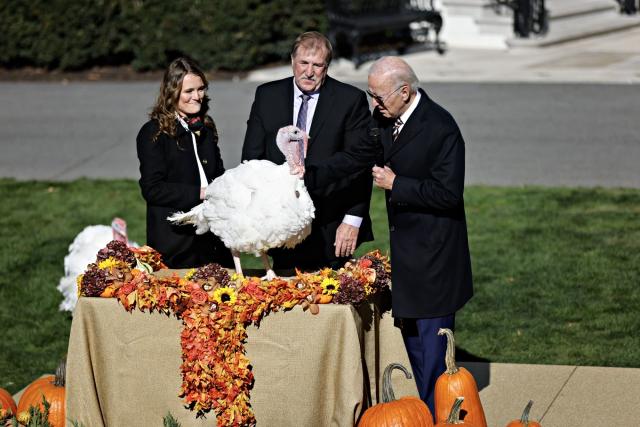
    This year’s lucky pair of turkeys that received a presidential pardon for not being sent to a slaughterhouse is Chocolate and Chip. The turkey symbolizes American festivity and character distinguished from all other birds of feathers, such as the eagle, the dove, or even the phoenix. So then it’s only natural to find out why the turkey has become the signature bird of the Thanksgiving holiday on Thanksgiving day.


    Benjamin Franklin, the amiable and ingenious American polymath founder, associated a virtue of morality, bravery, and strength with the natural characteristics of the turkey native to the American continent. He proposed that the bird be an emblem of the New Country. While the mystical implication of the bird with the New World has traditionally embodied in the cultural context of the pilgrim’s attributes to the nation’s founding in search of religious freedom from the Old World, the real stories about the American bird encompass the endorsement from the historical figures. George Washington proposed a Thanksgiving in 1789 as a day of “public thanksgiving and prayer,” which was chimed by Alexander Hamilton’s acclimation: “No person should abstain from having turkey on Thanksgiving Day.” But the Thanksgiving tradition began in 1863 when President Lincoln proposed the last Thursday in November as a “day of thanksgiving and praise to Almighty God, the beneficent Creator and Ruler of the Universe.” The regular Thanksgiving dinner menu culminated with one Sarah Joseph Hale, a magazine editor. She wrote Lincoln to urge celebrating the day with roast turkey, savory stuffing, gravy sauce, and pumpkin pie in memory of her beloved New England style of feast staple.
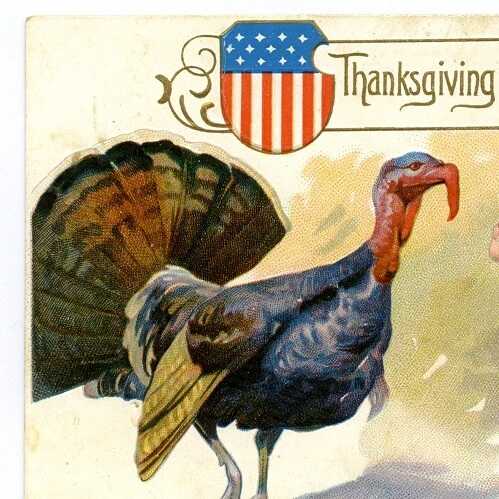
    Patriotic Turkey: Detail from a vintage Thanksgiving greeting card.


    In Europe, the turkey was a poor man’s fanciful feast because it resembled the peacock, a dish fit for the rich. The turkey occupies a dinner table alone as if it could stuff all the hungriest souls for days and nights. I agree with Benjamin Franklin that the turkey is a fit bird to become a bird of national symbol. The eagle may look regal and lofty, but it has no ingenuousness particular to America, which will always be a young country that is still growing and will grow as long as the tradition continues from generation to generation. Happy Thanksgiving.

  • Beggars can’t be choosers?

    Have you ever felt why you are here facing the ugly realities of life, enduring insults right in front of you after you are invited? I have, and the experience is still so fresh that if I don’t manifest it in writing, the grief will knit up the overwrought heart and bid it shatter to pieces, which has already been cracked, broken, then repeated. Job interviews are arguably the most tricky and adrenaline-inducing passage of livelihood for which some introverts have to give in at the expense of our fairy-like stealth, Sanity. You can either win or lose at the impression on the interviewer, who is more often than not less cultivated, let alone understanding humanity, no matter the social status. But then, you should not let your dignity and Sanity be ripped off or broken apart because you deserve a good one.

    It all started when I got first called in for a zoom interview last Thursday. It was for the position of part-time legal assistant at a small family law office in Downtown Los Angeles (not to be confused with Downtown Abbey, LOL). The office proprietor, an old man lawyer, was a typical lawyer who must have inspired Shakespeare to exclaim, “Kill all the lawyers!” It was not so much a job interview as an immigration or any bureaucratic interview, I gather, because of the following: 

    (1) His question of whether I had any family member or friend with divorce experience is irrelevant, knowing that I had no experience in divorce law. When I said no, he cast a doubtful glance at me;

    (2) After the zoom interview, what was the need for a second interview in the office for a part-time position in such a small law office?; 

    (3) I referred him to my blog as writing samples at his request, but he never gave me feedback on them;

    The interview reminded me of a police interrogation I am familiar with by watching British and American procedural detective TV dramas. He questioned me and observed my facial expressions to find faults. He was cross-examining me with the questions he had already concocted in his petty lawyer mind and insulted my sensitivity. He seemed to be of a typical victorian/Edwardian bourgeoise (not even peerage) would-be employer pleased with himself for being so rich, so successful by his so clever lawyering. 

    I am seeking employment to make a living, but I don’t want to work for/under such a rude and unpleasant employer. I wasted my time on earth because of yet another traumatic experience of failing humanity. What change has been improved since the labor movements in the tacit relationship between the worker and the employer when I cannot speak my mind because ignoring it in the oblivious land of forced amnesia will make me fall apart, and I can’t take it anymore? And it didn’t end on that day. He dared to inform me of my not being hired the next day at NIGHT. Thank God for not giving me the job. And I wish it was all just a nightmare, and that’s all.

  • Who is the patron saint of the Internet?

    The Internet is a vast open ocean of knowledge ranging from how to fix your clogged toilet and where to find the nearest dry cleaners to the meaning of language you have no idea about and to the year when the world came to being (4004 B.C., just so if you are curious.) Not that the Internet has obliterated the places of encyclopedias or dictionaries, but it has outranked popularity for its convenience with your fingertips without getting your fingers flipping pages after pages. So when I came across an article that the Catholic Church has a patron saint for the Internet, my pique spurred me to write about it.

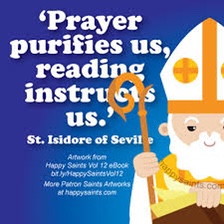
    It is no other than St. Isidore of Seville, a man of God who was keen on anything in the world’s knowledge. His ambition to know everything was sanctified in making Etymologiae, meaning Origins. It is a significant encyclopedia on everything from grammar to medicine, law, religion, and war. But that doesn’t end it. It encompasses pace, animals, ships, clothes, etc. Until the renaissance, the 20–volume magnum opus was a chief reference book in Europe. In the 1990s, a group of Catholics related Isidore’s achievement to the Internet, which the late Pope John Paul Second agreed with but didn’t extend to the patron-saint naming process.

    I think it’s fitting to regard Isidore as a Parton saint of the Internet in a religious hint of expectation that he will use his spiritual guardianship of the Internet productively and extensively. Naive as I may be, I hope there will be more pros than cons to using the Internet for knowledge of the world. You don’t have to be Catholic, of course. That would be like refusing to serve someone at a restaurant or a fast food joint because they are different from you.

  • Auto-correction and Titivillus

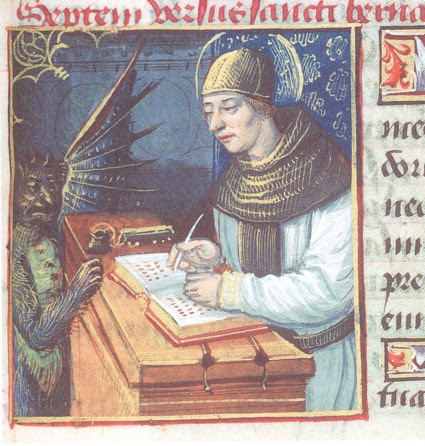
    Writing has never been easier these days than in the bygone days before the advent of the computer. If you are unsure about how to spell “Tomato,” then the computer will spell it for you by way of auto-correction. And it can even reconstruct your sentences like a pro. The magic is inside the computer, as if it has a mind and even a soul, as it were. This wizardly power of auto-correction can sometimes, however, lead you to an embroglio of nonsense, especially when writing emails or tweeting. Quite devilish, so I think and wonder: are things like auto-correction and the likes a wicked invention of science or science of diabolical existence? Hence, I am talking about Titivillus, the patron demon of scribes.

    The birth of Titivillus could trace back to the 13th century when Franciscan theologian John of Wales pinpointed the malicious demonic trickery for the scriber’s mistakes. That’s not a footless excuse for the faux-pas made in a beautifully ornamented medieval script. In medieval times, copying the passages of the Holy Scripture was a painfully punctilious task for a monk to accomplish with perfect penmanship and exquisite illuminations. And the job cost a good amount of his youth with arched back, squinted eyes, and cramped arms and fingers, not in the least due to the time spent scribing. Toiling (even though for the glory of God) and Rejoicing (for the joy of self-fulfillment), Sorrowing always hoovers over the glories. Titivillus often brings this Sorrowing by making the scriber err in labor, such as misspelling or miscopying. When that happens, a corrector scraped off with a penknife or an acidic solution was applied to loosen the ink. Or sometimes he just made little dots under a wrong word, meaning the reader should ignore that bit. In case of more significant errors, the passages were sometimes lined through, and the correction was written in the margin or copied on a smaller piece of parchment and glued into the book.


    To think of it, Titivillus has not returned to the Ninth Circle of Hell, always making himself a reason to stay as long as humanity continues writing. Writer’s block is a dark cloud hovering over the soul’s palace, the dome of thoughts. Philological carbuncles, including misspellings and awkward syntax, combine the demon’s interruption and the writer’s fear of writing. The fear is more than devilish trickery or neurotic obsession because it stifles creativeness and imagination of the writer. Still, I cannot help but think that today Titivillus manifests himself in the form of auto-correction, which can change the entire meaning of a whole sentence, often most embarrassingly and awkwardly. You agree?

  • The Pope and the Heretic by Michael White

    I first learned about Giordano Bruno through a tweeter thread about Shakespeare discussing his one of many influences, including this Don Quixote-like miscreant Dominican priest who wrote The Art of Memories, the subject I was and still am keen on to improve my regressing memory. Since then, Bruno has resided in my memory chamber as an enigmatic pariah, a formidable rebel without compromise. So when I came across this book by Michael White, a former member of the 80s pop group Thompson Twins, I knew I had to read it.

    White describes Bruno as a martyr of enlightenment, thinking ahead of his time. Unfortunately, Bruno was born into the wrong place at the wrong time, so he suffered from the Catholic Church’s authoritarian rule that dominated the World’s knowledge. However, Bruno’s theory that Jesus was preternaturally a superb magician and therefore not the Son of God, not to mention that the Holy Ghost was the spirit of the World and that Satan would be saved, was sufficient to raise the eyebrows of the ecclesiastical figures. Also, he opined that the stars seen in night skies were actually suns and that there were other worlds in the universe where living beings like humans existed. I speculate such an opinion might have influenced a modern-day belief that we are not alone in this universe because there are extraterrestrial beings. All these ideas were indeed revolutionary. But unlike Galileo, who was said to murmur, “Still, the earth circles round the sun” after he was acquitted of heresy, Bruno was stubborn in his ideas. He proudly defied the Church’s intention to pardon him if he would recant before the death sentence. In his excellent lyrical portrayal of the dramatic confrontation, White sees it as the microscopic representation of the conflict between religion and philosophy, myth and truth, superstition and science.

    Notwithstanding White’s admirable wealth of knowledge used in defense of Bruno, I cannot help but think that White’s stance on Bruno overlooks or connives at some facts. The Catholic Church put him at stake on account of his theological errors, deemed dangerous to the spiritual formation of the Church and the Faithful as a priest to the Church. Bruno was not a willing martyr of his ideas but a Simon Magus-like figure trying to trade his knowledge for recognition in the arms of different sects of Christianity, such as Calvinism, Lutheranism, and Episcopalianism, across Europe.

    It’s an irony that rather than the man written about, the man writing about him turns out to be a genius in writing. Perhaps White, a former musician, attributes this to his lyrical rhythm of narration drawn from his emulous erudition. Moreover, he writes the language of the general reader in the panoply of academic disciplines, and the reader will find no time for disorientation or disinterest. This book carries a tone of what the Italian anti-Catholic activists campaigned against the Church, with Bruno as the symbol of persecution against what they believed in. Nevertheless, it is worth reading it if you are a proponent of Giordanism or just a curious bystander like me.

  • ‘Life below Stairs’ by Alison Maloney

    The idea of domestic servants and their relationship with the masters is superficially romanticized not in the least due to period dramas, such as ‘Downton Abbey’ or Victorian masterpiece theater. In such fictionalized stories, the social dynamics between the classes are often bowdlerized or beautified, in addition to the romanticization of the working class as though to neutralize class antagonism in fear of marring a lofty literary theme. That said, ‘Life Below Stairs’ by Alison Maloney is a documentary of the real people who had to find themselves in servitude of their betters and their live-to-tell accounts of what it was like to be servants.

    While reading the book, I could not help but think that the professional domestic service in the capacity of maids, footmen, and butlers was not so much different from today’s social dynamics of at-will employees who provide their labor to employers for livelihood. Of course, the labor conditions and workers’ rights have been considerably improved, thanks to continuing reformation of workers’ compensations. However, the essence of the exchange of labor for necessities of life and the nature of employment is often precarious and insecure on the whims and caprice of businessmen and women. For example, recent union movements of Starbucks employees have prompted the company to close down under the pretext of low sales or redundancy. It betokens that the company will not tolerate such defiant action by the employees who provide their service in pure physical labor and mental exertions in catering to the needs of customers daily. Servants in the Victorian and Edwardian eras were employed chiefly by the middle-class bourgeoise who regarded keeping servants as a status symbol in the emulation of their upper aristocratic betters. In the States, servitude equated the slavery in the South, which was also maintained by merchant and business classes. Although I am not a proponent of aristocracy, aristocrats knew better how to treat their underlings because the need for servants arose from the necessities of keeping their estates and domesticity, not from a flash of ostentatious wealth that their jealous middle class was envious of.

    I envision myself as a housemaid in one of the early Edwardian eras (1900-1930), working from 6:00 am till 11:00 pm for a mistress whose temper is mercurial like Hera. That would be miserable with no weekend offs and mandatory church going with her. Then I feel okay to live in this moment of history even if my mistress boss is a modern-day bourgeoisie woman who wants her underlings to do thngs in her way because thanks to labor law, I only work from nine to five with saturdays an sundays to myself. Thank God for that.