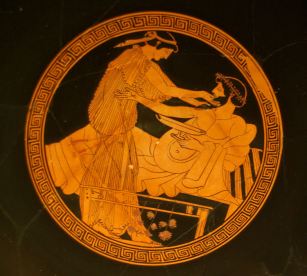
It would be devastating to know that the heart of your beloved has already parted with you. It would be even more catastrophic to learn that your love has been unrequited and consumable because it was never on equal terms for what’s worth to your once beloved. The affair of the heart is the common human trait that transcends the subjectivity of time and space, the boundary of ethnic, racial, and territorial demarcations. The truth of the matter is that when you are consumed with a burning passion sans the mind and the heart, you play fast and loose with your own life as collateral. In the ancient times, the unconstrained passion lured the desperately love-stricken to turn to the supernatural dependencies of magic spells or love potions at the expense of their own lives in the hope of making their beloveds fall in love with them. Such was the case of one slave girl in ancient Greece who made love a dangerous game.
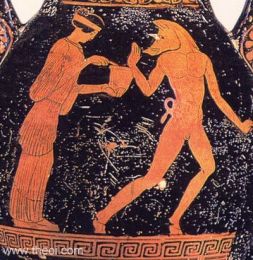
Her name was Dilitra, and she was in love with her wealthy master named Philoneos, whose interest in her was to satisfy his libido and nothing more. For she was his faithful and obedient bed-mate at his command. And she was in turn assigned to a relatively comfortable domestic drudgery, such as tidying up chambers and assisting in cooking in the kitchen, while other slaves toiled to the bone, as befitted what they were. As a concubine, Dilitra wanted no more and only wanted it to last as long as his master wanted her. Then all seemed to be a denouement of her happy concubinage when she found out that Philoneos would sell her to a brothel because he was simply “bored” with her. That was a total blow to Dilitra’s faith in Philoneos whom she loved and trusted. Blindsided by her lover’s betrayal, Dilitra resorted to the magical use of herbs and potions – called pharmaka as believed to be empowered from the goddess Circe – from a sorcerer who guaranteed her that he would fall back in love with her. So she poured the potion into wine, which Philoneos voraciously gulped down at dinner. The result was the instant death of her treacherous lover and the execution of the distressed poor Dilitra after the horrible torture by the authority on the count of punitive nature of the crime against her master.
The historical record of the tragic event tells a variety of facts prevalent in classical times. First, the idea of love was primarily erotic rather than platonic, sensual rather than holistic. In fact, what we now understand about “love” would have felt alien to the ancients in terms of the relationship between man and woman because such a modern idea of love was no more than a close bond between family members or a master and a horse or a dog. That is to say, love in the minds of the ancient meant the physical play of desires – Lust. In this regard, Dilitra’s desperate measure of using the magic potion betokens her attempt to awaken the flickering erotic love in Philoneos so that he would not sell her to a brothel to let her become a pornail – a common prostitute. Hence the potion was really meant to be an aphrodisiac that went awry.
Second, the use of spells and love potions was something of a norm in ancient Greece, where religion and daily life were inseparably bound together. It is said that there were two ways of inducing lust in a person: (1) an agon spell, which included magic, through the power of a demon to drive the desired one mad with lust for the one who initiated it. The effect of the spell, I think, could amount to the image of a fanatic band of maenads accompanying the wine god Dionysus. It was known to be mostly used by men; and (2) pharmaka, which was regarded as drug-induced love preferred by women because of the supposedly less mortally dangerous than the employment of a demon. However, anyone who opted for this “mild” form of craft did not know that its effect could be more fatal than an agon spell because it was a chemical intoxication consisting of various herbs that could be lethal when mixed improperly as is illustrated in the story of Dilitra.
It would be an anachronistic or impudent mistake of assuming that Dilitra’s tragic end resulted from her own foolhardy, rash decision to turn to quackery and superstition if we were pitchforked backward in time. It was her only choice to secure her life under the aegis of her lover-master whose lust for her was the only guaranty of the cherished wishes. On one hand, the story of Dilitra tells us how we as humans have evolved in understanding the meaning of love, many special thanks to philosophers and psychologists, that it complements the body and the mind (as represented by Eros and Psyche, respectively, in Roman mythology.) On the other hand, it shows us at the heat of the passion, we can return to our animal nature governed by id only. Now, that would be quite a thespian tragedy.
Author’s note: This writing is based upon my reading of an article about the history of love spells and potions in ancient Greece from a history magazine. The woeful life of the slave girl who depended upon her master’s desire of her was pathetic enough to put pen to paper. What if she just ran away when she found out her master’s intention to sell her to a brothel, instead of resorting to the drastic measure of getting the drug? No, she should have just escaped from his household forthwith. It seems to me that it was her lack of self-confidence that chained her down to the voluntary enslavement that ultimately led her to death.

 Flame, Glass and Ink are Poems, essays, and reading notes by Stefania Joori Suh
You must be logged in to post a comment.