
Tag: reading

  • Live, Die, Repeat, Repeat…

    Life is still beautiful, even if it deceives you.

    I wanted to find the Church’s stance on reincarnation and, above all, what the Bible said about this seemingly endless shapeshifting until the purification of the soul is complete, so to speak. What about the Christian belief that we live only once and have no return of life?

    According to “A Concise Dictionary of Theology,” reincarnation is the belief or metempsychosis (“animate afterward”) that the soul preexists its embodiment. After death, the soul exists in a ghostly state before animating one again, a body of the same in a different state, which sounds a lot like a demon or malevolent spirit possessing the body of the living. It is this very belief in resurrection and official rejection of the preexistence of wandering souls without corporeal substance that denies reincarnation itself. By maintaining an endless series of chances, the doctrine of reincarnation reduces the seriousness of God’s grace and, most importantly, human liberty exercised in one life that is ended by once-and-for all death.

    Furthermore, in the Catechism of the Catholic Church, death is the end of man’s earthly pilgrimage. When the single course of our earthly life is completed, we shall not return to other earthly lives as “it is appointed for men to die once” [Hebrews 9:27]. Christianity defends the duality of the body and the soul. However, reincarnation defends dualism that both beings exist separately and that the body is simply an instrument of the soul; existence by successive existence as an altogether different body is repeatedly assumed each time one recycles life. Thus reincarnation denies the idea of the resurrection of the body, as evidenced by the resurrection of Christ, and most primarily rejects the Christian doctrine of salvation. Therefore, there is no reincarnation after death.

    I feel much better now than before. While I succumbed to the belief in reincarnation, I couldn’t accept the thought of my present life as punishment for my wrongdoings in my past lives. To think that I have to live in a miserable state of discipline until my subsequent due recycling puts me on the verge of lunacy in the form of murderous headache for which I recently found myself in the ER. Viktor E. Frankl, the survivor of concentration camps during World War 2 and the founder of Logotherapy, urged us to trust that there is meaning in suffering, which helps us lead to our purposes in life. Samuel Johnson, one of the most significant 18th-century English men of letters and the author of A Dictionary of the English Language, describes life as progress from want to want, not from enjoyment to enjoyment. Forget the arguments about the religious dogma dictating an institutionalized belief for mass mind control. Or it so, then so be it. After all, reincarnation is also another offshoot of mysticism developed into religious thought. Then I will follow the light that gives me a sense of hope. And for this reason, I proclaim that my body and soul are inseparable and that I live only once, and that’s it.
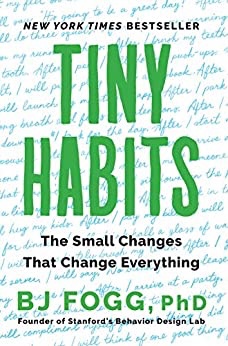
  • ‘Tiny Habits: The Small Changes That Change Everything’ by B.J. Fogg

    My rating: 4 of 5 stars


    When you feel that something important about your approach to your current life isn’t working, you should adopt a new way of sailing your ship at life’s sea. Hence, following my read of Aristotle’s Way by Edith Hall, I continued pursuing the answer in Tiny Habits by BJ Fogg, a self-help book based on Aristotle’s dictum that virtue is a habit in 21st-century parlance.

    Fogg’s approach to habit-forming practice is categorized into small steps that require no intellectual, or philosophical commitments, as in the case of new year’s resolutions. He refers to motivations and willpower as “fair-weathered” friends who hooray and holler at our resolutions to change at first but disappear into the lost memories of the first initiation when our souls plunge at the lowest later. Instead, we must befriend “Aspirations” and “Outcomes” as faithful friends who will help us build a Behavior Design that best matches our disposition and lifestyle by which we can realize our affirmation as the functionary of noble ideas. For example, if you want to save $500 as an emergency fund, you can start by curtailing your Starbucks visits or bringing your lunchbox to work, rather than saving a lump sum of money from your paychecks; as the saying, “Drop by door fills the tub.” Fogg refers to such small practice as the principle of “Golden Behavior,” which you can do when you feel like calling it a day, even on your most challenging day.

    Notwithstanding the noble intentions and the greatness of simplicity in Fogg’s guide to habit-forming, some carbuncles I find incongruent in his examples of his successful people who are comparatively well-off business owners or professionals. Of course, that is not to avert his excellent idea that the simple is the best. Still, I hoped to find examples of everyday working-class people struggling to make their lives better who have fewer resources, such as seeking help from a person like Fogg, a Behavior Scientist at Stanford University. Maybe I could inadvertently judge his study results only with limited information based on my reading. Still, I only wish that he would include a broad social spectrum of subjects in the advantage of Golden Behavior. But then I could be a captious reader feeling left out of the selected successful achievers.

    In all fairness, the book is worth reading if you are especially keen on Aristotle’s way of happiness, which I regard as personable and approachable, compared to Plato’s metaphysical way of interpreting how to live a perfect life. But let’s forget about the ancient Greek school of philosophy. Still, Tiny Habits do matter.


    View all my reviews

  • Purloined

    Those thousands of wishes
    Those thousands of dreams
    All vanished into the ether
    Like a fleeting mirage
    Of shining waters yonder
    When the fates saw them
    Not hers and let demons

    snatch them again ever

    Until she left this life
    And returned to another.

  • Candid

    “All’s for the best
    In the best of all
    Possible worlds,”
    Says Pangloss,
    A man who uses
    His reading against
    The Human heart
    As Candide sees it
    Drowning in the sea
    And his egalitarian
    heart has no place
    In the best of all
    Possible worlds.

  • Country

    Where I am from
    No one cares,
    But who cares
    When a country
    Whose borne
    We’re all wayfarers
    To the terra incognita
    Where journeys end
    By the Five Rivers.