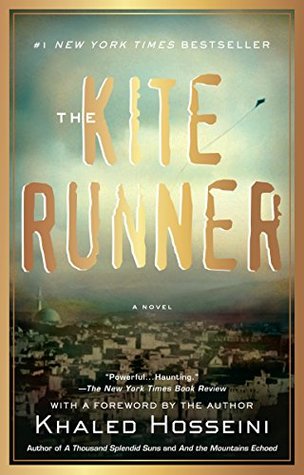
The Kite Runner by Khaled Hosseini
My rating: 5 of 5 stars
Writing is the most solipsistic and democratic means to make people discover your secret histories or inner world so that they can understand why you are what you are. That is what Khaled Hosseini does enchantingly in The Kite Runner. It is a bildungsroman story reminiscent of the Au revoir, Les Enfantes-Esque ambiance surrounding the narrative of a grown-up boy who wants to reconcile with the stupendousness of mistaken guilt becoming a malady of the heart. But that doesn’t mean it is all too surreal or stark grim to make an accidental reader think it is a wrong choice. On the contrary, Hosseini vividly conjures up the faces and scenes, resurrecting the spirits of the places and times, by putting together the tesserae of his memories in this rivetingly heartrending read.
The book incorporates the sociological theory of symbolic interactionist perspective focused on the relationships among individuals within a society and how political changes affect the lives of individuals and the sense of who we are and our relationships to others. The story’s narrator, a young Afghan boy of the upper-class named Amir Agha, gives the reader a ride to his childhood in Kabul to show the halcyon days of pre-soviet and Taliban reigned Afghanistan. First, you will see him and his best friend Hassan, a Hazara servant boy in his house, wallowing in reading stories and lost in kite flying. Then and thereafter, Hassan becomes a victim of the most horrific act committed by the half-German blue-eyed Afghan boy threatening him to win kite. Amir’s retrospective narrative becomes his public confession and ablation, all of which is a combined act of purging out the painful memories of the past and exorcising his demons tormenting him with the guilt of jealousy, ignorance, and cowardice. The whole narrative then becomes a plethora of pathos and empathy, resulting in a cornucopia of forgiveness and sympathy, drifting it all in a high-flying kite once and for all.
It is a fitting story in this particular time of Afghanistan history and Abdulrazak Gurnah’s winning of 2021 Nobel Prize in Literature for his achievement of universalizing human travails transcendent of racial, cultural, and geographical differences. Vivacious at times but dolorous at most, the Kite Runner is synthetic literature that wears habiliments of memoir and novel. There truth and fiction dissolve into one another anchored in real life with factual geographical and historical facts smoothly amalgamated in the individual narrative account, which reminds me of Herodotus’s “Histories.” Or it is an alluringly pioneering memoir-making that resembles Realistic Fiction. For whatever it is, the Kite Runner bestrides the aisles of contemporary literature sections, alluring the public with simple language that magically juxtaposed in beautiful prose style with lyrical quality, all soul and mind in the marks upon pages evocative of the spirits of the memories materializing.
View all my reviews
Tag: thoughts
-
‘The Kite Runner’ by Khaled Hosseini – book review
-
dum spiro spero
Light and dark, full and empty – how mysterious!
Spring of Words is now elusive – how tantalizing!
To the secret seeker with no pity – how heartless!
And no more spirit so festive. – how agonizing!Midnight and moonlight and shining stars – so beautiful!
Angles and fairies and ghosts – so ethereal!
Come to my aide before I lose sight of it! – Yes, quickly!
And possess me with the best of your powers – by all means!Is Tree of Knowledge going to become sere? – How unthinkable!
Has Tree of Knowledge already become sere? – How miserable!
Let nothing dishearten my spirit still pursuing, still trying
With hope, while I breathe, even if it seems impossible. How beautiful! -
Beam Me Up, Scotty: Admiral Kirk’s onboard
The skies were clear blue, and the wind mild and agreeable. The day was ripe for the moment the star returned to the galactic heavens in rejuvenated buoyancy of jubilee that he would be out to the extraterrestrial world again. “Beam me up, Scotty,” the man said as he boarded on New Shepherd, treating it like his beloved ship USS Enterprise. It was art imitating life in the former captain’s bright eyes; it was life imitating art in the old star’s beady eyes. For William Shatner, aka Admiral Kirk of Star Trek, it was a one-of-a-kind experience, equivalent to an out-of-body experience in which you fly from your corporeal vessel and wander in all whither, floating weightless, groundless. It was his very Real McCoy galactic trip to outer space.
On Wednesday, October 13th, Blue X, Amazon founder Jeff Bezos-owned spacecraft enterprise, took off from its launching site about 20 miles away from Rural Texas town of Van Horn with civilian passengers who paid astronomical sums for their space trip. But not Shatner, who spent nothing at the courtesy of Amazon founder Jeff Bezos said to be a long-time Trekkie and something of a billionaire with a flair for space cowboy. The motive for a publicity stunt to outshine Blue X over entrepreneur rivals, Elon Musk’s Space-A and Richard Branson’s Virgin Galactic Holdings Inc., is impossible to ignore, yet why not when it also produces positive effects of provoking the imaginary in the real? Shatner, at age 90, seemed no longer the dashing brilliant, just young Admiral Kirk any longer. Still, his spirit beamed up as he experienced overview effect outside the orbit, profoundly mesmerized with the deep fragility of Planet Earth, the Galaxy Blue. Shatner articulated the face of the Earth as so ethereal and impossibly gorgeous vis-à-vis the blackness of outer space that he had a eureka moment of what distinguished Light (Life-Earth) from Darkness (Death-Outer Space). Methinks that such pareidolia of the overview effect has something to do with his nonagenarian age, the last age in Seven Stages of Man, one foot closer in the grave. However, when I watched him in the news, overwhelmed by the ineffable emotions, Jeff Bezos removed his shades and embraced the old actor; all looked genuine, not an act staged for a post-trip publicity event. And even if it so, then it is a likable sort of entertainment that does viewers of all kinds good.
Criticisms on the expensive space trip only the haves can afford are worldwide and understandable amid the unequal distribution of wealth makes earthlings live and die or live and suffer. Yet the veteran movie star reminds me of an old soldier who has lived through the vagaries of life. Overall, the 90-year-old Shatner’s space trip materializes the earthling voyage of the USS Enterprise, boldly searching for new life and new civilizations into the galaxies.
Captain Kirk coming home
Floating under a parachute
Touching down on Mother Earth
in a soft haze of excellent dust,
Calling it home, Roger out.Welcome back to Earth, Admiral Kirk.
-
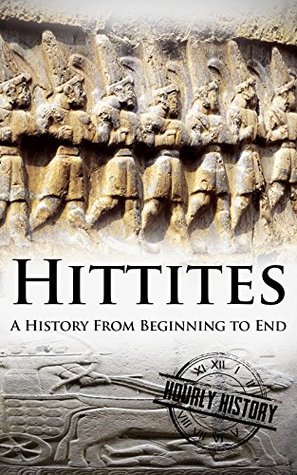
‘Hittites: A History From Beginning to End’ by Hourly History – book review
Hittites: A History From Beginning to End by Hourly History
My rating: 5 of 5 stars
The name Uriah always fascinated me from British Rock band Uriah Heep to the biblical Uriah, whose beautiful wife led him ultimately to death, willy-nilly, by King David infatuated with her sensuousness. When I learned that the ancestor of Uriahs was the founder of the Hittites race, being the great-grandson of Noah, the biblical patriarch, I had a Eureka moment. Consequently, I picked up this concise but comprehensive book on the Hittites to know a little more about the people whose founder had the great name.
Before the splendor of ancient Greek contributions to our human cultural progress as a collective enterprise, there was the forgotten but enduring legacy of the Hittites, the mysterious Indo-European trailblazers of civilizations at the crossroads of the East and the West in the vast plain of modern-day Turkey. The Hittites were an integral people to solve the mystery of mythological and biblical events anchored in the real world, thus dissolving fact and legend into one another like a genie from an empire that vanished into the dunes of time and comes alive in the calling. The calling of these mysteriously vanished people came first from British Reverends Archibald Henry Sayce and William Wright in the early 19th century. They discovered the artifacts and sites of the Hittites. Their discovery led to more remarkable discoveries. During the middle Bronze age and Iron age, the Hittites were the first to utilize iron from the region of present Armenia to craft tools and weapons. Also, the Hittites were deft at commerce, developing the city of Carchemish as an ancient mercantile hubbub in which they imported products from Phoenicia and exported them to Assyria (the North) and Babylon (the South) in Mesopotamia. In this fabulous ancient city, Israelites of the Old Testament acted as intermediaries in trade between Egyptians for exporting horses and chariots and the Hittites for importing them.
Like all those famous entertainers who sparkled then lost the lusters, the Hittites as a collective empire fell from splendor gradually by outside forces: some pointed the fingers at the Sea People, while the others blamed a certain barbarous Kaska people. But, perhaps, such clandestine ending of the Hittites is what makes them formidably alluring and mysteriously fascinating, blurring the boundary of fact and legend. Suppose you are keen on the history of ancient civilizations other than Greece and Egypt. In that case, this elegant primer for the history of the Hittites will equip you with fundamental knowledge enough to whet your craving for more and more profound knowledge about the Hittites.
View all my reviews -
the door of perceptions

My cat sits in front of the door
Like an ancient statue of Basset
And looks at me with desire
To break the spell of the moment.In the high night
When the only light
is iridescent emerald beams
from his large green eyes,I open the door
He believes to be
The door of perceptions
When there is only darkness.But he roams in eager eyes
With a lamp of his cat’s eyes
Searching for the wonder
With neverending hopes.Alas, my elderly mother stops
His hopeful night’s adventure!
Still yearning, ever curious
My cat tries it always tomorrows!


You must be logged in to post a comment.