 Judy always feels kept away from anything miraculously fortunate or even moderately pleasant ever happening to her. Neither gorgeous nor homely, Judy seeks approval of love and care to which she seems to be barred. This is her whimsical journey of a quest for her niche through the awesome events that she never expects to visit her. This is a short tale about Judy’s adventure in her wildest dream that turns her inside out and helps her to look at the world instead of looking askance at the world to look at her and approve her. It’s a kind of whimsical story mixed with adventure, western, and fantasy that I hope to be a fall-away from the dull flat platform of life. My first book ever published on Kindle is now available on Amazon for free. I hope you will like it. Thanks for reading. 🙂
Tag: Writing
-
‘The Wildest Dream’, by Me – review
-
Wandering cloud
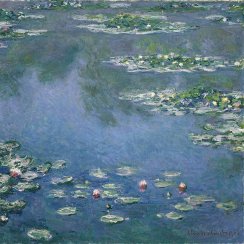
Water Lilies by Claude Monet Like a wandering lonely cloud
Skybound, Softbound, Spellbound,
I walked down to the lonely street
In the silver shimmering daylight,
Lingering in the horizon beyond
Reflecting on the shining pond.
P.S. I took a walk at the park this beautiful afternoon and saw a pretty pond therein. It was sparkling with the reflection of sunlight, which made me wonder if this had been what Anne of Green Gables might have seen on the way to the Green Gables with Matthew from the train station and named it “Lake of Shimmering Waters”.
-
‘West from Home: Letters of Laura Ingalls Wilder’, by Laura Ingalls Wilder – review
 West from Home: Letters of Laura Ingalls Wilder, San Francisco, 1915 by Laura Ingalls Wilder
My rating: 5 of 5 stars
Looks can be deceiving, for sure. It can yield an ill-judged misapprehension of the true person and therefore, form a certain prejudice about the person. A person’s appearance is a false shadow for the substance, but our faculty of mind based on a sensory perception with the works of imagination often falls into fallacy. That said, this charming little book comprised of lovely missives to her beloved husband Almanzo back home in Mansfield, Missouri comes surprisingly pleasant twist of the image of Laura Ingalls Wilder, the creator of Little House on the Prairie, whom I always considered to be stoic and imperturbable, a kind of austere and puritanical mid-west matriarch, who turns out to be one sweetheart with the untainted sensibility of feminity.
In these letters written to her batter half she called ‘Manly Dear’ during her travel to San Francisco and her stay there too in 1915 following an invitation from her only child Rose, you will read the words of her heart and soul enveloped in tenderness, colored in vivaciousness, and sealed with love, all the marks upon pages in the felicity of vivid descriptions wonderfully mixed with the perspicacity of reflective introspection, so jolly that reading them makes you feel like reading love letters from a smitten maiden to her smashing beau.
It’s one of the reads that require no practical analysis of the psyche of the author or of the social, political climates to make revisionist commentaries. It’s a pure mental delight of peeping into the inner world of the author that puts a smile on your face. Also, it’s a great read to while away your time at one sitting. On a personal note, if you have read Prairie Fires: The American Dreams of Laura Ingalls Wilder by Caroline Fraser, the magisterial biography of Ingalls, this book is a lovely accompaniment to feel this great American writer of all generations closer to you as none other than her true person, talking about her journey to you as a great story-teller.
-
To readers
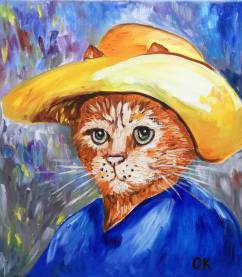
Cat in a hat La Vincent Van Gogh by Olga Koval Normally, I don’t post a crude litany of woes or untamed outcry of malaise because that’s not what I want my blog to be filled with. However, today is an exception to the rule because for the last couple of days the receptions to which my published posts have been particularly detrimental to my disposition and averse to my sensitivity. Well, I don’t think it really matters to any of you out there who happens to stumble into my hermit blog, but then I don’t really care what you think about it because it’s my sovereign blog, which is my only safe niche, an elbow room amidst this crazy existential daily life constantly threatening my sanity, bullying my sensitivity, knowing that I am distinct for that “Positive Thinking in Thick Skin” facade.
First of all, I don’t understand how people can follow a blog without liking any of my posts. Are they fishing in for their potential followers? I have noticed so many of them out there without liking any of my posts and following my blog, which I find it very insulting and odd. I am not here to foster an online relationship with anyone out there but to practice my writing skills as well as to use it as my creative, intellectual outlets yearning to surface from within because I can’t just will out what I feel and think without letting it out. Besides, I don’t want my existence to disappear into oblivion, which is a great injustice to my sovereign freedom of expression. That said, I don’t want to build up popularity by getting mindless followers either haughtily not bothering to like my writing or stopping to like it for whatever reasons. That breaks my heart to the extent to which it can’t be sawed up or replaced by a steel heart. It’s imbecility to have followers who are unappreciative of what I write.
Secondly, to pour hot lead into my already wide-open gap of the wounded heart and soul, I saw the stats that although people read my last post about 6 movies from the 60s celebration of National Classic Movie Day yesterday and today, only four people voted for likes! Such disastrous comeuppance made me so disappointed and disheartened that I could not but think that writing could also be a Modus Operandi of detecting all about yourself from the way you looked to where you were from. This betrayed my primal idea about being capable of metamorphosis and travel to become all that I want to be, to do, and to go under the protection of faceless stealth. Faceless because your face could be a hindrance to expressing your self in a true glass of the mind. In order to ascertain the cause of such an outrageously heartbreaking result of the last post, I have read my post over and over again, but there appears to be no sophomorically pesky solecism whatsoever. Further to the attempts, I visited the blogs of others about the same subject, but none of them is hard to regard it as a magnum opus! Do they think my post is inaptly conceived and professionally benighted or just plain average? And they even had comments from their members of the coterie eulogizing how great their picks were! Seeing all of this in my very eyes, I could not help agreeing with Edgar Allan Poe criticizing a clique formed among the New York Literati that excluded any writer outside the league of their own. I don’t think any of them appreciates my writing, and it makes me feel like such a fool that from now onwards, I vow that I will NOT volunteer to do any contributory writing unless I am asked to.
Thus I have reorganized a list of followers because I think it necessary for me to do so for the love of my broken heart and wounded soul. I see writings of others, which are not tours de force but filled with a rhapsody of why their inane posts are great. Jealousy? What hokum! It’s such amusement to see even writings can become a tool for attracting strangers as a social get-together platform. Here I am, a hobbyist amateur writer working 9 to 6 to pay bills and rents but whose literary ambition is as great as Ben Jonson and Charlotte Bronte. Charlotte Bronte had been rejected to have her work published many times and was of the same disposition as I am. (Yes, I am closer to her in temperament and sensitivity than any of you out there who likes to think you are or wants to think you are when you are not!). She and I are in agreement in thinking that any appreciation from a considerate and intelligent reader for our writings is highly appropriate and proper as decorum to the author. You know what I mean?
-
celebration of National Classic Movie Day

courtesy of Classic Film & TV Cafe FOREWARD: In celebration of today’s National Classic Movie Day, this post is written as my contribution to 6 from the ’60s Blogathon for National Classic Movie Day’ as hosted by Classic Film and TV Cafe. Thank you, Rick, for this awesome invitation 🙂
Ah, the 60s. Doesn’t it chime the bells of your cultural acknowledgment that resurrect all the images related to this provocative era? Whether or not you were a child of the ethos, it was the age of new wave, it was the age of revolution, it was the epoch of change, it was the epoch of experimentation. The zeitgeist of the 1960s called for a new mode of thinking. Through the seditious waves of societal changes, the thematics of films needed swiftly to adapt to the changing circumstances. That’s why I regard the 60s as a renaissance of the film, which I dare say elevated its status to that of the classical theaters in terms of quality of the thematics that attempted to portray the complexities of human nature amid the changing social norms and values at variance. That said, here are my best films of the 60s.
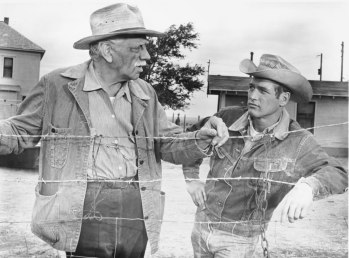
“The Hud” (1963) – Although dubbed as a western, this film betrays its habiliment by representing the eclipsed glory days of cowboy machismo that seems incongruent and anachronistic amid the rapidly changing social circumstances. The characters struggle, tenaciously gasping on their cattle and Modus Operandi, but the results are all over but the shouting. I think it is also Paul Newman’s best performance that shines through the film as a fictitious embodiment of the collapsed grand narrative of American machoism.
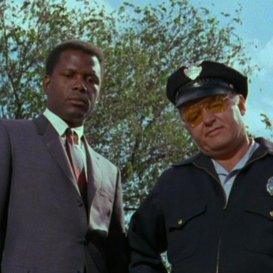
“In the Heat of the Night” (1967) – Attempts to portray social injustice are most cleverly and artistically translated in this excellent film about policemen of members on the opposite social continuum. Rather than antagonizing the characters, the film connects them with a mutual goal of finding truth and justice in their own ways that are seemingly diametric yet ironically similar in their steadfastness in upholding the most common human nature: pride, ambition, and compassion.

“To Sir with Love” (1967) – Based on a true story, this British drama is packed full of visual and audio delicacy. This film doesn’t, however, turn out to be a grand grave social activist movie about racial tensity. It shows how a dedicated teacher with mind and heart can lead his recalcitrant but misunderstood students to responsible adulthood without sanctimonious pedagogy or reign of terror. It reflects Plato’s cardinal virtues of Prudence, Justice, Temperance, and Fortitude embedded in the way the brilliant teacher treats his students despite their outward rebelliousness and general distrust in adult figures. The selfsame song by Lulu gives the atmosphere of the film all the more alluring and unforgettable.

“A Man and a Woman” (1966) – This French film that won a Grand-Prix in the Cannes Film Festival is an art itself, with beautifully ambient cinematography, doubled by the hypnotic leitmotif of a main musical theme that invokes the idea of ideal love that is never vociferously effervescent but quietly enduring, a perfect admixture of eros and psyche. The love between a man and woman can be this beautiful, and even smoking looks so artistically suitable to the theme of the film, making it all the more riveting.
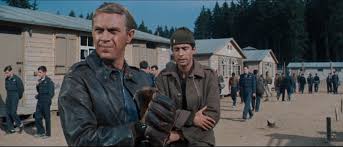
“The Great Escape” (1963) – What I like about this film is not the luxuriant cast of top-class Hollywood actors but the underlying theme of fortitude, courage, and patience, wrapped in a package of humor even in the times of trial. Although this is regarded as a war movie, no undertones of the campaign against the enemy or propaganda promoting wartime vitriol are underlined here as the dichotomy between the captors and the captives is often blurred by their day-to-day personal interactions within the ambit of conscience and humanity. That said, even the Nazi prison authority headed by stern but fair and conscientious officers is hard to invoke animosity or contempt. It’s more of personal ambition of achieving success in what the characters are driven to do – whether it’s escaping the prison or preventing it – This film is not about who escaped but who survived.
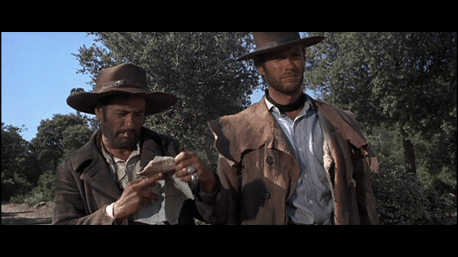
“The Good, the Bad, the Ugly” (1966) – Who says that you have to be born into the culture if you want to talk about it? Often dubbed as a Macaroni Western, this is the most iconic western film made by a brilliant Italian director whose fascination with the Old West and artistic ingeniousness made him capable of crisscrossing time and territory as if he had been born in the 19th Century American west. Besides, unlike many American-made westerns, this film does not have black-and-white ethical characters, either extremely evil or angelically good in nature, nor does it propitiate moral values or didactic lessons. It also employs the music by Ennio Morricone as an effective vehicle for creating the mood of the film without superlative narratives or gratuitous action scenes. It’s all about the naked human nature surfacing when temptation beckons with irresistible allure. What’s more, the film was entirely shot in Spain that looked so much like California.
In sum, the aforesaid films are innovative in incorporating visual presentations of stories with ambient music to translate the world of make-believe reality onto the screen in the most natural way. They are also bodacious in choosing the thematics that reveal the changed look on society in general, rendering the verisimilitude to the stories in order that the audience can feel relatable and sympathetic. For these reasons, my selection of the six films, I think, stand the test of time and merit their own places in the classic canon of masterpiece theater of motion pictures.
-
famous, ambitious

The incitement is fame to an honest mind, says Ben,
The spur the clear spirit raises is fame, says John,
I say the sap the adventurous keeps is fame anon.
P.S.: While reading Ian Donaldson’s Ben Jonson: A Life, I came across the chapter regarding the eminent English playwright/poet Ben Jonson expressing his sentiment toward the premature death of young Prince Henry Frederick, son of King James I of England, whose earthly princely fame was soon writ in water. He said: “Fame is the incitement to honest minds,” which was later adapted by John Milton, author of Paradise Lost thus: “Fame is the spur that the clear spirit raises. The desire for fame is the last infirmity of noble minds.” So I, who is an amateur hobbyist writer/indie-blogger, reworked the wise old sayings of fame by these reverential titans of English Literature. I don’t think fame is necessarily evil, corrupting the heart of a soul. If used wisely, it works as a stimulant to strive for the fulfillment of your goals and dreams, so long as the ambition doesn’t grow into Rabelaisian proportion.


You must be logged in to post a comment.