“I’ll teach you differences,” said King Lear as his motto of philosophical investigations in Shakespeare’s eponymous play. I imagine the ghost of King Lear would utter it again when he deigned to come to our realities of universities in this time. The importance of responsible education to remove the social ills and carbuncles resulting from dissentious political domination has never been more conspicuously called for in our high learning institutions as a recent consequence of the George Floyd incident, and the following the Black Lives Matter movement. However, this doesn’t mean that universities should be a breeding ground for training gladiators equipped with political syllabuses and dogmatic agendas to fight against the public foes. Instead, education should disabuse the ignorance of the unenlightened for our society’s universal betterment.
Professor Benjamin Y. Fong, in his NY Times article “Teaching Racial Justice isn’t Racial Justice,” addressed the issue of education as the fighting tool. It has become fashionable that most American universities have competingly added courses on social injustice to the Black Lives Matter movement. However, the idea of education is to provide students opportunities to learn and actively engage with conflicting thoughts and various real-life issues in a place enriched with knowledge linked with the fellow members of the human race from antiquity. In this environment, a university is a place for education that can improve social conditions in the fight against social, political carbuncles, not for the battle itself, training students for social gladiators.
Many universities are focused on the quantitative quota of educational syllabuses aimed for the universities’ reputations as the most liberal and forward-thinking higher-learning institutions for the socially recognized prestige, not the qualitative aspect of the education of the minds. It is not the textual syllabuses filled with political ideologies and social campaigns. Still, the practical teaching of various conservative and progressive considerations enables students to incorporate the learning to their perspectives. Education serves to articulate ideas based on the standard of reason and taste universal in all human creatures regarding the principles of judgment and sentiment common to all humankind.
Suppose we want our higher learning institutions to remedy the existing ills of our social and political realities by implementing more social justice courses. In that case, we must first understand the fact that education itself is not the fight itself. Neither Plato’s academy nor Aristotle’s lyceum was a place for the battle against the absurdities of Man. Or even the beloved, peripatetic Socrates did not use his open universities in Athens as a place for campaigning against the government hostile to his philosophy. Remember that there is no new thing under the sun as long as we as the collective enterprise called Humanity continue to voyage in the Universe.
Category: Miscellany
Anything that’s on my mind.
-
Samuel Johnson Rambles on the practicality of knowledge – essay
Ignorance is the timorous and indolent plight from fear because knowledge is considered to be remotely extensive and inscrutable to be comprehended. It retards the progress of the mind and numbs the sense. Samuel Johnson avers in his weekly essay ‘The Rambler, No. 137’ avers that one remains unenlightened unless he is diligent to search for the origin of wonder with a pause of reason, a sudden cessation of mental progress when confronting the unknown to him. The need for general knowledge, the knowledge that confers Citizenship of the World, is an essential element of human characteristics, and an easy task to fulfill in search of meaning in life.
Johnson’s idea of knowledge is simplicity. It is jettisoned from a concatenation of needless abstrusely sophisticated theories and ideologies. It also chimes the bell with the Renaissance virtuoso Leonard da Vinci’s adage that simplicity is the ultimate sophistication in all principles. However intimidating or formidable the unknown is, the essential feature is simple to understand by way of ‘Divide and Conquer,” a principle that complication is a confederacy of the abstruse that can be broken into parts marked by the gradations from the first agent to the last consequence. The force that breaks the shackle of fear for conquering the unknown huddle is patient diligence armored in confidence. The labor of inquiry for wonder follows natural curiosity and confidence that eclipses the soul’s darkness. It comes to fruition by ceaseless efforts to ascertain the origin of the wonder in simple ways. The English philosopher who also advocated democratic pedagogy, John Locke, affirms that the surest way of thorough comprehension knowledge is to attempt little by way of repetition. For the widest excursions of the mind result from short flights of mental imagery and instant thoughts triggered by neurons fired in our cerebral cortex, which can be transformed into an organization of ideas firmly engraved in the mind.
However, knowledge loses its purpose if it dissipates into the possessor’s cerebral ether or is locked in the mind’s cabinet. It becomes useful and purposeful when put into practice. That is why Johnson gives heed to those who pride themselves in the impressive educational backgrounds and belittle others whose mental capacities they arbitrarily judge ignorable or even ordinary. Knowledge is for share, and it is a duty of a scholar who has a wider variety of knowledge through years of academic endeavors for the common benefits of the world he lives in. As Francis Bacon fittingly concurs, books can never teach the use of books. Generally speaking, it is common for intellectuals, despite their ostensible calls for democracy and justice for all, to live out of touch with the practical realities of life and often regard such matters as trifles. But what is worthy of their glorious learning if it does not accommodate the purpose of life? Johnson criticizes such lofty arrogance of the rarified subset of the general population because they lose their days in unsocial silence and live in the crowd of life without a touch of humanity. It also reminds me of Bacon’s utterance of loneliness in a group as such: “Magna Civitas, Magna solitudo.” In this regard, George Orwell is together with Johnson because they saw the educated’s superciliousness, the intellectuals, who often conferred their knowledge to their honor in the voluntary seclusion.
Upon reading Johnson’s essay, I could not help but wholeheartedly agree with the purpose of knowledge and the idea of sharing it with others for the world’s common good. I was also glad to learn that I was not the only one who thought that people with academic credentials were frequently dismissive of the opinions of what they regarded as the mortals of the ordinary among whom I am. Therefore, I hope that the reader who reads this essay of mine should not belittle the soul attempting to obtain the sunshine of the light of letters to understand the world in a perspicuous way to declare to the world that I also can think and express it cogently. That is my essay on knowledge for the purpose of life. -
New Possum’s Book of the Curious Cat
There’s once a cat name Romp Pomp Bunter, aka the Curious Cat,
who liked to romp with pomp and bunt his head against
his guardian, the woman with the beautiful but lonely heart.
She named him in rapt contemplation of the thought, of the thought
of his name; his ineffable, effable name, debonair and extraordinary.The Romp Pomp Bunter has a secret that no one knows it:
The Romp Pomp Bunter once saw a grand statue of Bastet
In a book on the history of cats originating in ancient Egypt
And was so impressed with the splendid grace of the goddess
That he wanted to emulate the mysteriously beguiling poise
Even if he was a Californian moggie tomcat of Los Angeles.But the Romp Pomp Bunter, ever the Curious and Adventurous,
An orphan kitten whose parents nobody knew or cared even,
Felt that he was originally from the Ancient World with a reason
That he looked nothing like the ordinary domestic short-haired,
The insignificant, the common, the trite, the obsequiously tamed
Breed of Cats that contrasted the Egyptian Mau, the First of Firsts
Endeared to Pharaohs, Queens, Priests, Soldiers, Farmers, and Artists.So, the Romp Pomp Bunter believed that he was the Royal Descendant,
The indolently elegant, adoringly capricious, the inscrutably alluring
Egyptian Mau, the paragon of the goddess Bastet, divinely beguiling.
You see, that is why his name is the Romp Pomp Bunter, the Curious Cat. -
A perfect cat owner?: confession of a novice
I remember watching the cat guru Jackson Galaxy’s post on YouTube about a prison where a group of inmates is assigned each cat for mental and a behavioral correctional program. The inmates seemed calm and content just as their foster feline friends reflected and talked of the amazing effects on their hearts hardened by the world never kind to them. The images of a condemned man in a cell and a homeless cat from a shelter became a beautiful impressionist painting with an air of serenity wrapped up in the soft sweet twilight colored by the warm hues of pleasantness that filled the canvass and stayed in the heart of the beholder – forever. The loneliness cut in halves transformed into togetherness, and there was nothing else but the mutual need for love and care.
With the picturesque imagery engraved in my heart’s shrine, I cannot help but question the generic prerequisites for being an ideal cat owner indoctrinated by those professing to know things about pets. The doctrines of a perfect cat owner are as follows: you have to live in a space wide enough for her to exercise her natural hunting instinct, to have another cat to prevent anxiety, aggression, and loneliness, and most of all, to be a near-perfect human full of love and understanding blessed with material means to satisfy the need of a cat to the extent possible. The protocols remind me of eugenics elements by which only the best males and females can produce offspring desirable for humankind. Only the superhuman race can fall in love, beget children, and raise them to be perfect in physical and mental attributes to continue the Superhumanity. On the same token, being an ideal cat owner is to be an ideal person who deserves love from nature because of his ideally perfect being—quite the Nietzschean idea of Superhumanity.
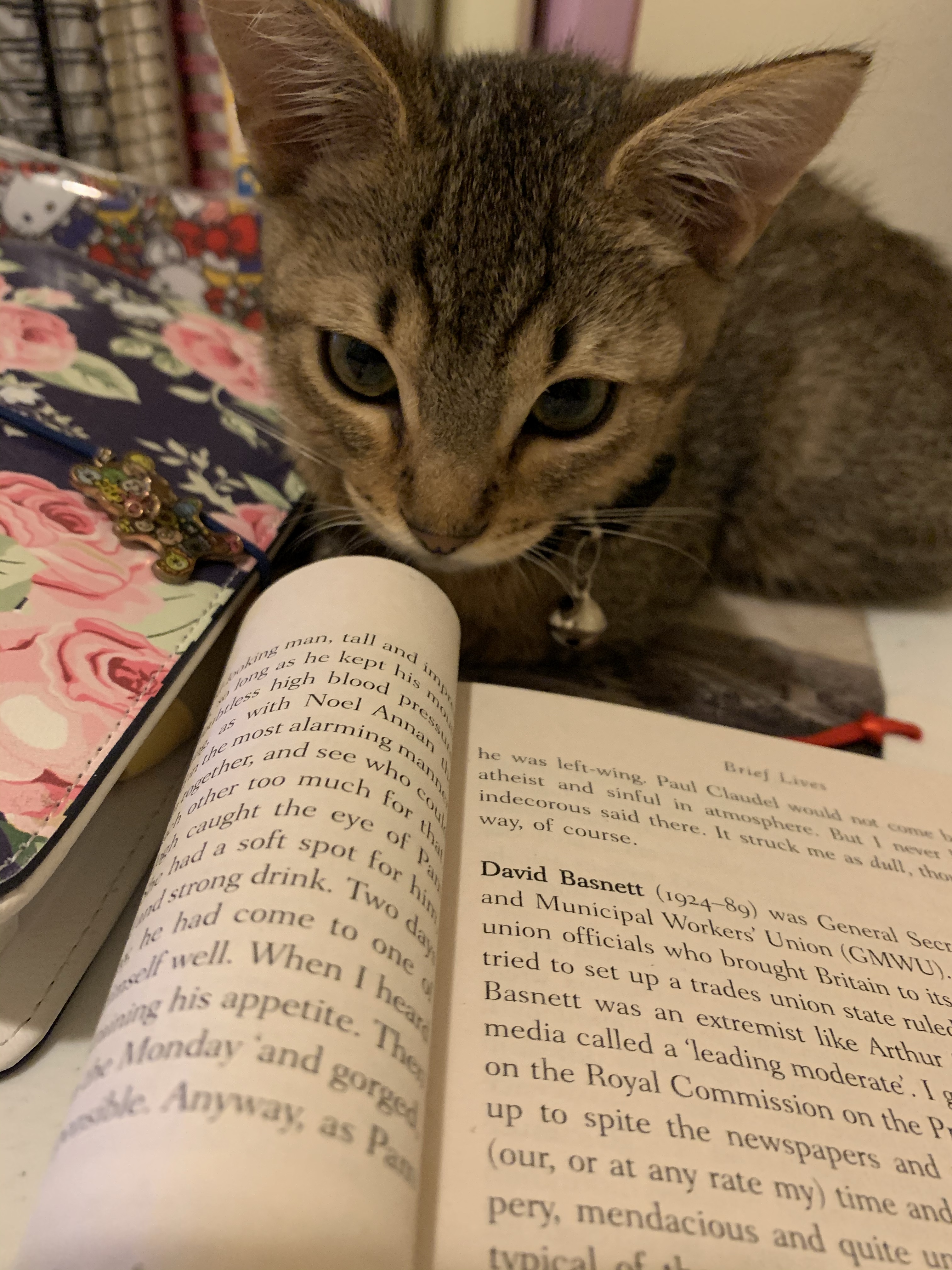
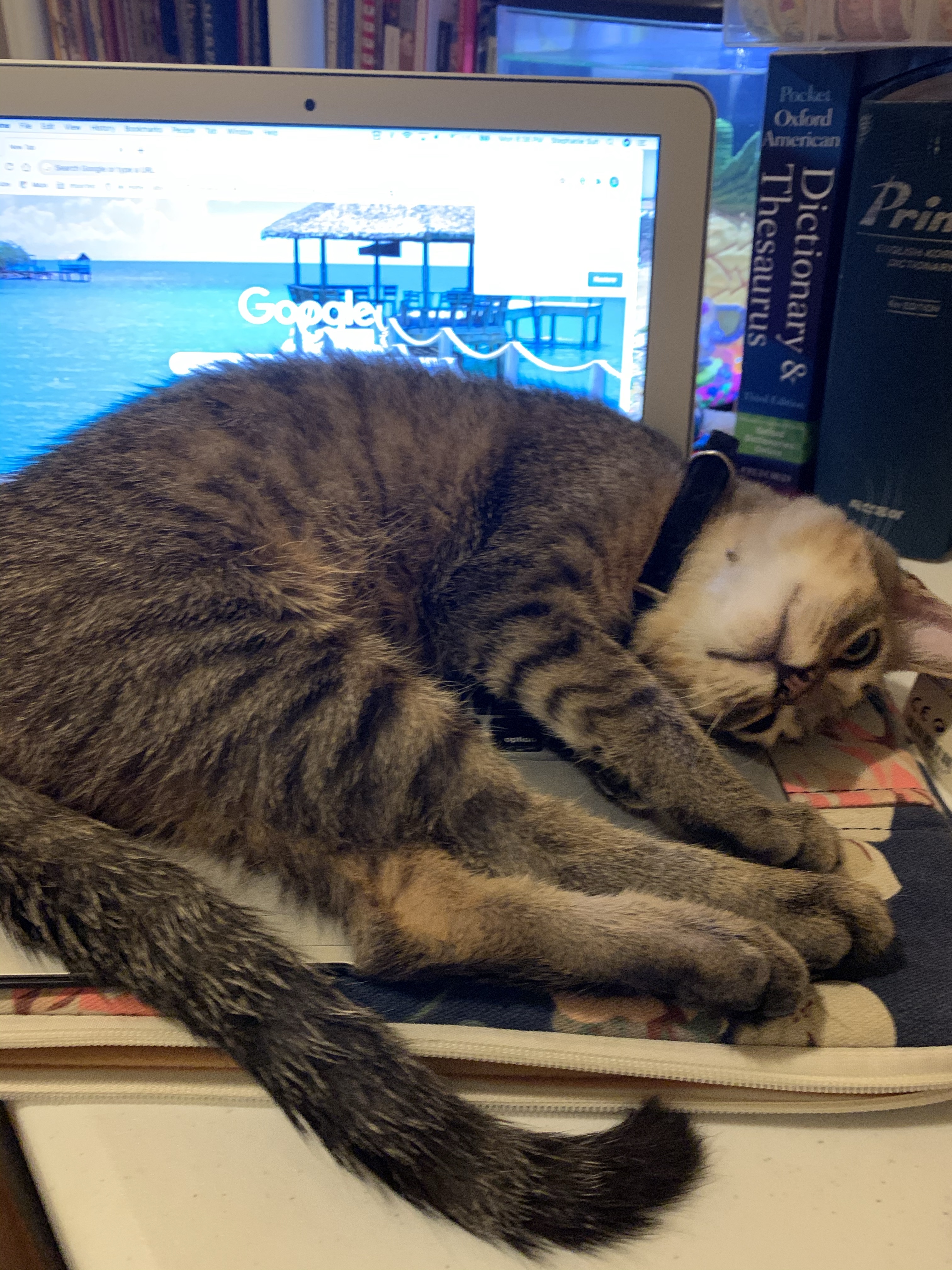
An ideal cat owner’s doctrines align against the condemned man’s images and the homeless cat in a cell. Then I also look at my 4-month old tabby cat Toro, whom I adopted from a shelter three months ago. Is he unhappy with me in this tiny apartment room? Is it because of boredom and separation anxiety doubled with a significant change of environment from pastoral life to city life that has driven him to a sudden pulsing and biting my hands and feet? Does he hate me because I leave him at home all day long with a mother who hates him when I go to work? Does he want to leave me and be adopted to a loving, perfect new owner because of my imperfection? Am I less qualified than the inmate to have a cat altogether? The thoughts smothered under the ineffective veil of forced positivism have reached the point where they can no more bear the suffocation and begun to erupt the lavas in the fiery magnitude.
As a first-time pet owner, I like to think that it is not a coincidence but Providence that Toro has come to my life because he was the only kitten who came to me and my brother bunting his little flurry head against our hands through the cold metals of the cage in the shelter. Toro and I are much alike in many aspects: leisured time in seclusion, uncompromising individuality, insatiable curiosity, innate sensitivity, and unfailing feistiness. We also instinctively know each other’s mood because when I am dejected, Toro studies my facial movements and comes nearer to me with those adorable eyes filled with liquid warmth. Then I look at the cute little Toro before me and think that genuine love and care transcends the high walls of a grim prison and eclipses the roof of a perfect happy house. There is a home sweet home for me and Toro in my tiny apartment. -
Paid forward by a Stranger
The French existentialist Jean-Paul Satre was a cynic when it came to the milk of human kindness. He smirked by saying that generosity was more or less a feelgood giveaway of the doer in the self-contentment of magnanimity. The intention is ego-driven, not altruistic. Satre may be a brilliant intellectual in the post-modernistic world, but he was essentially missing something, obviously not knowing it for the following reasons.
I still remember a lecture given by a religious sister whose spirituality bloomed in her charity and intelligence about the practice of charity in our daily lives, rather than doing it as a penance after a guilt-ridden confession. For you never know, the one benefitted from your kindness might be an angel in disguise (the mysterious shopper!) or even Christ himself (the Lord of Lords!) So, how will I interpret an act of generosity when a total stranger paid for my sandwich at Subway?
It was a rather gloomy afternoon today because of the disappointment with the general members of humanity that I felt most acutely painful to my glass heart. The things deemed trivial or insignificant matter to me, stay in there until I burn them with candlelight under moonlit tranquility of the mind. Samuel Johnson is right in saying that you cannot will away the unpleasant feelings in full force at once. That is why we object to despotic edicts of stoic austerity to quell the perturbed state of mind. The Sun was high, but the spirit was low, and I could not pretend to be cheerful and optimistic as if there was no word for Unpleasantness in my dictionary.
So when I was in a nearby Subway store during lunchtime, I felt wretched and wished that the time would go fast so that I could go home with the alacrity of departure. But no, the reality bit when a store clerk asked me if I wanted my bread to be toasted. No, I said politely and proceeded to the counter for payment, when the register guy told me that the man before me paid forward my sandwich. Really so? But I didn’t know him. There were two men, seemingly office workers from nearby, coming for some quick bites like me. And I still don’t know which man paid for mine, but what does it matter when both of them are total strangers anyway? Then I checked my reflections on the outside building’s crystal-clear glass windows and saw a woman decently presentable looking in thin figure clothed in a DKNY tweed jacket and Michael Kors jeans, which disqualified me for being a hobo woman. So why did he pay forward for my Tuna sandwich?
Whether he was a confessional penitent doing penance or an angelic agent is still a mystery, but then something is better to remain as it is, I think. The unexpected surprise from the stranger put my emotions on the continuum of low arousal on one hand and high pleasantness, on the other hand, creating satisfaction that my life could be likable and ultimately livable. It’s a small pleasure that keeps my sailing endurable and doable in a wide ocean alone against monsters, thunder and lightning, and doldrums. No wonder the sandwich tasted sweet. -
Samuel Johnson Rambles on Dictatorship over Feelings

VFS109729 Dr. Johnson (1709-84) at Cave’s the Publisher, 1854 (oil on canvas); by Wallis, Henry (1830-1916); 49.5×59.7 cm; Private Collection; English, out of copyright Temperance is not an abnegation of sensuous pleasure that is innate to our human nature. It is one’s willingness and ability to rein in his or her horse of impulsive id under moderation lest the driver of the mind chariot lose the control and fall by the wayside of life’s journey and leave it in the lurch of spiritual anomy. Yet, to obliterate the pleasure of the taste that our sense requires for nourishing the body and soul will only produce counterintuitive consequences, leading to noogenic neurosis, chronic depression, or existential frustration that life is nothing but a vast vacant lot. That is what Samuel Johnson, one of the great writers of the English language and a trailblazer of the English dictionary, discerned in his brilliantly unbridled and witty essay ‘The Rambler, No. 32, written on Saturday, July 7th, 1750.
Johnson was an intellectual of the best kind: erudite in the scope of knowledge drawn on his wealth of reading, artless in expressing his views on the Pooterish lettered caste that prided themselves on the florid display of arcane words and difficult syntax, and charitable in recognition of the vicissitudes of human life without prejudice. Perhaps, such admirable traits contributed to creating a dictionary of the English language, which required the universal understanding of humanity to comprehend the origins and meanings of a language of any kind. According to Johnson, Stoicism seemed too puffed up with its lofty philosophical principles of restraining feelings that would only beget misapprehension of the old school of thought for denying the most natural human emotions.
Emotions measure changes on a continuum of arousal on the one hand and the pleasantness and unpleasantness on the other. For example, High Arousal and High Unpleasantness produce Fear, whereas High Arousal and High Pleasantness equal to Ecstasy. Low Arousal and High Unpleasantness beget Misery, but Low Arousal and High Pleasantness lead to Satisfaction, which is a positive emotion. It is this physiological state of feeling that Johnson deemed it desirable in the face of existential frustration. One in despair can not eradicate the low tide of an emotional wave but can divert it in a direction that gives a fresh viewpoint on the heart’s malady, thus making life worthwhile to continue with every new try. It is logical reasoning because consciousness predicts the world we live in, a constant revolving hypothesis of reality triggered by neurons in the visual cortex. Since the brain does not have a function to think of itself, it uses a template of emotional scripts based on experience. Thus, instead of willing away unpleasant emotions, one can translate it on a different emotional template, measuring it on the arousal continuum for positive emotional affects.While Stoicism advocates the puritanical governance of the sense and taste for Reason’s eminence, humanity’s natural law revolts against the unnaturally philosophical dictatorship under the disguise of decency and propriety. Stoicism is a school of philosophy that distinguishes the cult from “the sensibilities of unenlightened mortals.” Johnson was right in saying that repressed feelings about pain could only lead to a dormant sense of guilt in a denial of physical reality and later erupt into violent tantrums or perverted forms of debauchery. Pain is part of life, and the way to relieve its severity is by way of finding its riddle with fortitude through doing things that channel the concentration on the pain to something meaningfully pleasant, creating a sense of fulfillment. This concept is also parallel to Viktor E. Frankl’s Logotherapy, a school of psychotherapy about willingness to meaning in life as a result of responding genuinely and humanly to life’s challenges. Both Johnson and Frankl denied no tactile sense of pain, emotional or physical, and prescribed a palliative solution for mitigating a malady of heart.
Johnson’s essay on criticism on Stoicism agrees with my idea of expressing genuine feelings about sadness to effectively communicate to listeners’ hearts in a compassionately empathic way so that pains will be less burdened, griefs shared in halves, and loneliness complemented in companionship. Likewise, I believe that suicidal feelings arise from that utterly helpless loneliness alienated from the world. They are usually concealed by the actor’s self-made barriers, where the emotions are despotically imprisoned. And I believe that Johnson would have agreed with me.


You must be logged in to post a comment.