 Cursed Britain: A History of Witchcraft and Black Magic in Modern Times by Thomas Waters
My rating: 5 of 5 stars
Witchcraft as popular belief system may sound anachronistic, if not extinct, in our age of the Internet, Satellite TVs, and planned colonization of the Moon, in the same way, that people in Renaissance regarded the Medieval times culturally backward and religiously superstitious. Yet, it has survived the leaps of time and waves of persecution, withstanding like a flickering candlelight in hours of stormy dark nights and remains in modern landscapes of buildings, cars, airplanes, and people with mobile phones on their hands.
Thomas Waters in his Cursed Britain: A History of Witchcraft and Black Magic in Modern Times tells us how this ancient belief system of faith-based healing at its lightest and of maleficent bewitching at its darkest has kept its vitality from the rural areas of provinces to the bustling streets of cities in Great Britain throughout the centuries based on his extensive research of historical documents and scholarly analysis on the uncanny but very real phenomena that grips your attention on every page of this fascinating book.
If you are keen on historical facts and anthropological evidence of human nature in relation to the ancient esoteric knowledge that looks so appealing and tempting, this is an excellent book.
 Shakespeare said that fool thinks he is wise, but the wise man knows himself to be a fool. This also means that a wise man knows what and when to speak. In this respect, simulation and dissimulation according to English Philosopher and statesman Francis Bacon is wisdom providing you with a strong heart to discern the opportune time to tell truth and to do it in protect of yourself against derisive remarks and false opinions on you by whom you talk to at work and any other social occasions. In Other Words: you take false shadows for true substance lest you should lose yourself under the misapprehension that revealing all of yourself will develop rapports for socialization.
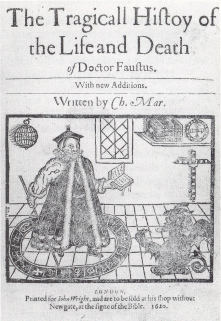 He was a formidable agent provocateur: a blasphemous rebel, a proud atheist, a counterfeit, and a sybaritic seeker of tobacco and boys and an alleged spy for the government with his literary arsenal and daredevil machismo toward life. It was no less a dramatist, playwright than Christopher Marlowe, who introduced the concepts; a man whose life was staged so mysteriously and controversially that even his death was enveloped in a provocative imbroglio of factoids. In a case of life imitating art, Marlowe’s life was an epic tragedy for a literary enfant terrible struggling to mark his name in the Elizabethan England, where his literary genius and individualism were something of irreligious decadence to be reckoned with. Marlowe’s version of Dr. Faustus was his testimony against conventional absurdities of life in defense of his existential meaning of life, and there’s his outcry of existential dilemma spreading through the mind of the reader and connecting to the world of Marlowe.





You must be logged in to post a comment.