Tag: arts

  • Fellowship of the arts

    img_0622

    Music has such a charm; it makes bad good and conjures memories of the places and faces of the past with nostalgia in a magical way. It’s a kind of mind teleportation, artistic time-machine, which takes you from the rut of life to anywhere you can dream about. So much so that ever witty and lively William Shakespeare said: “There’s nothing in the world so much like prayer as music is.” Just as reading makes the reader pass over to the literary world of imagination, listening to music carries the listener over to the auditory feast of melodies and rhythms, wonderfully harmonized, all in the mastery of fine musicianship inspired by the Mousal, the music muses, which is demonstrated by the fabulous  Biltmore Trio.
    img_0621

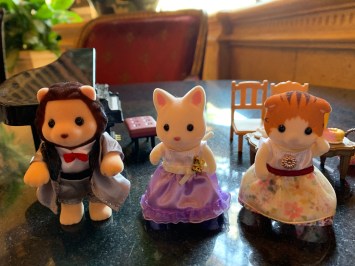
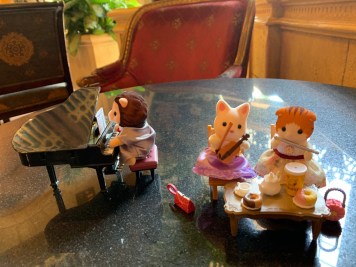
    Biltmore Trio consists of Ben Lion (Piano), Claire Whitecat (Violin) and Julie Tigress (Flute). They are fine amateur musicians who get together two days a week to play music together for reason none other than being aficionados of music, especially of the Baroque music. All of them have full-time occupations by which they earn their livelihood: Ben is an associate professor of history at Avonlea Community College. He is also an established writer for various magazine and short stories. Claire is a free-lanced book illustrator primarily for children’s books. Julie is a legal secretary working at a busy litigation law firm that would not function without her presence. They are good friends from childhood and share their love of music, books and other interests that pique their intelligent minds with scintillating curiosities. Hence, Biltmore Trio is a musical manifestation of their fellowship in the Appreciation of the Arts and Altruism of Humanity based upon the idea that the beauty of art is for everyone, not a prerogative of a few select. It is important that the public has a right to art because as Oscar Wilde attested, “Nothing can cure the soul but the senses, just as nothing can sure the senses but the soul.” How true it is!

    img_0623

    With such tenets of art in mind, Biltmore Trio’s free lunchtime recital of Frederic Hendel’s “The Arrival of the Queen of Sheba” at the eponymous hotel lounge fills the hearts of the audience with mirth and merriment and frames their minds with beauty and alacrity. The trio’s fine musicianship becomes even more brilliant with their milk of human kindness that benefits all regardless who they are and what day do.


  • Loveliness blooms in Logotheraphy

    img_0598

    A thing of beauty is a joy to them. Its loveliness increases. It never passes into nothingness. Oscar Wilde, who extolled physical beauty as a form of virtue manifested in a physical form, once flamboyantly remarked: “Crying is for plain women. Pretty women go shopping.”  Although Seraphina Rabitte and Mathilda Beare demur at such uncharitable notion of meritocracy of women’s appearance, they love visiting beauty stores in a way that little children love going to candy stores (or toy stores to be more realistic these days). For the ladies like to keep themselves prim and proper in the belief that presentable appearance (not a physical symmetry per se) indicates how one takes cares of herself by realizing her creative, attitudinal and experiential values in everyday life.

    img_0599

    The belief is grounded in Logotheraphy, one of the three Viennese School of Psychotherapy founded by Dr. Viktor E. Frankl, a neurologist, thinker, psychiatrist, but above all, a remarkable human being who endured personal experiences of Promethean hardships and suffering in Nazi concentration camps and conquered them in triumph of will to meaning. Fashionable and knowledgeable Matilda and Seraphina are students of Logotheraphy, the theory that human nature is motivated by search for a life purpose that is unique to each individual. Unlike other schools of psychotherapy and many other subdivisions thereof, Logotheraphy encompasses a wide scope of the humanities and of course, neuroscience, making it a brilliant multidisciplinary school of thought. In fact, it is a paradigm of the consilience of the knowledge of the humanities and that of science. So, in the context of regarding Logotheraphy, the fashionable ladies’ attitudes toward appearance betokens their ways of preventing noogenic (existential) frustration by engaging themselves in activities to dispel a hint of depression or inertia from their minds, even if it means only going to shopping.

    img_0601So, you see it isn’t a symptom of conspicuous consumption as a result of our hyper industrialized social environment that Matilda and Seraphina like pampering themselves with cosmetics. Besides, who can blame them for having none other than a woman’s reason? Didn’t Queen Elizabeth also proclaim herself to have a lion’s heart in a woman’s hide? Also, did the Queen not show fierce attention to fairness herself by putting the most fashionable make-up and dresses and hairstyles of her time? Well, these modern ladies are no less different them from their loyal member of sisterhood in the race of Humankind. In fact, Matilda and Seraphina have aristocratic bearings in appearance and manners due to their fine upbringing and sweetness of the mind by nature, so whenever they go, they give admirable impressions on people whom they encounter. They are the paragon of a virtuous woman as John Milton extolled in Paradise Lost: “Those graceful act, those thousand decencies that flow from all her actions and words.”


    Author’s Note: Many thanks to the attendants at the Cosmetic Company Store in Camarillo Premium Outlets who kindly permitted me to take pictures in their store. 

  • Bolero of the sea

    The unquiet sea, the restive sea, the wild sea,

    All passion and and vision of things hidden;

    The restless roar of rapture cries out loud

    as it touches the lonely shore in bold stride.

  • Beauty and the Beach

    img_0584

    she longed for the wild beauty of the seas,
    the gushing waves of restive waters;
    And the heart of the Great Pacific Ocean
    carried her over the edge of the horizon.


  • leisure play

    img_0529

    What then, if you lose your leisure

    With no time to stand and stare.

    No time to stand on the top of the hill

    And stare the world under with thrill.


  • Sound and Fury – Two


    images paris.jpg

    She is always waiting, and it seems like it is her forte. Like Clytie yearning for Apollo’s love, Iris pines for love as a sublimation of sensuality that is the union of Eros and Psyche. It is different from the religious sense of Agape love that is of a spiritual element only. Iris knows it all, and she is a student of the Nietzschean school of thought believing love is the surrendering of herself to the other in the consummation of desire so pristine and unadulterated of knowing and understanding of the flesh and the soul of her lover. But the tragedy is that she has read all about it, not experiencing it for real. She lives in the reality of her books and thoughts, and it is there she feels safe and comfy without fear of rejection. So, her world of love dwells in her maiden meditation to fancy-free, giving her imagination free rein to the extreme extent without the violent ends of such violent delights. In her mind’s garden, Iris lets her wild horse run her chariot without the goad because otherwise it would rebel against her order of severely restricted movements, which is unnatural to the beast, and drive her into a high cliff and then push her into fathomless Sea of Shadows.

    She seems to speak an infinite deal of nothing, but the feeling of existential Cul-del-sac Iris is having weighs as heavy as the celestial heavens that titan Atlas was holding for eternity. People said, “Beauty is only a skin-deep,” but that’s just a lame, piteous excuse and empty consolation for being unattractive, unwanted, unloved. For that matter, at least Oscar Wilde was honest in saying that a woman’s beauty was a form of genius that needed no explanation because it’s like sunlight. Love looked not with the eyes, but with the mind, so said Shakespeare, but it does not seem so to her.

    It is the attractiveness that makes people interested in the soul of the beheld. That’s why Iris wants to go to Aphrodite’s Beach somewhere in Cyprus, where it is believed that the goddess of love Aphrodite used to bathe. For it’s said that a woman in want of fairness will be transformed into beauty if she swims naked alone at the beach with no spectators around. Her fierce desire for fairness attests that all women should be told they are pretty and beautiful, even if they aren’t; they have no other reason than being women. Like a madwoman who has such a seething brain that sees beauty as a paradigm of goodness, Iris dwells on the beauty of life, watching the stars and seeing herself running with them in beauty.