The image of Aeneas in her eyes awakes
the primal senses in the thalamus,
lights the vision in the occipital cortex,
decides that she loves what she sees
as the sensation becomes consciousness
on the high altar of the prefrontal cortex,
and then on the funeral pyre it all becomes
her dolorous memories in the hippocampus.
Author’s Note: The subject of neurogenesis and neuroplasticity is multidisciplinary, ranging from literature to history, fine arts, and sociology, because it analyzes how the mind works by conceptualizing raw senses into consciousness. That said, I wanted to incorporate the bullet theory of how the brain works in connection with the operation of cognitive faculties called “the mind’ into my favorite unrequited love story of Dido, the beautiful queen of Carthage who hopelessly felt for the wondering Trojan hero Aeneas, who left her at the behest of of Juno (Zeus in Greek mythology).
It was meant to be the largest horse in the world when the future Duke of Milan Ludovico Sforza commissioned Leonardo Da Vinci in 1482 to conjure it up from the phantasmal world of the artist with his magic chisels. This fantastical statuesque beast, “Il Gran Cavallo” (aka “Cavallo”) was soon to be cast in bronze, standing 24 feet high as the greatest equestrian statue in the world, following the clay model of the equal height made by Da Vinci. Then war broke out in 1499, ravaging Milan and engulfing the clay horse, leaving Da Vinci alone with the original sketches of Cavallo to go back to the drawing room. Such was Da Vinci’s plan to restore the aborted birth of the magnificent bronze horse before it became indefinitely suspended by his death.
The story of the unfinished Leonardo’s Horse piqued my usual counter-popularity curiosity when I came upon an article in a magazine on the train. Since this year sees the 500th anniversary of the death of Leonardo Da Vinci, many an article has featured the masterpieces of Da Vinci and the background stories thereof, but to me none other than this story about Da Vinci’s last masterpiece is intriguing and worth the writing. In fact, this “Horse that Never Was” had spanned a phantasmagoria of imaginations throughout the centuries until a certain American art patron named Charles C. Dent intended to make it his lifelong goal to bring the abstract equestrian statue to reality in 1977 when he first learned about Leonardo’s incomplete project about which the National Geography magazine covered. Upon his death in 1994, American sculptor Nina Akamu continued to carry out where her Renaissance predecessor had left off based upon the surviving sketches as a substratum of artistic guidance and completed a bronze sculpture of the horse in 1999, which was dedicated in San Siro in Milan, Italy. The great statue of Cavallo is a sight to behold with poised magnificence: it commands a sense of legitimate attention in a moment of suggestively continuous galloping that looks wholly authentic and real, rendering a majestic impression of dynamic continuity to marching music as pomp and pompous as Radetzky March.
Da Vinci’s creation of the great horse proves to be his last masterpiece that truly links the past with the present and the future by the medium of art. It weaves the subjectivity of time into a grand tapestry of history and betokens cultural achievements as an intelligent collective enterprise. Akamu wonderfully re-created the great horse by internalizing the artistic sense of the Renaissance period by devoting her years of studying Italian Renaissance works of art in Italy as she pursued the highest levels of craftsmanship and professionalism in the field. Also, her love of animals, especially horses, contributed to the anatomical study of and aesthetic perspective on Leonardo’s Horse. Akamu’s recreation of Cavallo manifests beauty that penetrates minds of the beholders and lingers there in solipsistic ecstasy so deep and intimate that it feels almost physical. For our faculty, as it interacts with a plight of fantasy, is rather instinctive than reasoning; rather sensual because it delights in pleasure than because it thrives in disciplines. That is why “Il Gran Cavallo” is a gorgeous piece of art.
Sweet sleep, gentle sleep, nature’s kind nurse
puts me into the bath of Lethean forgetfulness
with the balm of rosebud for the heartaches
and wipes away my tears from the sorrow eyes.
Author’s Note: I hope to forget all things, erase all things, clean all things from the tablet of my mind, which is filled with woeful stories and unpleasant scenes of the day. Sleeping has been the only natural medication that relieves me of the hurt mind.
Great Philosopher Spinoza advised the mankind of how to endure suffering in days of yore: “Emotion, which is suffering, ceases to be suffering as soon as we form a clear and precise picture of it.” The essence of this suprameaning of emotional suffering, which Spinoza also poetically termed Amore Feti (Love of Fate), is to endure what you can’t change but to accept it as it is, for there is a meaning to it in the dark night of the soul. In the terrible ordeal of the tormented soul, one has two choices to make: to yield to the force of deception calling for total abandonment of hope or to force oneself to turn to the voice of hope to sustain strength of the heart. The sovereignty of humanness is manifested by this holy office of selecting the spiritual choice in the darkest hour of the soul in the deepest valley of the abyss. “Hold the Sun in Your Hands: The story of Erika Jacoby”, a short documentary produced by Harvard Westlake-School, is one such tale of a survivor from the atrocity of moral and physical turpitude as a young child at Auschwitz during World War II.
A curious alchemy of illustrative animation and neorealist documentary delivers a momentum of pathos without elaborately scripted lines or special effects in the most powerfully elliptical way, which adds to the authority of truth that the story itself owns. Ms. Jacoby’s straightforward narration without a prolix litany of her woeful past is felt through the heart of the viewer, and it communicates to the mind of the viewer her smothered traumatic experience at Auschwitz, where she had to witness the death of her beloved and the enormity of evil reincarnate in the Nazis’ mass killing of the Jews and the violence against humanity through the eyes of a young girl. Accordingly, the film is seen in the perspective of a young child whose innocence betrays ingenuousness of the story and thus delivers the profoundness of such experience that sublimates it into the highest form of Art in the context of regarding Da Vinci’s aphorism of “Simplicity is the ultimate sophistication.”
This short documentary has chimed the hearts of thousands, including those judges at the Cannes Film Festival, which is one of the most highly regarded film festival (note that it’s not an “award” ceremony where only gowns and jewelry and tuxedos and fake smiles are visible.) in the world. It will be shown at the American Pavilion at Cannes this month as part of a series on young, emerging film makers, one of whom includes Ian Kim, who is son of Mr. Harry Kim, a corporate lawyer at a law firm I am privileged to work. The creators of this documentary will appear on stage at Cannes, ergo it will be a festivity of creation, a festivity of humanity. Above all, the fruit of this film is a triumph of human will that rose above the carnage of war and the degradation of dignity and a manifestation of meaning of life, will to meaning, freedom of will as also corroborated by Dr. Viktor E. Frankl, founder of Logotheraphy and also a survivor of five concentration camps during World War II. Ms. Jacoby shows us what it means to have hope as long as she lives. Dum Spiro, Spero. This documentary will strike the highest notes of your heartstrings.
dons the barren places soon
with green sleeves and emeralds.
Author’s Note: It’s the end of April, which will never come back, vanishing to the horizon of time and space, the misty past with memories and images. I was on my last train home after work this evening and wanted to record this last day of April of 2019, which was my first April here in California. So as a ceremonial gesture of farewell to my Californian April, I wrote this poem as I was basking in the bright golden rays of the gorgeous Californian Sun that began to stay a little later than before.
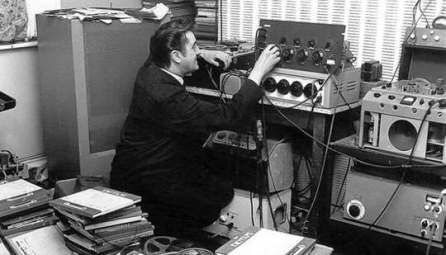
I had thought Joe Meek as an imaginative character in the eponymous title of electronic music by Matmos until I came upon an article about the real Joe Meek from this month’s History Revealed. Since I liked the music, I read it with relish, which was also a great pleasure entertaining a long commute time on the last train home after work. It was indeed worth the reading because the article was both informative in telling about this highly sensitive artist who was ahead of his time and reflective in leaving the reader to ponder about what rushed into to cancel his own fate in his own hand.
Joe Meek was an innovative and unique record producer in 1960s, but he was more of a maverick figure in the music industry because of his uncompromising individuality in musical taste paired up with his blazing volatile temper, which were attributed to his thespian epilogue. But according to the article, the most capital assumed factor contributing to the tragedy of Meek was said to be his homosexuality in the time when it was an illicit tendency of warped minds and degenerate souls that belonged to Sodom and Gomorrah. That is to say, shoehorning obsession with sexuality into the sine qua non of a man’s demise is a non sequiter without considering other evidentiary elements.
It seems that Meek had cultivated the trauma of violently depressed, pitifully unstable childhood into a grand unified theory of self-loathing that in turn became self-indulgence to an inordinate measure. It was more of a lack of parental love and support in his childhood that fueled Meek’s high-strung disposition like an unquenchable prairie fire in wilderness. It is a precipitately formulated hypothesis that Meek’s tragedy ensued from his paranoia of persecution of homosexuals in his time. For a panoply of unpleasing manifestations, including alcoholism, drug addiction, compulsive copulation, enduring guilt, and an inability to form a lasting emotional relationships, are also shared with heterosexuals. To me what Joe Meek suffered from was his inner conflicts with his unhappy past, his sovereign artistic sensibilities that made him uncommunicative and estranged, and his sense of insecurity, all pitchforked in existential reality of life where he as an indie producer had to constantly worry about what to do next if his records did not produce lucrative results. To corroborate this hypothetical theory, Joe Meek was said to have a Janus personality, redolent of the characters of Dr. Jekyll and Mr. Hyde, because he was also a very affable person with polite manners and a sense of good humor in to the bargain.
Such a man of complex inner world is often prone to fatal mental breakdown, which happened to Joe Meek. What carried Meek over the last sacristy of his sanity was his being interrogated by the police for the infamous “Suitcase Murder,” an epochal murder plastering the headlines of the media in January 1967 when the raped and dismembered body of 16-year-old Londoner named Bernard Oliver was found in two suitcases near the city. The police was hell bent on investigating all homosexuals in the city, especially the high profiles ,one of whom was the unfortunate innocent Joe Meek. Consequently and patently, the Inquisition let loose his sanity, resulting in his shooting his landlady and ending his own life thereafter. He was only 37 years old.
Therefore, to conclude that it was all about his homosexuality and nothing more causing his tragic end seems to ignore other more mental, spiritual, and existential matters that Meek must have struggled with. A spiral of loneliness, insecurity, frustration, and disorientation was Joe Meek’s quagmire, and from this quagmire in turn came his own killing field. “See though fear. Face the fear. Recognize a lie or a masquerade for what it is and deal it with a mortal blew,” said Ralph Waldo Emerson during his lecture to young men. But sadly, Joe Meek was too beaten down in harsh existential life where he felt unwelcome all the time despite his great artistic achievements. Thus, to end himself seemed to be the only escape from emotional turmoils, “for who would bear the whips and scorns of time… the pangs of despised love… when he himself might his quietus make with a bare bodkin?” –Hamlet, Act III, sc I.
Author’s Note: This writing is based upon my review of an article about Joe Meek from this month’s historical magazine History Revealed. Normally, I would bypass an article of similar nature, but this one held my attention for the following reasons: (1) Joe Meek’s dilemmas ensued from his inability to cope with the demands imposed on daily tasks in life due to a constant grip of depression and anxiety; and (2) application of Freudian psychoanalysis on his miserably repressed sexuality in public to the proximate cause of his tragedy disregards the more essential elements of humanness. For these reasons, I felt pathetic toward his life, and thus wrote this writing.




You must be logged in to post a comment.