Beneath a new visiting sun Sees a woman through tears, Sorrow of the heart she feels As it deepens into a sea of pain.
Beside her an ailing old woman Lies in natural amnesia for woes She wishes to send away in vain When a life’s grip is relentless.
Fear crowded, tension soaring Zealots of God clad in weapons, Fierce eyes searching for victims Outside is the terror reigning.
Demands of life, duties of care A caryatid bears on her head, She faces the faces of terror With a brave heart for the fate.
Author’s Note: Yesterday, I wrote about my essay on the current situation of Taliban-seized Kabul in Afghanistan but still could not take it off my head because I felt for their fear for unknown futures. An article of the day from Reuters was about the ordinary Afghans who had to make livelihood even against a possibility of danger that lurks around everywhere where thousands of people are attempting to escape from the new Taliban regime, often futilely. Therefore, this little poem, albeit insignificant willy-nilly, is my small tribute to the brave ordinary people on the frontline with life in Afghanistan who are just like you and me. The heroine of this woman is another Me in Afghanistan who shares a similar life story.
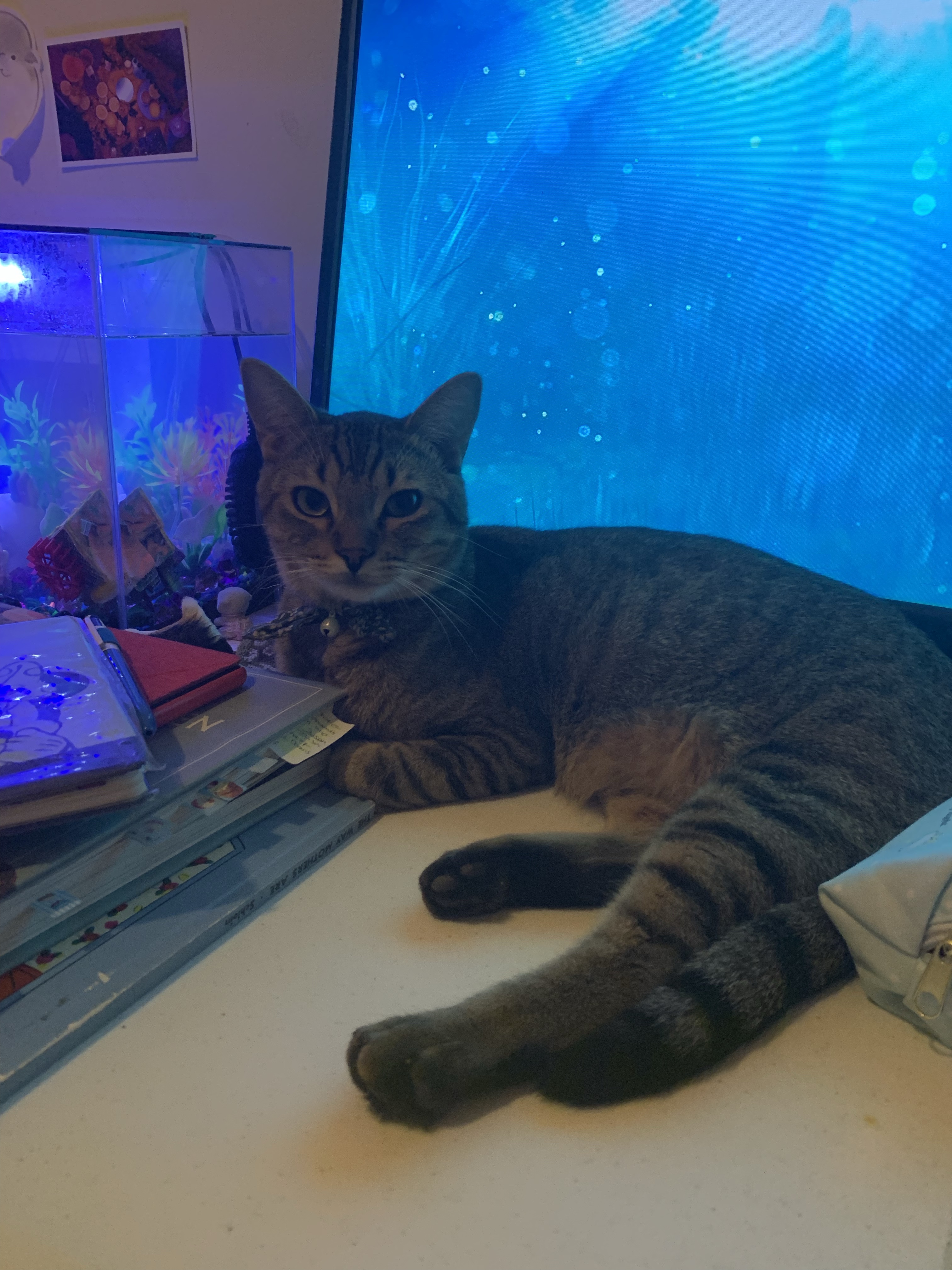
St. Frances de Sales’s advice, “Have patience with all things but first with yourself.” is no more so than with the three weeks’ heartbreaking ordeal to win back my cat Toro’s trust in me. His traumatic visit to the veterinarian now seems to dissipate across the feline Elysium slowly, or so I want to think. He is not hiding under the bed in my presence, becoming a sweet writing company on my desk once more.
I have recently watched a YouTube that goes viral about an unlikely friendship between a stray cat and a young woman, which makes me think of my relationship with Toro and what it means to build trust between two lives. The woman found a stray tabby cat around her house and began to acquaint him with food. She named him “Tiger,” not least due to his perspicacious tiger stripes and adorable feistiness, giving him a distinct personality and charms that were all the more endearing to the sensitive woman who was also in need of company in her solitude.
Thenceforth, they became complementary to each other for consolation, security, and most of all, love. Tiger is still his feisty self, and the woman is still trying to adjust herself to his whims and caprice. Still, they feel comfortable in their presence and love. The tears welled in the windows of her soul when she said that building trust between two took time and patience. You can’t make someone love you arbitrarily by force. You don’t need a love spell or magic potion to enslave someone into your desire of possessing the body and mind, as the ancient Greeks and Romans used to. Without Psyche, Eros would not/could not have culminated in perfecting the art of love as a primordial god of Love.
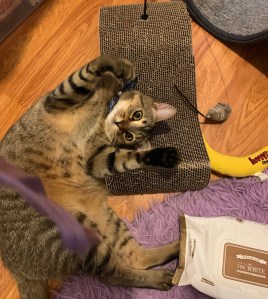
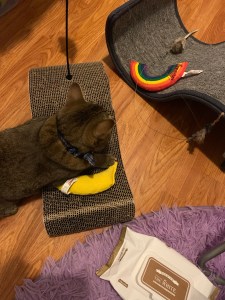
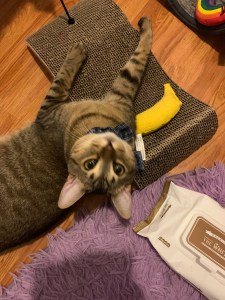
Toro is in some way like Tiger: his name means a little tiger in Japanese with his distinctive stripes, and M signature proudly marked on his little forehead. Although not as feisty as Tiger, Toro has a remarkable personality of adventurousness, curiosity, playfulness, and resilience, all affectionately wrapped in his good nature. But I don’t take for granted that wonderful Toro is my cat, and therefore, I deserve his trust and love. Animals, especially pets, also have hearts that pump up the blood and feel the feelings. I regard them as friends, companions to enrich our existential human lives with a touch of sentimentality that we hardly express when we are among our species in fear of being regarded as a sign of weakness. And I am always thrilled to feel his little heart at my feet as a friend.
When my eleven-months old cat Toro started drooling in white foams last Wednesday evening after swallowing a tiny flying insect in my bedroom, I was in a panic. I called nearby emergencies, describing the state Toro was in, but they told me his symptoms were not regarded as critical. Instead, they told me to monitor him, so I did. He stopped drooling the next day and drank a lot of water. Nevertheless, my concern was still growing, doubled with regret that Toro should have met an owner in a vast, spacious home with that which would make him happy. The pang of grief punctuated my already broken heart, and I was distraught.
“I am not feeling very well.”
Luckily, a vet to whom I had previously taken Toro for his difficulty in excreting in Little Tokyo said she could see Toro on Saturday morning. The waiting period until the appointment was an ordeal by the torture of the heart. My spirit was sunk in a sea of sadness, blaming myself for not providing Toro the optimum environment to thrive in his best feline nature. The bedroom is so tiny that it is more of a den, and the living room where my elderly infirm mother spends most of the day intermittently is off-limit to Toro by keeping him alone during the day when I am working. My evening playing with him might probably bore him to death because my lack of creativity fails to invent more stimulating kinds of play that will perk up his energy. I cannot help but think that I am becoming a bane of Toro’s existence, the cause of his unhappiness.
Pre-idopathic cytitis diagnosis time when Toro liked me
To pour lead on my open wound in the heart, when I finally took Toro to the vet on Saturday, she diagnosed him with idiopathic cystitis. She showed me a scanned copy of Toro’s mildly swollen bladders with information on the illness caused by stress. That’s it. The diagnosis realized my imagination and shattered a slim hope of something other than STRESS. I see all the cares I had given to Toro as best as I could beyond my measure by taking him to vets and telling him how much I loved him as much as I could dissipate into the elusive dreams of my little happiness with Toro. My happy moments with Toro vanished into yesterdays, bidding farewells to tomorrows.
“More exciting play!”
It’s been a week since the diagnosis, and now Toro has changed. Toro now hides under the bed, doesn’t come up to my bed, and avoids me when I am home. Besides, he doesn’t eat as much as he used to, about which the vet told me to be patient because that could be the effect of changing his prescriptive diet from gastrointestinal to urinary care. What is strange about his sudden change of behaviors is that he was never like this from his previous visits to vets. Come what may, Toro seems to be unhappy, and I am very downtrodden for his changed behavior. He was the only one who showed me his affection.
Toro in his whimsical mood for playing
I still remember his adorable, curious big eyes peeping out of an opening from a box carrier when I brought him from Ventura Animal Shelter last August at the age of nine weeks. Purring and kneading are long gone. My reason suggests that re-homing Toro is the best I can do for his happiness, yet my heart tells me not to listen to it and look for another place for a better living environment. Nevertheless, I yield to my heart’s voice and want to believe that there is still hope for us to be happy in a better living condition. I hope to see mirth wonton around us and happiness sparkle before our very eyes soon.
Forty years on our evolutionary scale amounts to a microsecond on our twenty-four biological clock. The millennium years, even Before Christ, feel so alienly anachronistic from our modern sensibility. The sense of time builds upon a fundamental element of consciousness as molded into a collective emotional experience as contemporary citizens of the world, just as the peoples of the misty pasts we tend to overlook felt the same for the civilizations before them. They were the titans of the pre-ancient Egyptian, Greek, and Roman cultures. They, like the evening sun in its full declination, vanished in the hazy horizons of the time, still dazzling with its scarlet hues of radiating halo lingering on the remnants of human civilization to this date.
Forgotten peoples of the Ancient World is an anthology of the peoples whose feeling of permanence and importance in their time of the world betrayed their fates buried in the tires of cities beneath the earth and returned to the dust in the winds. To illustrate, Akkadians were the first builders of the empire who elevated the Akkadian language to the cultural and political lingua franca of the late Bronze Age. The Hyksos were outstanding charioteers, and their military prowess benefitted their Egyptian subjects. The Bactrian culture was a delightful mixture of Greek and Indian heritages, while the Vandals gave a final, fatal blow to the already destabilized Roman Empire. These peoples affected the celebrity civilizations we are automatically associated with the ancient civilizations. As to why the forgotten peoples became peripheral in our realm of ancient history, it is a question of the immanence of the supreme being in the universe. However, what is certain is that they were the torch-bearers of the first civilizations passing the torch of society they had ignited and encouraged to the next in a relay run of collective humanity.
The book is an excellent anthology of these ancient peoples in chronological order from east to west, showing how civilizations expanded from the cradle across the plains, mountains, deserts, and seas to the Isles of Britons. Divided into the eras marking the epochal changes of history, Matyszak succinctly elucidates the peoples of the misty past with his trademark witty ways of describing historical contexts. Moreover, the exciting historical trivia resurrects the eras in a phantasmagorical display of faces and places.
To conclude, the stories about the forgotten peoples attest to the objectivity of truth applicable to any time of history that that which is here was there, has been, and will be. All things must pass, and there is nothing new under the sun. Our sense of time and culture is a likeness of truth, a matrix-like reality, because our facility is rather instinctive than reasoning, rather physical than metaphysical. Who would have known that people 100 years later now would think our time and us in this time anachronistic and antediluvian? Herodotus felt the same when he arrived in Egypt and saw the wondrous pyramids in awe that the people before his generations had built. So did the Babylonian king, who dug and discovered artifacts from centuries ago. We have seen the hungry ocean gain advantage of the kingdom of the shore, and the firm soil win of the watery main, increase with loss and loss with increase. The forgotten peoples and we are time’s subjects, and time bids are gone.







You must be logged in to post a comment.