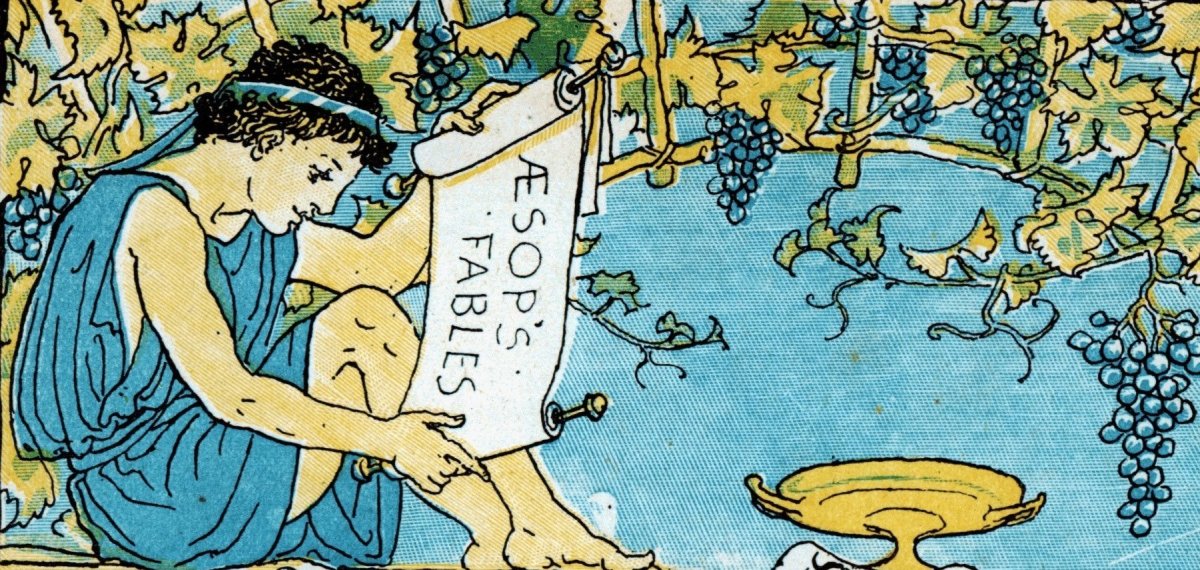
Last week, I reread Aesop’s Fables as an adult (that is, in terms of the ages on an evolutionary scale) in the 21st century and found them just as attractive as the first time reading it as a child. What a feeling! A freed slave once, Aesop’s natural wit combined with protean imagination made him able to investigate the essence of things, the nature of things, and attribute it to human nature’s characteristics, which ultimately brought him mortal death and immortal life. He was, in a way, a lot like Hephaestus, the god of fire, blacksmith, presider of the arts, and the only legal husband of the goddess of love and beauty Aphrodite who found him unbearably unromantically ugly.
Aesop’s Fables still scintillates in the brilliance of affabulation and humor that nicely relates to Nietzsche’s concept of immanence, the understanding of nature of all things; the Natural Law called conscience the supreme ruler of the universe has inculcated in us. The Fables are full of lessons that are akin to Jesus’s parables employed in his teaching of ethical codes for Christians in daily life. Of course, Aesop was of the Pre-Jesus era. Still, his stories bespeak something of human nature that had already existed, which is ongoing and will continue as long as humanity exists. The cardinal virtues of prudence, justice, temperance, fortitude, and Christian values of faith, hope, and charity are all embroidered on the elliptical, imaginative, and impressive episodes of and among humans, animals, and even gods in this immemorial anthology of ancient wits. “The North Wind and the Sun” teaches about the force of gentility over the fear of intimidation. “The Woman and Her Hen” resonates with the timeless adage of everything in moderation. “The Milkmaid and her Milk Pail” corroborates the famous proverb that you should keep a bird in your hand than catch two in a bush. Treating others in a way you want in reciprocity illustrates the dinner scenes in “The Fox and the Stork.” And yes, I believe President Ted Roosevelt must have gotten inspiration from “The Astronomer” that you should look at the stars while keeping your foot firmly on the ground. And there are more stories to wow modern readers.
Aesop’s Fables are so practical and amusing that all of them collapse millenniums between his telling and our reading it. Besides, all of them read like Book of Proverbs or Psalms in free verse or prose version, which makes the reader unburdened with textual analysis to decipher meanings intentionally obfuscated by the high intellect the academic writers of the sort. The Fables are comprehensive to all, serving a purpose of providing tenets of reading; to bestow pleasure of the sense and satisfaction of reason in a way you do not consult a help of a dictionary or other lexical or literary reference. Reading the Fables gives a feeling of watching a TV cartoon, say Woody Woodpecker, which tells something about man’s nature wrapped in an animal hide. So do not fear reading Aesop’s Fables now. It is well worth spending your free time discovering the universality of the truth with that “A-Ha!” moment regardless of the subjectivity of time.





You must be logged in to post a comment.