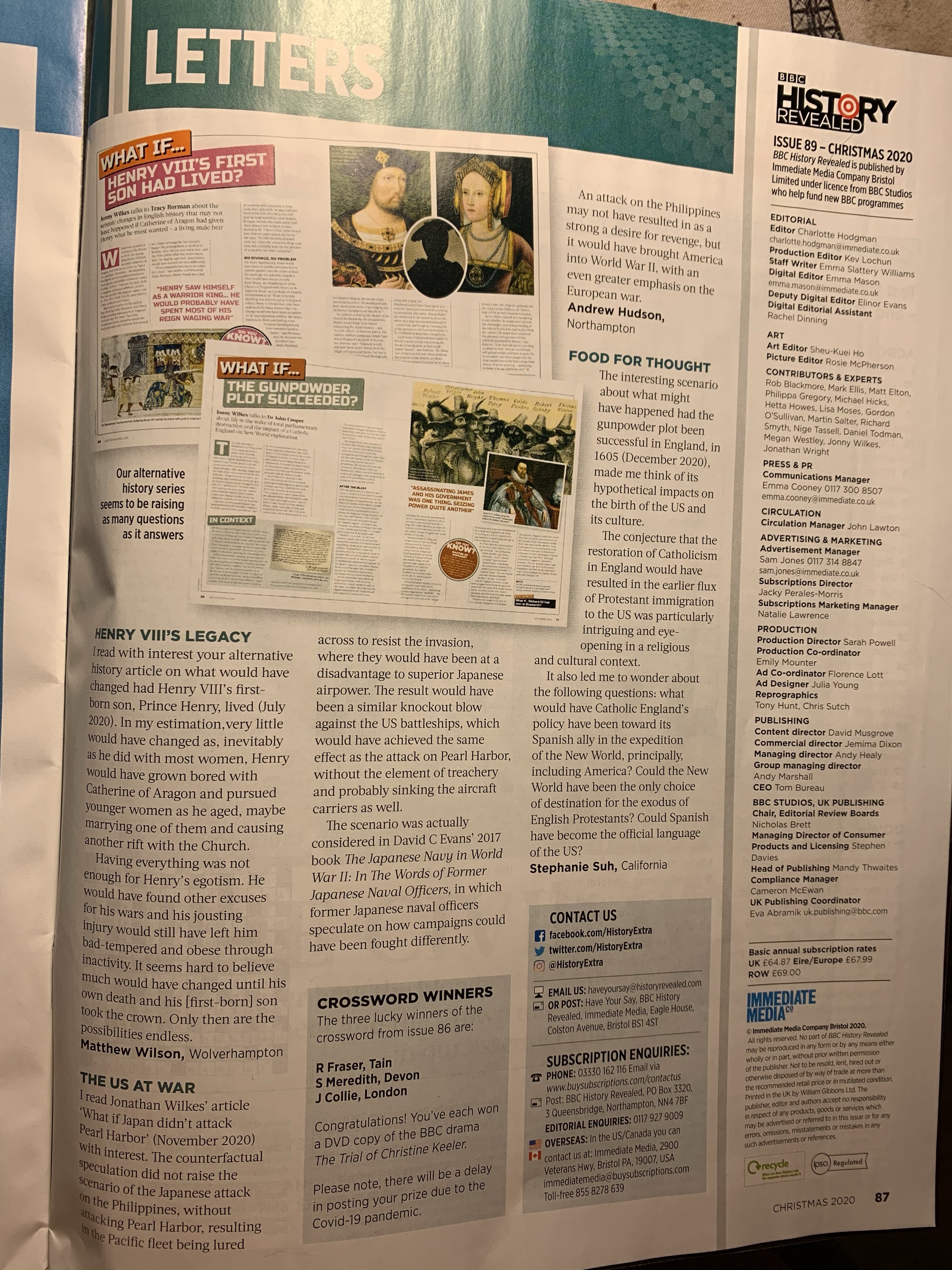
Reading the history of ancient Greek, Egyptian, and Western Civilization, in general, gives me mental refreshment. It connects me to the people who lived before me, crossing over the boundaries of time and territories. So, it was a pleasant present after a day’s work when Mom handed over to me a Christmas issue of the BBC History Revealed magazine that had arrived at home. To my delight, I saw in the magazine my letter to the editor about my questions on the hypothetical consequence of the successful gunpowder plot, which is best known for the Guy Fawkes Day in the U.K. The following is the transcription of my published letter, which is titled “Food for Thought.” In fact, this is the 6th time that the magazine has published my letters! Wow!
“The interesting scenario about what might have happened had the gunpowder plot been successful in England in 1605 made me think of its hypothetical impacts on the birth of the United States of America and its culture.
The conjecture that the restoration of Catholicity in England would have resulted in the earlier flux of protestant immigration to the States was particularly intriguing and eye-opening in a religious and cultural context.
It also led me to wonder about the following questions: what would Catholic England’s policy have been toward its Spanish ally in the expedition of the New World, principally, including America? Could the New World have been the only choice of the exodus of the English protestants? Could Spanish have become the official language of the States?”
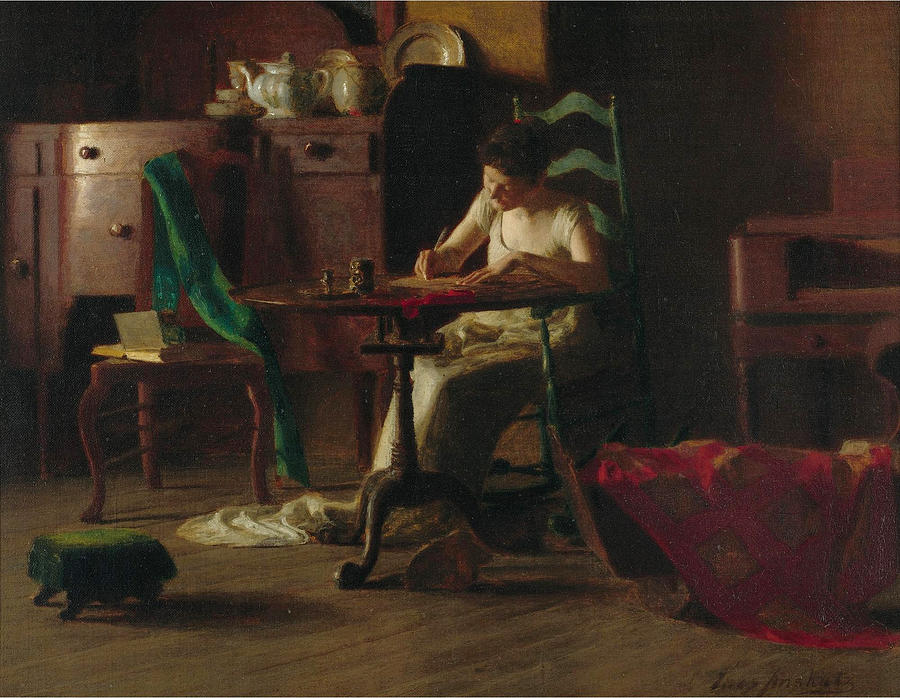
Suppose a brownie or a leprechaun I happen to rescue from a Gargamel lookalike wizard insists what my three wishes are as a quid pro quo (depending upon how friendly the fairy is). In that case, I will say forthwith one of them is the Marvel of Writing, which I have lost somewhere in the course of life. I can turn myself into a great writer with the magical pyramid of power from a hodge-podge reality of indigested letters of reality as black as Persian Night.
Johnson’s essay on the role of the scholar evolves from Francis Bacon’s adage: “Reading makes a full man, conference a ready man, and writing an exact man.” It rings a bell with the Nietzschean idea of Superhuman, superseding any mortals known for their erudition perennially enshrined in the history of human civilizations. A truly knowledgeable person I principally associate with a great writer can digest what he reads, explain it to others in facile terms, and substantialize it in writing, a mental Osmotic process that nourishes the mind and invigorates the body.
Although I agree with Bacon as Johnson did, I am more with their ancient Greek teacher Socrates. Socrates warned his pupils about regurgitating what they heard from his lectures without putting it in their own words. That was one reason why the great philosopher disapproved of writing practice that had just emerged in his time. Copying letters of others without understanding them on his own would stun the cognitive powers rather than promote a broader and deeper range of cognition. Reading was not as popular in Socrates’ time as in ours because it was at the beginning of the new intellectual dawn of Greek Civilization. So, Socrates was a thinker, neither a reader of texts, nor a writer of tablets. Does this make him less of his students Plato and Aristotle?
Does the amount of reading necessitate that of writing? Wouldn’t too many words go undigested inside and clog the pipes of thoughts when writing? For example, an ambitious amateur writer wants to write as if she were possessed by the spirit of Patience Worth, who transformed an ordinary homemaker into a brilliant writer. She adheres to a writer’s gospel of “Read a lot. Write a lot,” but it is easy to be said than to be done. The more she reads, the worse she writes. She wants to reason the perplexing reason with frustration and disappointment. She feels lost in the middle of midtown Manhattan where there are many streets and avenues but nowhere is her niche. Yet once she gets out of town, the state, the coast, her mind becomes clear, imbued with a fresh breath of inspiration that moves her hands on the keyboards automatically. Contrary to Johnson’s opinion that grandstands with all other established writers and academics, the amateur writer feels liberated from a siege of letters that intimidated her army of thoughts equipped in her design of armors and shields with her coat of arms sovereign and beautiful. Her reasoning power was buried under a chaos of indigested learning.
Although Johnson’s magnanimous advice of the equilibrium of reading, writing, and speaking on a writer’s continuum is respectful and worth reading, its reality is subject to the individual aptitudes of learning, ways of reasoning, and natural dispositions. One may write better because of reading more, while the other has the opposite consequence. A hermit – let us say more realistically, an introvert – is not always an incompetent, anti-social, sullen loner whose airy petulance barricades against others whose intelligence may seem intimidating to be dealt with. I think to write more is far better critical than to read more because writing is a sovereign act of expressing an individual mind and spirit, free from the comparison of the florid words of others with the writer’s own that would dispirit the vivacity of the creative spirit. To conclude, I thank Thomas Mann for his affirmative saying:” Solitude produces originality, bold and astonishing beauty, poetry.” Truth is truth to the end of reckoning. Then it is yet another truth of others, not necessarily yours.
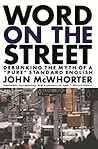
Sometimes, the courage to express my thoughts in English as a second language meets with insidious challenges between the grammarian Scylla and fault-finding Charybdis, lurking in the safety of anonymity on social media to stalk the prey with perverted joy. So, it is only natural for me to find encouragement from the books reassuring me that the mastery of language does not equate with intelligence. So, it is no wonder that I have the pleasure of reading Word on the Street, an invigorating narrative told in scholastic zeal and impressive erudition flavored with street-smart audacity. McWhorter, who belongs to the constellation of brilliant linguists, such as Samuel Johnson and Steven Pinker, talks about language in terms of social and cultural contexts, making the academic subject a hot topic of a Charlie Rose talk show.
McWhorter takes his view against language relativism that language shapes thoughts. The possession of words does not determine the thought process to contextualize the mentalese. Therefore, slang, idioms, and parlance outside the elite group of society and the educated middle class are not denigrated as improper English. In this sense, Pidgeon English, the quaintly charming admixture of scattered English words and a speaker’s native language, is not a corrupt version of pristine English but a hybrid of languages born out of the ingenuity of the human mind and changeability of language in nature. Isn’t English a living proof of the incredible amalgamation of languages still undergoing evolution? Who would have thought that English of the underclass would shine as a lingua franca?
What strikes me most about the book, which concurs to his fellow linguist Pinker’s point of view on language not as a touchstone for one’s cognitive ability, is that solecism in spoken and written language does not reflect the user’s less desirable trait of academic ineptitude. To put it more bluntly, just because your grammar is besotted with errors doesn’t mean you don’t know what you are saying, or forthright, you are less intelligent. Take Leonardo da Vinci, the Renaissance polymath, who had no fewer than six grammar books on Latin and Greek to grasp the syntax of the classical dead languages he was so hopeless to learn thanks to his lack of formal education. In fact, da Vinci’s writings are ridden with misspellings and amorphous sentence fragments, just as Leo Tolstoy, Jane Austen, and Emily Bronte showed in their manuscripts. So, did their imperfect language skills overrule their force of imagination and contextualizing it in words? Does this betray that language shapes thought?
McWhorter can transcend the demarcation of race in the communication of this extensive knowledge about the subject drawn from a wealth of learning and scholastic industry with urban wit and debonair guy attitude to his readers, academic or general. His intelligence freely crosses over time gaps, chasms between class divide across continents and oceans with a universal theme of words that we, as human creatures, have spoken thus far. And he tells it using full of scintillating metaphors, examples, and anecdotes, which helps the reader comprehend otherwise monotonously academic subject without pressure and enjoyably. Samuel Johnson said that the possession of knowledge is to share it, and the possessor of the knowledge shines when he applies the knowledge to the crowd of life. Well, Word on the Street shows it all.
It is the Mystifying Absurdities of Human Nature that seems to be more of animal instinct for the Survival of the Fittest. It always makes me wonder when I see people with a terrible temper and callous personalities being successful in their careers. Although Shakespeare said a fool thinks himself to be wise, people seem to think that fool to be wise in real life. That was what came to my mind while reading Samuel Johnson’s weekly essay, The Rambler, No.142, subtitled “A Rural Tyrant,” written on Saturday, July 27, 1751. (Come to think of the date, it seems that Johnson spent his weekend writing essays as in a journal, which is an admiring habit to emulate.)
Johnson tells the readers about a swanky mansion he and his wealthy acquaintance named Eugenio, who had invited Johnson to his rural estate, happened to pass a swanky mansion surrounded by the grandeur of wealth and pretentiousness of power. Until Eugenio had told his learned friend that the villa was known for ghostly hauntings, Johnson’s natural curiosity piqued his search for truth; thus, he began inquiring about the whys and wherefores of the ghost inhabitant. The ghost was Squire Bluster, a bilious, despotic employer of his household personnel and ruthless landlord of his villagers. His capricious fission of tempest kept their financial securities at his whimsical mercy. Bluster enjoyed the powers of terror and, in the height of his perverted joy, insulted those imploring for his mercy with malice and enmity. No wonder nobody in the village repaid his vice with contempt and conferred perennial infamy on his epithet after death – at least corporeally. Notwithstanding the shame, Bluster cared nothing of it and still reigned in horror at his earthly abode because to delight in ghostly terror was his new afterlife enjoyment. Johnson lamented that the evil squire had only the gloomy comfort of reflecting that he was likewise feared if he was hated.
In the same vein, the descendants of Squire Bluster are not a rare family but are ubiquitous boundless of territory, race, and gender. For example, employers are hardly magnanimous and altruistic in their expendable employees’ genuine wellness and demand their employees in the usual, professional pretext of constructive criticism packaged in belittling, castigation, and insulting for the sake of strictly business. But I never subscribe to such façade because we are not automats but with sense and judgment common to all human creatures. You can’t tell the other to grin and bear the insults because they are not supposed to mean personal. If you want your subordinates to do their job correctly, you must be worth receiving such quality labor from them by being respectful of your character. But alas, it is my only vain wish, an empty echo from the valley of my heart because the descendants of Squire Bluster are a multitude and will do whatever they think rightful and deserving. Don’t’ forget that respect from fear is a terror of the sense and a trademark of tyranny, exacting unchallenged obedience from people.
As members of society and citizens of the world, we are one way or another connected to the past, present, and future. That is why history is a multidisciplinary study to understand human nature and learn lessons from the past. Listen to Winston Churchill: “Study history, study history. In history lies all the secrets of statecraft.” Watching our nation’s leaders on T.V., dividing the country into splinters of dissenters instead of embracing them as one people of the nation, makes me urge the current political leaders of our country to read about what it means to be an intelligent and influential ruler who knows a thing about leadership.
Roman emperor Hadrian was of history scholar, specialized in ancient Greek history and mythology. He was affectionately known as a “Greekling” and endeared and admired by the Greeks whose land he made in the Roman Empire. The Greeks’ love of the Roman Emperor was inscribed in the Arch of Hadrian built in AD 131, an archeological wonder with the 59 feet high structure made from marble from Mount Pentellicus used for the Parthenon, that read: “This is the city of Hadrian, and not of Theseus.” The Greek elation reached the pinnacle when their Roman ruler built the Temple of Olympian Zeus, Hadrian’s dedication to the king of Greek gods and goddesses’ splendor. He also made the legendary Library of Hadrian, containing 100 marble columns with halls with printed ceilings, alabaster walls, and great statues of the Olympians destroyed by the malice of fortune AD 267. Greek enthusiasm for their Roman emperor was no unreason for their willing submission to Rome’s rule, which they had once colonized. The site of the Temple of Olympian Zeus and the Arch of Hadrian in modern Athens
The Temple of Olympian Zeus and the Arch of Hadrian
Hadrian’s fascination with Greece developed from his learning under the tutelage of his cousin Trojan became a foundation of Pan-Hellenism to turn Athens into a new cosmopolitan cultural center for the Roman Empire. By way of acculturation, Hadrian hoped to stabilize the Roman Empire’s fractious eastern part and effectuate the colonials’ ruling. Hadrian followed what the antecedent Roman poet laureate Virgil in the Aeneid to solidify Greece and Rome’s cultural link. In this fashion, he succeeded in ruling the colony with glad acceptance by the governed, who even declared him a founder of new cosmopolitan Greece, intent on cutting ties with the mythical ancient past.
Hadrian’s motto of Pan-Hellenism reminds me of Macedonian predecessor Alexander the Great’s Hellenism, both of which proved work in incorporating different cultures into a dominant culture with respect and benevolence. Both Alexander and Hadrian had an eye for beauty in arts embedded in cultures they annexed to the dominion and knew how to rule wisely and effectively. It was acculturation of the native cultures on both sides, the ruling and the ruled. Yet, Hadrian’s way of exercising sovereignty over Greece is more accommodating and welcoming, even if the intention was not free from political ambition. The ancient Athenian historian Thucydides confirmed that history is the ultimate record of the events by recognizing certain commonalities between the past and the present that transcends the subject of times and applying it to our present situation. If our current political leaders take a cue about social integration to the same vein’s present social conditions, it might help the country stratified by race and class.
“I’ll teach you differences,” said King Lear as his motto of philosophical investigations in Shakespeare’s eponymous play. I imagine the ghost of King Lear would utter it again when he deigned to come to our realities of universities in this time. The importance of responsible education to remove the social ills and carbuncles resulting from dissentious political domination has never been more conspicuously called for in our high learning institutions as a recent consequence of the George Floyd incident, and the following the Black Lives Matter movement. However, this doesn’t mean that universities should be a breeding ground for training gladiators equipped with political syllabuses and dogmatic agendas to fight against the public foes. Instead, education should disabuse the ignorance of the unenlightened for our society’s universal betterment.
Professor Benjamin Y. Fong, in his NY Times article “Teaching Racial Justice isn’t Racial Justice,” addressed the issue of education as the fighting tool. It has become fashionable that most American universities have competingly added courses on social injustice to the Black Lives Matter movement. However, the idea of education is to provide students opportunities to learn and actively engage with conflicting thoughts and various real-life issues in a place enriched with knowledge linked with the fellow members of the human race from antiquity. In this environment, a university is a place for education that can improve social conditions in the fight against social, political carbuncles, not for the battle itself, training students for social gladiators.
Many universities are focused on the quantitative quota of educational syllabuses aimed for the universities’ reputations as the most liberal and forward-thinking higher-learning institutions for the socially recognized prestige, not the qualitative aspect of the education of the minds. It is not the textual syllabuses filled with political ideologies and social campaigns. Still, the practical teaching of various conservative and progressive considerations enables students to incorporate the learning to their perspectives. Education serves to articulate ideas based on the standard of reason and taste universal in all human creatures regarding the principles of judgment and sentiment common to all humankind.
Suppose we want our higher learning institutions to remedy the existing ills of our social and political realities by implementing more social justice courses. In that case, we must first understand the fact that education itself is not the fight itself. Neither Plato’s academy nor Aristotle’s lyceum was a place for the battle against the absurdities of Man. Or even the beloved, peripatetic Socrates did not use his open universities in Athens as a place for campaigning against the government hostile to his philosophy. Remember that there is no new thing under the sun as long as we as the collective enterprise called Humanity continue to voyage in the Universe.



You must be logged in to post a comment.