I first saw Chan Marshall singing in 2007 Chanel Haute Couture, while models were swanning around like ethereal fairies in gorgeous Chanel wardrobes. Better known as her stage name “Cat Power,” she was the Queen of the Show in her graceful poise whimsically mixed with her super cool urban retro-chic fashion singing a soulful and powerful melody of ballads like a stylish bohemian troubadour. So I downloaded her songs from iTunes and loved her solitary lyrics imbued with Southern blues soul and offbeat timbres probably as a result of her elbow room in the beloved New York City. To top it all off, Chan Marshall became one of My Nine Muses.
Cat Power: A Good Woman by Elizabeth Goodman is a beautifully written memoir of the enigmatic singer as a result of Goodman’s own adoration of the singer as a fan. Of all other books on Chan Marshall, this book is par excellence in the context of regarding the beautiful play of words, the elliptical table of contents, the journalistic efforts to sleuth for buried truths, and the audacity to publish all of it against her adored heroine’s own disapproval thereof afterward because the book seemed to lay it all bare in public. But Ms. Marshall’s worries could have been assured, for the book makes her all the more human and real, imparting a sense of empathy and sympathy because all her frailties and foibles, in one way or another, strike the chords with ours as well. Does everybody not have a dark registrar and think the cold star on a wide sea seems to betoken one’s life? Goodman whose writing feat had achieved grace in the New York Times, Rolling Stone, and NME (“New Musical Express”) knew the universal ethos of such human conditions that had also enveloped the beautiful musician in the person of Chan Marshall. The title of the book is a summation of Goodman’s reality of the star.
In sum, the book is a comprehensive memoir of Chan Marshall, who reminds me of a cross between Francoise Hardy in style and Patti Smith in music. In the peculiar alchemy of literature, Goodman wielded her writer wand to conjure up the image of Chan Marshall in the book that also appositely strikes the cover of the book. Pace the criticism of the book as a rip-off from Ms. Marshall’s privacy and of the author as a jilted ex-friend for the reason unknown, it is worth the reading by the sheer enjoyment of good writing and Goodman’s affinity for popular culture, especially in music.
The pomp and pageantry of polished military parade was a handsome sight to behold: the glory of valor, the canopy of military prowess marching in illustrious formation to Beethoven’s mettlesome “Yorckscher March” all seemed ebulliently auspicious for the Fuhrer, for the Fatherland, and for the People of Germania. And then was heard no more. Woe betided the soldiers lured by such sensual grandeur of militarism meticulously embroidered on piquant propaganda into the March of Carnage at the expense of their youthful dreams and hopes shattered by shells and shrapnel of weapons of killing. Or those whose existential dilemma left them but a choice of going to war found themselves hostages to Goddess Fortuna.
The detritus of destroyed arms, scorched earth, and blood-stained uniforms might have been washed up by the tides of time, but the memories, willed or unwilled, still remain in the minds of the former Wehrmacht (German military forces of the Third Reich) veterans and tell the stories of their firsthand experiences of war in their own words like tesserae religiously put together in a mosaic of humanity. It’s all here in this book, bereft of acerbic decry of the “Nazi” soldiers, packed full of imperturbable accounts of the fading warriors.
In the historical tradition of Thucydides, whose credo was to examine the validity of any popular beliefs for historical objectivity based on factual information, this book follows the ancient credo of providing factual reports of the reality of war in the context of the soldiers’ individual experiences of life and death based on unambiguous, substantive eye-witness account. The reader will get to see the phantasmagorical display of images of war as filmed by each of the veterans presented in a way that it creates a feeling of watching a neorealist film of straightforward nature made by a hand-held camcorder. In all considerations, this book is worth the reading to appreciate the tribulations and personal experiences of the soldiers of the much despised and feared military forces during World War II because after all, they were also humans who fought for their own lives against the showers of shells and shrapnel. To conclude, no other poet than W.H. Auden could have chimed the bells of emotions and feelings of the soldiers this resonantly in his poem Spain:
To-day the deliberate increase in the chances of death, the conscious acceptance of guilt in the necessary murder; to-day the expending of powers on the flat ephemeral pamphlet and the boring meeting.
To-day the makeshift consolations: the shared cigarette, the cards in the candlelit barn, and the scraping concert, the masculine jokes; to-day the Fumbled and unsatisfactory embrace before hurting.
The stars are dead. The animals will not look. We are left alone with our day, and the time is short, and history to the defeated may say Alas but cannot help or pardon.
The Greeks called it Ethos, and the Germans named it Zeitgeist. The world has always seen and experienced epoch-making changes of guiding ideals or beliefs that particularize ideology of an era under the cataclysmic reconstructions of social modus operendi, cultural trends, and memes. Something like that happened in the mid-late 19 century post-Civll War America, and it was something of American Renaissance. Emily Dickinson saw it as a flash of a hummingbird’s flight into a route of evanescence – of the antebellum social arrangements, hierarchies, puritanical morality, and intellectual formations, all of which seemed unseemly and even contumacious in a dawn of new era. So Christopher Benfey presents in this beautifully ethereal book his sensitive and illustrative script of Post-Civil War American literary scenes in which the likes of Emily Dickinson, Harriet Beecher Stowe, and Mark Twain are played on the same epochal screen, using the image of a hummingbird as a cross-cutting medium to interweave the lives of the American intelligentsia.
Benfey draws on his unparalleled knowledge of the American literary intelligentsia with a tender and intelligent contemplation on action and thought in the culturally sophisticated realms of East Coast America in the aftermath of the Civil War. For instance, he introduces the reader Reverend Henry Ward Beecher, a brother of Harriet Beecher Stowe, a passionate collector of expensive paraphernalia, whose Byronic-like charm and charisma led him to a famous scandal involving a love affair with the wife of his friend and parishioner. But Benfey sees the reverend as breath of a fresh air in the stuffy Protestant tenets of mortification of sensualism, which is only a friori natural to God-given human nature. In fact, Beecher substituted the drab and dreary Calvinist doctrines of predestination and infant damnation with the love of nature, the tender love, and mercy of God who created Beauty to be realized and appreciated, not to be despised and avoided. Besides, Charles Darwin’s Evolutionism manifested a perfection consistent with the Christian views: that all living things evolved into their most advanced forms meant the perfect beauty made in the Image of God. Indeed, such perceptions of God and his creations bespoke liberalization of Protestant moral codes that often yielded to perverted acts of unnaturally repressed desires. It was a leap into a new world of “fluidity and flux”.
All this seemed to conspire to reckon the moment of new arrival of intellectual zeitgeist with a divine revelation or a sibylline prophecy in this book, which is why it is deemed a contemporary nonfiction that reads like a classic fiction. Rich in detail and vivid in description that successfully resurrect the period, it is a riveting tale of the American literary legacy to be told with Benfey’s poetic use of simple language with a fascinating take on the felicitous subject worth the reading. The book embroiders on the lives of the American literary celebrities of the time by interconnecting their lives with the gossamer threads of contemporary providence or fortuity in one way or another, willed or unwilled, when a pre-Civil War mindset and post Civil War necessities still clashed. Nevertheless, Americans after the war came to see a new substratum of social order and diverse directions in all aspects of life, fittingly found in the figure of a hummingbird, an indigenous bird of the American continent, that is uniquely American. IT was also a time of Transit of Venus, as the new tone and sensibility for new era became dawned on the American social and cultural horizon. This book is a tessera elegantly and delicately put together by Benfey’s appealing narrative and approachable scholarship in a mosaic of American Art.
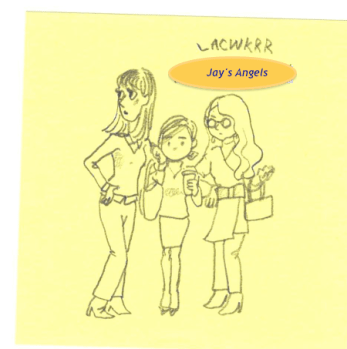
Move over Charlies Angeles. Here come Jay’s Angeles. (from l to r: Stephanie, Gwen and Monica): Illustration by Gwen B.
Director/Writer/Producer: Stephanie S.
Illustrator: Gwen B.
Ambiance Coordinator : Monica K.
Stars: Stephanie S. (Legal Assistant), Gwen B. (Accountant), and Monica K. (Legal Assistant)
Synopsis: Three ladies who are recently hired at a downtown LA law firm by a top notch lawyer Jay C. sometimes get together during lunch hour to share their flattering hopes for their futures, remote but not that far-fetched anticipations of meeting white knights on steads, picky valuations of Mr. Rights, and other simple vignettes of their romantic adventures in Love El Dorado, all under the pretext of helping Stephanie to morph into a seductive la femme fatale, so to speak, to elevate her status to that of Irresistible Aphrodite in Pantheon of Love.
The Ladies get kick out of their funny raillery about all and sundry, ranging from a best face washer to their erstwhile significant others or would-have-been, from the pros and cons of their de facto bosses to their next best wishes and wishful thoughts about their better tomorrows. But who can deride their maiden dreams as pettifogging idleness indigenous to womanhood when they are hard-working women fulfilling everyday demands placed upon their daily tasks from within and without?
Mind you that due to their innately highly whimsical and capricious nature laced with covert extraordinary spiritual prowess, they sometimes change themselves into the Witches of the Biltmore. So it’s a league of their own, and it’s members exclusive, and it’s highly selective. But don’t you let them scare you away, my dear reader, for they are also mortals whose blood is red and hot and heart is warm and pumping. They are Jay’s Angels.
Author’s Note: Working in office requires lots of social skills: diplomacy, adaptability, modus vivendi, persona, euphemism… It requires a sense of humor, a handmaid to productivity imbued with can-do attitudes and stoicism to accept misfortunes and fortunes as they are – but with lovely smile all for the love of yourself – . Be it ever so naive or gullible, but one thing is certain that although my life at present is attuned for the office life as my primary reality for livelihood, which is why I lag behind my list of to-read books, this new kind of reality has called my attention to its adventurous digression from my textual existence rooted in reading the worlds of others. No, that does not mean that I trade myself for recklessly rash frolics, but it might help me to widen a social horizon to encounter a panoply of unknown characters, as piped up by Shakespeare thus: “There are more things in Heaven and Earth than are dreamt of in your philosophy.”
19th Century America was rapidly expanding her territory to the west with the growth of population. So the inception of a rapid mail service across the continent to deliver important business documents, letters of importance both private and governmental, and newspaper articles was inevitable. But it was a risky business to do because crossing the continents at that time meant a perilous adventure fraught with hostile Indians, highwaymen, treacherous desert weathers and temperature, and other unforeseeable elements indicating danger.
DiCerto tells the reader of historical and cultural backgrounds on which the birth of The Pony Express as a joint venture of William H. Russell, Alexander Majors, and William B. Waddel was founded against the odds, when the United States as a young nation in the world started to mark herself as a burgeoning western country with booming commerce and increasing population on a vast land in comparison with the European counterparts. During its operation, the service reduced the time for messages to travel between the Atlantic and the Pacific coasts to about 10 days, which is remarkable even for today’s standard of mail transit time. And it is a notable achievement of the Phony Express that the message carrying President Lincoln’s Inaugural Address was delivered from St. Joseph, MO to Sacramento, CA by a legendary pony rider Bob Haslam in record 8 hours. In this book, the author explains about how the Pony Express came to exist despite its short lifespan (April 3rd 1860 ~ October 1861) with the advent of the transcontinental telegraphic system.
The author also relates with his consummate story-telling skills venturesome tales of the fearless young riders of the Express and their work routine, work conditions, and their interesting anecdotes, all of which are based upon veritable document records with pictures. The book is never a bore with the scintillating discourse of the historical context smacking of wits and love of the subject matter by the author who, in fact, asserts that this book is his child out of a long labor of love and passion for this awesome historical enterprise in the American history.
In The Adventures of Asterix, a popular Franco-Belgian comic strip whose protagonists Asterix and his friend Obelix in a village of Gauls during the Roman occupation in 50 BC outwitted their Roman colonialists with Druidic magic potion and spontaneous ingenuity laced with Celtic sense of humor and and mysticism, the Gauls were constantly at war with the Romans in the reign of Julian Caesar, who was bent on subjugating the culture of the colonials, let alone the recalcitrant Celtic spirit, to that of the empire. But it wasn’t always like that, pace popular conception of the Roman ruling of the Gauls and the Britons as widely portrayed in popular culture. The relationship between the Romans and the Celts was quite peaceful and even surprisingly symbiotically beneficial – that is, at least prior to the emergence of Caesar and Claudius.
The Romans and the Celts were in Apollonian co-existence bound by flourishing trade and cultural exchange between the two peoples. There was a long period of peaceful trading between the Mediterranean Romans and the Celts of Gaul inhibiting modern-day France with exports and imports particular to each of the regions. To illustrate, the Gauls were known for their penchant for diluted Mediterranean wine that was transported by boat on the sea and wagon in land from the Peninsular. The Romans received in return Celtic slaves who never seemed to be short of a supply because there was a surplus of slaves in Gaul where frequent raiding among the tribes was the sine qua non of such abundance of exploited manpower to be used to tend the Roman vineyards and other aristocratic estates. Gaulish chieftains offloaded excessive number of newly acquired slaves by trading them off for proverbial Roman wine to distribute it to his followers as an ostentatious display of their wealth and prowess in their tribes. In fact, the Gauls’ love of the Roman wine was so undeniably famous that among the Romans the stereotypical image of the Gauls as drunkards slurping wine through their long, drooping mustaches was widely circulated in the empire.
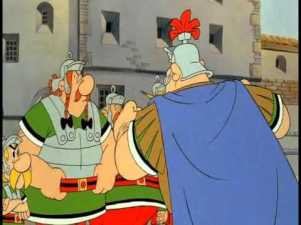
Asterix and Obelix in the Roman Army
Olive oil, tableware, jewelry, and other luxuriant goods were among the popular Roman exports, however expensively they were sold by canny Roman traders, who then bought metals, cured hams, beer, and hunting dogs from the Celts at low prices. Notwithstanding such discontentment in terms of fair trade, the prosperous bartering of the goods between the colonials and the colonialists brought the grist to the mill of effective management of the colonies in the context of regarding economic and political stability that could/would have been otherwise in turmoil as a result of despotic constraints on the preexisting native social and political structures characteristic of colonialism. This favorable symbiotic relationship between the Romans and the Celts (the Gauls in France and the Britons in Britain) greased the wheel of the cultural and political expansion of the empire by egging the Celts on to adopt Roman-style systems of government and the young ones on to enlist in the Roman army as auxiliaries.
Julius Caesar
However, the pacific era of the Roman-Celtic relationship saw cataclysmic waves of change that would punctuate the stability of the status quo as destabilizing forces loomed large in Western Europe: Firstly, the prospect of Germans occupying the Alps was a cause of concern to the Roman Elite. Secondly, Julius Caesar, the ambitious Roman ruler who was seeking for a popular acclaim to fortify his rulership in the empire as well as booty enough to get himself out of debts, determined to impose his despotic rules on the peoples of the conquered lands as portrayed in The Adventures of Asterix. Then later, there came Claudius, the lame and slightly deaf emperor who was spared of his life by his nephew Caligula perhaps on account of such physical defects. Claudius launched a campaign of conquest in northern Europe to attain military prowess in the region and thus enforced totalitarian policy on the management of the colonial systems, discouraging autonomous trading and social and cultural exchanging between the colonial and the colonialist.
In light of the above, the relationship between the colonialist and the colonial sometimes begets unexpectedly mutual benefits in terms of cultural exchanges between the two peoples counter-intuitive byproducts, such as attested in the case of the Romans and the Celts, which could lead to diversification of native cultures, enriching the wealth of cultural legacies that would become another mode of new culture. If the Celts had been vehemently resisted against the cultural influences of the Romans as a result of the conquest of their lands, the cultures and history of Western Europe would and could have become very different from what we have known today, such as the English language, architectural and other historical artifacts, and political systems. In my opinion, sometimes, the colonial regime is not altogether downright evil in the sense that it somehow results in amalgamation of cultures favorable to both of the ruling and the ruled, not out of the benevolence of the former for sure but of the necessity of governing the conquered in the most effective way in order that the conqueror may quell the social and political dissonance arising out of the inept administration of the colonial affairs. In point of view as held by Ancient Athenian historian Thucydides, one must listen to the other less popular side of the story to transcend the subjectivity of times and to test the validity of truth. In this regard, I opine that however adamantly one may object to the benefits derived from the Roman-Celtic relationship, it attests to the fact that it enriched the cultures of both of the peoples and helped them reshape their ideas of epicurean ways of life that has passed on to the present progeny.
Author’s Note: The inspiration of this essay comes from my reading of “Traders to Invaders,” written by Barry Cunliffe, formerly professor of European archeology at the University of Oxford, from December 2018 issue of BBC History Magazine.
 Cat Power: A Good Woman by Elizabeth Goodman






You must be logged in to post a comment.