Tag: Nonfiction

  • Kinship of Aeneas, George Orwell, and J.K. Rowling

    1images

    I see them almost every day with carts chockablock with their haggard belongings at a coffeeshop in the morning. They come in disheveled, reeking of abandonment of hygiene, but they seem past caring of it, let alone resigned to unwelcome glances of strangers. They are no less than Mendicants, Vagabonds, Tramps, Panhandlers, Beggars, or the Homeless themselves, defying the laws of social evolution and Marxist dialectic changes. You see,  they have withstood epochal changes.

    It was one Monday morning while I was perking up my spirit still under the spell of weekend reverie with a cup of coffee in my regular Starbucks shop nearby my workplace when a homeless woman approached me and cadged for money to buy coffee. I conceded her plea because her forlorn spirit manifesting in her once beautiful face evoked pathos, which would have stung me with a pang of conscience if I had let it foregone. Besides, the fact that she was a woman living in the street, where all foreseeable and unforeseeable risks were lurking to violate her dignity as a fair sex, vexed my mind and heart. It was all too a fortiori opportune to read the article with the lethargic face of the homeless woman still fresh on my mind.

    Never mind piousness, didacticism, and self-righteousness. It goes against the grain to decry poverty at the door of the poor themselves, which is always easy and convenient to pin down based on personal faults, but that would attest superciliousness of being not one of the unfortunate kinds. That is to say, the homeless is the result of addiction to substances, laziness, and careless ways of modus vivendi; therefore, the homeless are unworthy of sympathy nor empathy.

    As a matter of fact, the liberals wade in with their de rigueur weary blaming of the heartless conservatives for their preferential treatment of the given, the fortunate, the haves, while the conservatives lambast the cry babies’ importuning their sorry states as a tendency of the cossetted dependency substratum. Both of the parties do nothing but grandstanding against one another for their voting rights that exclude these “marginals” of society they could not care less. However, the causes of homelessness are one collective social evil comprising many a factor; it’s a complex one involving mental health issues for sure, skyrocketing rent fees as a result of rampant trend of gentrification, prevalent lay-offs and unresolved unemployment rates, low wages, integration of families, and a variety of personal elements that are oftentimes looked on with insignificance as trifles. George Orwell, whose brief period of impecuniousness upon returning from Paris to London forced him to live as a tramp as plainly narrated in his empirical Down and out in Paris and London, conceded: “… if they [the homeless] are worse than other people, it is the result and not the cause of their way of life.” That is to say, no one wants to be homeless with a will.

    Come to think of it, our human conditions are precarious and many times operated outside the boundary of planned stratagem, for human life is woven by unexpected variables and vicissitudes that befall any one like you never know. Aeneas, a royal Trojan hero in Virgil’s Aeneid, became homeless in the wake of the fall of Troy and found himself and his homeless followers dependent upon the kindness of Dido, the queen of Carthage and her people. The great Russian writer Maxim Gorki and the American Jack London were once homeless. And there is J.K Rowling, who lived a life of near-homelessness with her infant daughter without a job before the first book of the Harry Potter series was published. Woe betides anyone who patronized them for the want of the gumption before they became somebody.

    Whether or not we like it, the caste of the homeless will most likely to proliferate unless political leaders stop pontificating about their party ideologies that lose touch with the realistic world of everyday life of the ordinary people. They say the extravagant lifestyles of the aristocracy and their haughty treatment of the poor were the sine qua non of the French Revolution, which was the radical reconstruction of the class system that excluded the welfare of the poor. Then why do I yoke the images of the haughty aristocrats to those of the present-day politicians who seem to thrust the issues of rising homelessness into the bottom of a filing bin and to keep pointing fingers at the homeless for their misfortune? Maybe in an irony of fates, if these politicians wake up one morning and find themselves in the shoes of the unfortunate, they might understand it, but I hope it will not be too late then.

    저장

  • Musee d’orsay in Paris – review

    Musée d'Orsay in Paris - a travel guide and tour as with the best local guide (Paris Travel Stories Book 4)Musée d’Orsay in Paris – a travel guide and tour as with the best local guide by Wander Stories

    My rating: 5 of 5 stars

    Of all the world famous museums, my favorite is Musee d’Orsay in Paris because it possesses most of the paintings of Impressionism, to which I am partial because of its prevalent portrayal of ordinary life of people with simple but innovative techniques of using color and light like never before. In fact, I enjoyed a virtual tour of this lovely museum with a guide of Musée d’Orsay in Paris by Wander Stories, a wonderful reference book on this lovely museum with rich information on the history of the museum, biographies of artists, let alone the backgrounds of their paintings they created, all of which beautifully presented in a wealth of rich color photos and illustrations to conjure up the vivaciousness of life right before your eyes in the comfort of wherever you may be.

    The birth of Musee d’Orsay starts with the zeitgeist of our modern era when the spirit of liberty and expressionism was born out of a pyrrhic victory over the antediluvian customs and dogmas upheld by a few select. Originally, the land surrounding the museum was part of a private garden belonging to Queen Margaret, the wife of King Henry VI. In the 19th century, the Palais d’Orsay was used for the Court of Accounts, most of which were burned down to the ground during the uprising of the Paris Commune in 1871. Then in 1897 the government decided to build a new railway station to facilitate transportation of passengers to the center of Paris directly, preparatory to the upcoming 100 World Fair. During WWII, the station was used as a mailing center to send packages and letters to prisoners of the war and to receive them after the war. Finally, the station was re-born as Musee d’Orsay exhibiting all the arts from the second half of the 19th century with a presidential blessing of Francois Mitterrand in December 1986.

    Musee d’Orsay embodies individualism freed from the rigid status quo of the old academics in the French arts scenes. It houses famous impressionist and post impressionist paintings of the 19th by Gustave Courbet, Eduard Manet, Edgar Degas, Camille Pissarro, Pierre-Auguste Renoir, Claude Monet, Vincent Van Gogh, and so forth. All of these painters were revolutionary vanguards of Impressionism, a new genre depicting everyday life of the ordinary not of mythological or even loyal figures and the simple beauty of nature in the most artistically innovative methods of painting that had not been seen in the paintings of previous eras.

    Vincent Van Gogh’s “The Siesta” in the museum deserves a special recognition both by its artistic merit and personal background of the painting. It was painted when Gogh was a patient in a mental asylum. Initially beginning his career as a preacher, Gogh was soon disillusioned with arid rigidity of Christianism, and turned himself to the word of painting in attempt to find a solace for his restless soul. He often copied the works of Jean Francois Millet and thought more highly of him than of Manet. Gogh’s use of vibrantly contrasting colors, such as blue and yellow, violet and organic, Gogh portrayed rural France at its most vividness dynamically.

    As with many creative artists, Gogh lived a difficult life of being let down by his low self-worth. To illustrate, Gogh had a drunken brawl with Paul Gaughin, in which Gogh threatened Gauguin with a razor then fled a local brothel, where he ended up cutting off the lower part of his let ear lobe. Moving from one asylum to another, Gogh’s creative ingeniousness was recognized and encouraged by Dr. Gachet, an Impressionist enthusiast who drove this extraordinary patient of his to creative indulgence, leading Gogh to create 70 more paintings in 70 days, although he sold only two paintings in his lifetime. The last day of Gogh was just like another working day, for he shot himself in the chest while painting in a wheat field. Notwithstanding the tragic end and life wrinkled in anguishes and distresses, Gogh’s resilient spirit driven by his creative madness is enshrined in his paintings that have stood the test of times all around the world, canonizing him as a key figure in transformation from Impressionism to modern art in art history.

    Musée d’Orsay in Paris by Wander Stones is a lively reference book about the museum and the oeuvres of the aforesaid and other famous painters with beautifully displayed photos and detailed information on the paintings and the painters in easy language. This is also a lovely book to be viewed on a Kindle Fire with easy references to pages and stunningly colorful photos effortlessly downloaded on the device to enjoy the tour of the museum anywhere, magically transporting you in front of each of the paintings in the museum. Or if you plan to visit the museum, then reading this book will prepare you with arms of information. All in all, the knowledge from the book will help you appreciate the beauty of the arts at their best because as defined by Sir Edmund Burke the standard of reason and beauty is all the more appreciated by the faculty of the mind affected with the works of imagination and the elegant arts, which is universal in all humans and of sentiment common to all mankind.

  • Ditto to ‘On Writing’, by Stephen King

    Camille_Pissarro_-_Flowering_Plum_Tree,_Eragny
    Flowering Plum Tree by Camille Pissarro –

    I have been writing profusely and religiously almost on a daily basis since I created the blog a month ago. I love the process of writing my thoughts and feelings publicly in hope of communicating with the people who can share them and appreciate my writing. Although I don’t have a huge fan base, nor do many people leave comments on my posts, I am not dispirited because even David Hume, the author of Human Understanding received a total lack of recognition upon publication, nor did Athony Trollope’s The Macdermots of Bally Cloran gain any readership. Nary a one bit. What a comfort.

    While reading Stephen King’s On Writing: A Memoir of the Craft, I have been getting many invaluable tips on how to write a story, what to write, and what to possess to write. King’s advice is down to earth, straightforward, honest, and friendly. Also, he is very humble to share his own craftsmanship in reference to his own personal experience which I am greatly appreciative of. Before I read the book, I felt a great distance from the contemporary American writers and their works because they seemed to belong to another world where I could not find myself comfortable with and connected to. However, King with his book On Writing has kindly and warmly invited me to the world of modern American literature and his personal/professional world in a very American way.

    His writing style is precise, perspicuous, scintillating, and personal. There are no belle lettres, no plum words, no grandiloquence, no priggishness, and no platitudes therein. Just a straight story-telling as truthfully as possible. It’s both intellectual and entertaining. Besides, the facts that (1) he went to a state university; (2) he’s not from an affluent or a typical middle class family; (3) his writer wife, who also went to the same university as he did, worked at a Dunkin’ Donuts’ to support their family; and that (4) he plays the rhythm guitar in an amateur rock band consisting of his fellow writers have drawn me closer to appreciate his world of literature, his brilliant creations.

    Furthermore, King seems to have read my mind in regards to my arrested development of writing stories I want the world to read. To write good, I have to read a lot consistently. Also, setting up a writing routine on a daily basis is highly recommendable. He suggests any aspiring writer write at least 500 words per day. So here I am writing this long-forgotten online journal. And the most important thing to keep in mind is that I should not lower my level to expose my writing to any external feedback by publicizing it in expectation of receiving praise or even the smallest comment, unless my writing is complete and reader-friendly after satisfactory re-draft of the original. Besides,  I will not canvass for readership because I don’t want my blog to be tainted by internet marketers of dubious origins and their ilks. In fact, the satisfaction results from writing a story that is honest to myself, that is easy to write about, and that is vivid in telling a story abstracted in my brain. Thus, I have decided to publish my blog post upon thoroughly circumspect review thereof. And I will keep this journal diligently and write a short story per week.

    I will let go of myself in the world of armature writing and see how far I will get to. And if this is not my thing to pursue, then I will toss it to find another avenue in my life. But for now, I will stick to this writing plan.

    *Having done this entry, I have realized 699 words were written! There I go! I have already written a short story of mine!

    P.S. Sir Francis Bacon once said, “Reading makes a full man, conference a ready man, and writing an exact man.” How rightly so.

    The rare equanimity of this Sunday evening (also in celebration of denouement of the senseless Daylight Savings Time in the States) allured me to trace back my bygone days, and hence this entry of my interior monologue I wrote on Tuesday, December 8th, 2015, several days after starting my blog on wordpress.com. I have always liked to write since I could read and write, no matter how amateurish it may be.

    Although I can’t imagine myself earning the bare necessities by means of writing, an act of writing emboldens my otherwise timid self under the aegis of anonymity. Well, I have my name Stephanie Suh manifested as the author of the writings on my blog, but other attributes of mine are protected by stealth, and it will remain so in fear of losing a magical sense of writing as a ghost writer. (Or sometimes, I feel like Artemis, a divine huntress who vehemently protected herself from the leers and jeering of mortals in terms of her fierce guarding of noble independence. ) After all, writing is an act of discovery of a self, ego qua meaningfulness, a search for sense of purpose in life. It’s also a sanctuary, an elbow room of a restive, lost soul on a life sea. It’s also a cultivation of  plants and flowers and trees in your Secret Mind Garden. 


  • ‘The Library: A Catalogue of Wonders’, by Stuart Kells – review

    The Library: A Catalogue of WondersThe Library: A Catalogue of Wonders by Stuart Kells

    My rating: 5 of 5 stars

    Libraries are more than boring stockpiles of books gathered, nondescript depositories of books collected frequented by socially gawky individuals we love to call “nerds” or “misfits.” They are symbolic fortresses of our human cultural progresses as collective enterprises. In fact, libraries are precious repositories of our cultural wealth and knowledge inherited from the forerunners of the Humanities with prescient intentions to preserve the intellectual and spiritual prerogatives of the mankind for the posterity. Any book lover sees this magnificence of libraries, and that is the motif of Stuart Kells’s The Library: A Catalogue of Wonders, a vivacious, jocund presentation of histories and development of libraries and an uplifting rhapsody of bibliophile – love of books. What’s more, this book is not a product of armchair thesis of a library as an anthropological institution, but of an empirically telltale account of cultural, aesthetic, literary, and social phenomena dedicated to preserving the writings of Mankind based on Kells’s actual visitations to the libraries he presents to us.

    To begin with, Stuart Kells wears many hats in this book: a teacher, a guide, a book-collector, a historian, and a confirmed book-lover. But most of all, the image of him as I follow his narrative is that of a cross between a teacher and a tour guide with erudition and bonhomie. Like peripatetic Aristotle communicating to the minds of his students in the ancient Greek Lyseum, Kells invites the reader to saunter with him in his own mental library of snippets from a variety of literature and history that merit their substratum of textual human cultural artifacts bestriding the shelves of the Humanities ranging from the classical to the contemporary, all in the loving and caring custodianship of the author whose love of books is so deep and passionate that it’s almost physical. It’s personal, historical, academical, and magical in a way that imparts a sense of flitting in the phantasmal reverie of the world of libraries, now and then, existing and extinct, and  real and imaginary, to the reader.

    We travel along with Kells playing the role of a likable and knowledgeable cicerone from the Library of Alexandria to the Italian monastery of Bobbio in the Middle Ages that was said to house 666 manuscripts, Germany’s Wuttemberg State Library possessing a 17th century portrait of Vlad Dracul, aka Dracular, and the Abbey Library of Saint Gall, aka St. Gall’s Library, in Switzerland, which is now a UNESCO world cultural heritage site holding more than 400 manuscript volumes produced before the year 1000. And before we know it, Kells also brings us to the fantastic libraries of the famous Hobbits, also known as a race of bibliophile with personal libraries at home, however small the size might be, and the medieval monastery library in Umberto Eco’s The Name of the Rose, where lightheartedness of the atmosphere contributes to the joy of knowledge and the elevation of the mind and soul. Although Kells’s Australian identity tells of the superiority of J.R.R. Tolkien’s Mathom House, a wondrous library of literary paraphernalia, over the Italian Eco’s monastery library, it’s altogether a magical sightseeing of the mystical libraries conjured up before our eyes by the imaginativeness of Kells, and we can decide which of these fantastic libraries appeal to us.

    To conclude, the book is an axiomatic compendium of world’s famous libraries throughout the western civilizations, smartly studded with tidbit information on eccentric librarians, book-collectors/booksellers, and historical figures in between the chapters serving as a kind of delightful intermissions introducing a subject of each new chapter with provocative anecdotes and vignettes, which are pleasingly digressive rests from the tour of the libraries. It’s really a bright book, not a heavy-duty one with lots of footnotes and scholastic priggishness that the reader may expect a book of this subject matter to be. Notably, Kells’s interpretations drew on his impressively eclectic knowledge of these extensive sources as a respectful book-trade historian, but he wears his learning lightly and writes with a general reader in mind. And I believe that just as the famous English poet Samuel Taylor Coleridge often kissed the books of the Dutch philosopher Desiderius Spinoza, out of Kells’s passions for books and possession of the knowledge of multidisciplinary studies comes his love child in the form of this jolly, easy-to-read book.  In the end, the reader will come to love this book for simple, pure pleasure of reading and may kiss the book.

  • The Spectator – review

    cover_20181103_issueAlthough I try not to read a newspaper on a daily basis because it is always fraught with starkly existential horrors of life that rudely bestride a secret garden of my sanity like a herd of barbarians in the ancient forest, I enjoy reading a selection of magazines filled with well-written articles of interesting topics aiming to educate us, the citizens of the world, on the state of affairs around us in order that we may formulate our own views of the world based on the acquisition of the knowledge. In this regard, this historically and intelligently renowned magazine The Spectator epitomizes literary journalism in the most scintillating way that makes reading a magazine at once an enlightening and entertaining experience.

    Established in 1828 (but its actual genesis began way back in 1711 by Addison & Steele.), this magazine is packed full of current affairs, reviews of the Arts, essays, and many more that will pique your attention; they are also surprisingly easy to read without the usual journalistic lingo chockablock with gobbledygook, priggish literary expressions, and biased opinions that are common features of magazines of the similar kind.

    My Caveat emptor for The Spectator is thus: because of its political and cultural leaning toward conservatism, many of the first time readers might feel guarded to hold their due admiration of the fine quality of writing laced with the characteristic British witticism. But don’t let it deter you from enjoying this cracking compendium of our today’s world in a wonderfully intelligent kaleidoscope, which is a truly one-of-a-kind. This magazine provides to you all the knowledge with information rarely found in any other popular contemporary periodicals, especially here in the States where the majority of them are proudly anti-establishment, anti-tradition, and just about all anti-anything civility without meritorious writing styles laced with scintillating witticism that was once wielded by the pens of Mark Twain, Horace Greeley, and Roger Ebert.

    All in all, in reflection of Benjamin Franklin’s timeless sage adage “An investment in knowledge pays the best interest,” it is worth the subscribing to The Spectator. And if you have a Kindle Fire like I do, you will be looking forward to receiving and reading it every week with a kind of expectation you would rarely get from reading just another lackluster periodical.

    P.S. This overview of the magazine was written in response to an email sent by Amazon asking for my customary opinion on it. Hence this review.

  • Forma Urbis: the ancient Roman’s cyclopean map

    Photo 25 Jan 2013 10_56 pm
    Forma Urbis

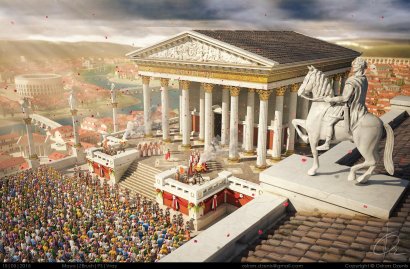
    Everything about Rome – the Eternal City – was grand and majestic, including the Pantheon, Roman Coliseum, Library of Celsus and Pont du Guard, all of which represented the magnificence and loftiness of the Empire stretching from the West to the East, from the North to the South that meant to last for eternity. And the size did matter to the ancient Romans; the bigger the artifacts were, the better they got to be. Proud champions of Bigness, the ancient Romans developed a cartographic masterpiece called “Forma Urbis,” meaning a city map, only on a bigger-than-life scale like you had never seen before had you been a Roman citizen at the time.

    hodges_pantheon1

    During the reign of Emperor Septinus Severus (193-211 AD), this behemoth map delineating a street plan of Rome mostly with symbols came into being as a cartographic statement of grandeur and power, practicality and divinity of the Empire. The map took up an entire wall of Temple of Peace measuring 60 feet wide and 43 feet high. It also depicted Rome’s urban landmarks across 5 square miles from grand temples of various warehouses of the city. This majestic map of the Eternal City bestriding the wall of the temple, however, lacked tax collection information and other bells and whistles of administrative functions. Hence, its manifest function was believed to be no more than an august ornament, a source of civic pride and awe to the spectator.

    oskars-dzenis-blessed-by-the-gods-ancient-rome-competition

    Does this giant map still exist? The question is very much similar to whether or not a megalodon, a supposedly extinct species of shark that lived about 23 to 2.6 million years ago, is still alive as there are frequent veritable accounts of witnesses of the creature elsewhere in the world. Although the existence of Forma Urbis is verifiable based on historical contexts, the actual form of the map exists as 200 fragments to this date because throughout the succession of ages, the bits and pieces were purloined by treasure hunters, especially during the Renaissance period. Nevertheless, for what’s all worth, the ancient Roman’s intention to preserve the artifact succeeded in the legacy of the grandeur of the Empire that wasn’t built a day, and to which all roads led from the four corners of the world. This vignette about Forma Urbis from an anthropological vantage point also reveals a picture of the society that tells of the standard of beauty and the glory of the Empire as contextualized into this fragment but still perennial legacy of the Eternal City.

    P.S. This miscellany is based on my reading of an article about the eponymous subject from the recent issue of National Geography History; I find the magazine an excellent source of acquainting myself with many an interesting historical fact covering from the time immemorial to this date across the Atlas, leaving no one, no country, no culture behind, all of which are finely written by erudite writers whose academically impartial viewpoints of their subjects are worthy of applause. You can never be bored with new knowledge, and your mind will never be the same ever.