I still have a bottle of Old Spice
and a bottle of Johnson & Johnson baby lotion;
I don’t know why.

I have left them on my vanity table
among my bouquet of perfumes.

To withhold the last vestige of you from time
is like keeping a child you have left.

Do you still use them
on the skin of your dusk?

The mixed scent of man and boy
is the imprint of your paradox:
shyness and boldness,
beauty and violence.

It’s domestic intimacy against time,
against its force of forgetfulness.

When I breathe in the scents together,
I see my long fingers tracing your cheeks.

Languor intoxicates the grammar of absence
I have learned
since you left the vertigo of you here.

I hope you have forgotten them
so that I can keep them here
in my bouquet of scents—
yours and mine.

I keep the alphabet of your name
written on the palimpsest
of the summer night.
I collect promises like Swarovski jewelry, from necklaces to earrings, to bracelets, and more. I love pretty things, so I change them, but it all comes down to a few select ones that I usually wear to my heart’s liking. So are my promises. There are many, but only a few of them remain, and one of them makes it out to a World Cup final.
I have always wanted to write a book that I can leave as my legacy, just so to prove I have lived, that I, Stephanie Joori Suh, lived, saw, and wrote. The thought that one day my body will become a speck of dust or ashes gives me a panic attack amounting to losing my eyesight completely. The ancient Greek poetess Sappho also felt the same, as found in one of her surviving fragments. Besides, there is something in me urging me to write as it is my nature. My father once told me that he had the same urge to write poetry, as his mother did too. Maybe it’s in the genes, like a family of practicing ancient secret rites.
What I have done is to write my first chapbook of poetry this year. It is a collection of poems I wrote from my East Coast years to the present West Coast years. I auto-published a short story before as a Kindle Read, but this is my first time submitting a poetry chapbook to editors of ten presses. Some of them are for chapbook prizes, and some are regular chapbook submissions. And… one of them sent me an email last Wednesday that they wanted to publish my chapbook. I do not want to open a champagne early until I have an actual chapbook of mine in hand. Still, I feel I am in the procession of poets from the misty past and continuing as long as humanity remains.
On returning to the quiet joy of reading, one discovers that some stories are not only theirs but yours too. Annie Ernaux’s A Woman’s Story was one of those stories—hers and mine.
It was one of the days I visited my mom at the convalescent hospital for the elderly when I started reading this story, sitting by her bedside. Call it providence if you are religious or coincidence otherwise, but I wasn’t expecting it to become my story as well about my mom, who had been hospitalized since her stroke in January of this year. It was as though Ernaux was speaking to me as a daughter to daughter about her mom and mine, collapsing time and place and the cultural and social differences between us. No wonder I wanted to finish reading it at one sitting.
This book is not of a certain literary genre. To call it a biography of her childhood and her mom’s influence on her misses the point of why it took her a year to finish the book. It’s much more than that. The absence of her mom made the author realize her mom’s place in her memory. Her mother was the first witness to Ernaux entering the world naked, and later, to her becoming the woman she is. It’s both a biological and an existential view of the author’s raison d’être. That there is no longer anyone on the other side of the first relationship, which has ended forever. It aches. It lingers. It evanesces. And before all of this will vanish into the ether, Ernaux lives to tell about the presence that was so familiar with her being that not seeing, hearing, and feeling it is painful to bear without letting it take the form of writing because writing is personal yet public, pensive but assertive, and quiet but powerful.
I can understand the kind of ache the author felt after her mother’s death. Whether you loved her or not, you would never see her in life again. She may live in your vision of the past, but her person as a presence does not exist in this world. And that realization of forever disappearance would throw you into the abyss, stifled, blinded, and muffled—by the ineffable sorrow mixed with mystical longing.
I think about my mom and me. What if she leaves this world soon—tomorrow, the day after, or anytime soon? Oftentimes, I wake up with indescribable terror at the thought that soon I will lose her to eternity if I breathe, like a panic attack. And it dawns on me that it is this feeling of detachment from the relationship, as the bond between mom and daughter is severed forever.
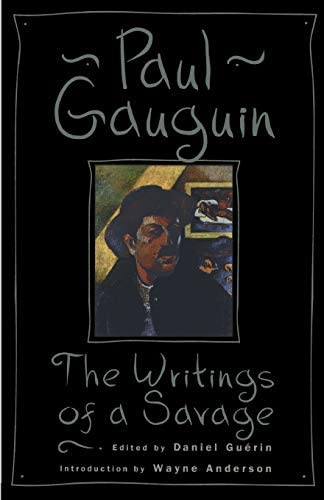
With sixpences beneath a visiting moon, Gauguin could produce wonder. He was an artist in an endless pursuit of the rising sun at the dawn of a day with a flaming glory in dazzling magnificence. He was an intellectual with a wealth of knowledge drawn from a wide range of reading and classical Jesuit education. Gauguin was a man of irony, with contrasting colors reflected in the soul’s spectrum, from the passionate red to the sanguine blue, hopeful green, and melancholic purple, which is why he left Vincent Van Gogh alone in Arles, in never-ending loneliness. He craved recognition in a grand salon, yet he longed for independence on an island beneath an ancient sun. So, naturally, I wanted to know about Gauguin from his own writings, not from another in the form of a biography. Hence, The Writings of a Savage by Paul Gauguin.
The book is an attractive compendium of mostly letters to his select few friends and, occasionally, to his wife, as well as essays and articles on the arts and religion, demonstrating Gauguin’s erudition and introspection. While reading the book, I could not help but think that if he had been a professional journalist or an art critic, his artistic talent would have basked in the glorious dawn sun rather than a struggling painter always on the verge of starvation. But most of all, what I wanted to know was if Gauguin had cut off Gogh’s ear, as I heard the rumor. Before reading this book, I had already assumed Gauguin was a man of temper because his image was incompatible with the Dutch painter’s delicate, sophisticated, and sensitive appearance and temperament. But while my prejudice was not entirely faulty, Gauguin proved himself innocent as he talked about it before his impending death away from civilization. Besides, my reading of Gauguin’s writings convinced me that he was not culpable for the injury, even if some like to assemble circumstantial rumors to make the French pariah artist appear jealous and violent toward the suffering Dutch genius. Gauguin might have been passionate, but his passion is directed toward his artistic creation of the worlds he sees in his mind, while the snobbishness of critics and bureaucrats curates the works of painters who know nothing about the arts.
Imagination, innovation, and independence are the jewels of Gauguin’s prime colors that create his artistic Elysium. Gauguin was liberal in social stance, especially against clericalism, but sovereign in his artistic philosophy that how to draw doesn’t mean an exact copy of the figure because that’s not the purpose of art for art’s sake. As the title suggests, Gauguin was a noble savage who, as a disciple of Rousseau, returned to a primordial state of humanity to escape the over-intellectualized inertia of civilization, which depreciated and ignored his art. I still can’t say the book converted me to the cult of his paintings, which differ from those of Renoir, Monet, and Pissarro. But the book is a medium of looking through the labyrinth Gauguin has built, leading to his secret garden, wondrously vibrant and dazzlingly radiant.





You must be logged in to post a comment.