 Thirty Seals & The Seal Of Seals by Giordano Bruno
My rating: 3 of 5 stars
The art of memory has been a popular subject for occultism and academicism throughout the centuries. The subject deals with our incredibly flexible human intelligence with its general multipurpose learning strategies that can work wonders if the doors of imagination are opened to the mystery of the knowledge without constraints of religiosity and fears of the unknown territories of human possibilities. Of the intellectual trailblazers of the craft of memory, none other than the figure of Giordano Bruno stood out blazingly even at the burning stake as an accused wizard. For it was akin to a witchcraft of perfect knowledge as expounded in his Thirty Seals & the Seal of Seals, the book banned by the Church in fear of losing the faithful to the Power of Knowledge.
The book illustrates a set of “basic” rules that reads more like Euclid’s Elements or Pythagorean Theorem, which means it is not written for general readers. This is because the book was part of a job application for a teaching post at the Oxford in the Elizabethan England, demonstrating his admirable erudition, superb command of the English language as a foreigner, and naked flattery to the academics at the university. Bruno got a few lecturing opportunities at the Oxford, but his cerebral mind devoid of wit in addition to his short, unprepossessing appearance was regarded as far-fetched and unfavorable to the attainment of the sought-after position at the Oxford. In fact, this book does not provide the reader with special spells for obtaining perfect memory but gives the method of encoding letters or syllables of the name of the thing into a set of predetermined images. It is magic in the sense that if this method is perfected, it works wonders. It’s a psychological mind game, the magic of psychology per se.
This magical book, this banned book will betray anyone who expects it to be something of magical Rosetta Stone for obtaining the secrets of perfect or better memorization. But that doesn’t mean the book is entirely abstruse to enjoy; the idea of the intellectual trinity comprised of Pallas Athena (The Senses), Vulcan (Imaginations), and Mars (Judgment/Reason), all of whom are overseen by Jove (the Soul) is quite intriguing and related to Socrates’s idea of reasoning. As a matter of fact, this book is not so much an esoteric book as deeply psychological literature that boasts Bruno’s indomitable intelligence and recalcitrant individualism that stigmatized him as a renegade. Maybe that’s the reason this illustrious intellect was burned at the stake as a dangerous pagan.


 Shakespeare said that fool thinks he is wise, but the wise man knows himself to be a fool. This also means that a wise man knows what and when to speak. In this respect, simulation and dissimulation according to English Philosopher and statesman Francis Bacon is wisdom providing you with a strong heart to discern the opportune time to tell truth and to do it in protect of yourself against derisive remarks and false opinions on you by whom you talk to at work and any other social occasions. In Other Words: you take false shadows for true substance lest you should lose yourself under the misapprehension that revealing all of yourself will develop rapports for socialization.
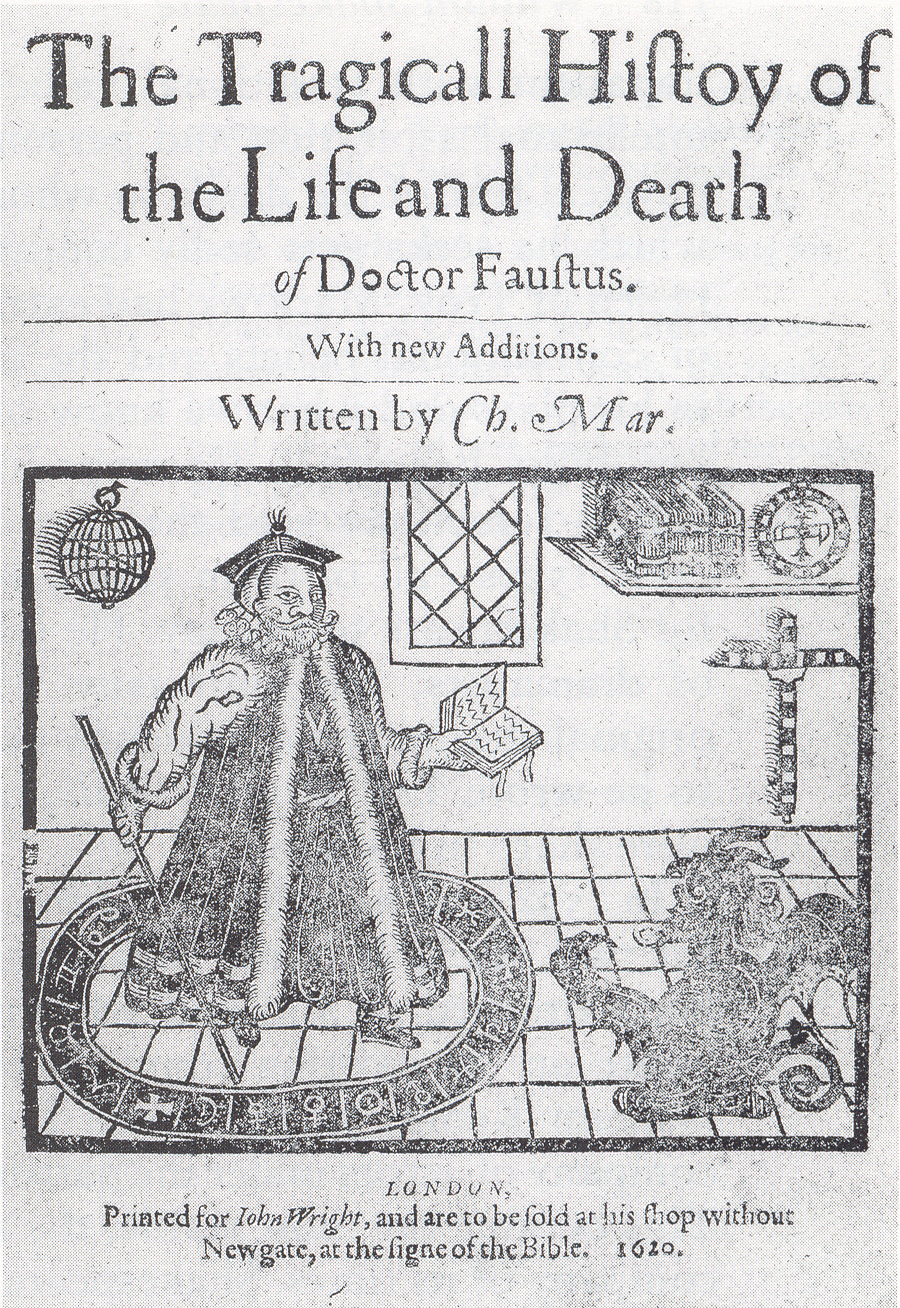 He was a formidable agent provocateur: a blasphemous rebel, a proud atheist, a counterfeit, and a sybaritic seeker of tobacco and boys and an alleged spy for the government with his literary arsenal and daredevil machismo toward life. It was no less a dramatist, playwright than Christopher Marlowe, who introduced the concepts; a man whose life was staged so mysteriously and controversially that even his death was enveloped in a provocative imbroglio of factoids. In a case of life imitating art, Marlowe’s life was an epic tragedy for a literary enfant terrible struggling to mark his name in the Elizabethan England, where his literary genius and individualism were something of irreligious decadence to be reckoned with. Marlowe’s version of Dr. Faustus was his testimony against conventional absurdities of life in defense of his existential meaning of life, and there’s his outcry of existential dilemma spreading through the mind of the reader and connecting to the world of Marlowe.

You must be logged in to post a comment.