Tag: Writing

  • go francis – viva papa!

    There has been much ado about it. Some say it’s unthinkable. A few say it’s schismatic. Many say it’s heretical. They are talking about Pope Francis’s intention of rewriting a sentence of Lord’s Prayer with their eyebrows raised in contemptuous incredulity. The fact is that most of these dissidents are like the insular Pharisees and have never liked the pope for his munificent largess of humanity without boundary. The so-called “conservative” Catholics do not want the pope to make Lord’s Prayer as close as to what it is supposed to mean, even calling his purpose an audacious challenge to the infallibility of the Holy Spirit by which the prayer was inscribed in the Holy Writ. But is the pope, who himself is an eminent Jesuit scholar, willfully shaking the bedrock of the teaching and faith of the faithful indeed? Or is the pope really an Antichrist incarnate?

    The subject sentence at issue is: “Lead us not into temptation but deliver us from evil.” The Pope has recently told Italian TV that it nuances that it is God himself that puts us in temptation, whereas it is us who fall into the trap of evil by our free will. Yet, the dissidents argue the pope’s bona fide, ad homine intention on the following grounds: (1) the change of Lord’s Prayer will sever and bifurcate Christian unity; (2) it will obfuscate the original meaning of the Greek version; and (3) it is simply outrageous to change the most sacred, ancient form of universal prayer as taught by Christ himself.

    It is understandable that the root of such misunderstood sentence arises out of the old translation from the Greek to Latin Vulgate and then to vernacular language. However, in terms of the original language of the bible, it is hard to pinpoint one because (1) Jesus and this twelve disciples spoke Aramaic; (2) the new testament was mostly written by Hellenistic Jews (Jews speaking Greeks) and Greeks converted into Christianity; and (3) the bible was further translated by scholars into vernacular language, so that it could be rendered naturally comprehensible to the faithful in their own language. In this regard of clarity, the pope wants to make it lucid to chime the bells of the souls.

    If the dissidents regard the pope’s noble purpose of making necessary changes to Lord’s Prayer as a subverting act toward the sacred authority of Lord’s Prayer, then they should look back on the history of Church from the First Council of Nicaea to the Council of Trent and to the Second Vatican Council to remind themselves of the intentions of the Church to render herself accessible to the masses throughout the turmoil of epochal waves of changes according to its corresponding zeitgeist. So why not this time? Call me schismatist or heretic. For all what’s worth in all good faith, I side with Pope Francis.

  • Have my say @ bbc history revealed

    I wrote this letter to ediotor of “BBC History Revealed” during my lunchtime today upon reading an article about the Wild West. A prospect of its publication is beyond the pale, outside the boundary of even the slightest hint of flattering hope and vain wish. Yet, I was egged on by to express my opinion on it as a new frontier-woman in California with the literary advice from Henry David Thoreau and Horace Greeley that the West is where we can start anew because of the Pacific Ocean, a terrestrial version of Lethe, the river of forgetfulness.

    Dear Editor:

    The article about the Wild West in this month’s issue was particularly interesting, since I am a recent immigrant from the East to the West: the restive nature, the swashbuckling gunslingers, the outrageous outlaws and the ruthless vigilantes were all embroidered on the popular Hollywood-generated image of the West that became something of a  factoid to people living outside the West.

    Even though the U.S. Census Bureau declared in 1890 that no more western frontiers were left to conquer, I believe that the culture and ambiance of the West remains here in California. As someone who lived many years in New Jersey and the New York City before moving to Camarillo, the most distinctive characteristic of California is its unsullied beauty of nature in replacement of the skyscraper jungle as I see every day on the commuter’s railways.

    Surely, there’s no more John Wayne, Clint Eastwood, Gary Cooper, or Paul Newman with Robert Redford walking in the streets. Yet, the spirit of eternal youthfulness is still nuanced by a combination of its beautiful rusticity of nature and a diversity of people interacting with the special aura surrounding the land.  For this reason, the West has not lost its charm with its continuous saga of immigrants in search of better future and the timeless beauty of nature.

  • chapter 4 – hunter

    italian-landscape-sketch_we

    Cumae.

    Whoever denominated this city must have been either inspired by the ancient Roman spirit or just plain high, having a momentary kick of phantasm just as Cumaen Sibyl had experienced in the cave filled with hallucinating gases and vapors. But this Cumae was nothing of the sort. 4 hours of drive from Rome, populated by yuppies, young technocrats, and artists of all kinds, it was typical suburbia that middle-class liberals would like to claim as their permanent residence. No wonder liberal politicians took their winning of votes from Cumae for granted. Which was quite a symbiotic relationship between the constituents and the politicians because young people with money and artists tended to subscribe to liberalism. It was not because they were particularly zealous for the liberal causes, but rather because it suited their modes of life.

    Into this largess of liberality, Hector was driving fast. Driving was never an annoying drudgery, but today it was. He needed to think about his next oeuvre which he did not even have the slightest idea of what it would be. Yet, the image of beauty, that mysterious entity formed by the midsummer’s moonlight sonata two nights ago was keeping him restless, making him breathless, and turning him resistless.  The passion dashed him to the finale of his journey as he was trying to think deeper about his secret imago. ‘Finally, I am at home.’ Hector felt safe and relieved at last when he entered the studio. It was well-kept by Mrs. Maria Martinez, who came to clean on a weekly basis. The paintings and sculptures of his creation welcomed him silently, but that was even more liking to Hector. He felt free from a leviathan of stress, obligations, morality… He was intoxicated with a sudden urge to sing a hymn to Dionysus and wanted to be among the cult of his temple. Out of the bliss of solipsistic presence came his ritual bath filled with an aromatic fragrance and warm water that would melt any man of steel or wood into a captive of euphoric oblivion; it smeared Hector’s manliness with an enchanting perfume of calm and soaked it in Sea of Forgetfulness. So much so that Hector wanted to proclaim such euphoric moment to be part of his Eleusinian Mysteries by hollering “Eureka,” just as Archimedes had done. My dear reader, it all seems that taking a bath would lead one to brilliant enlightenment.

    It was almost 6:00 PM when Hector decided to take an evening promenade. He was a perambulator, taking delight in walking a long distance, which put him in a league with Henry Thoreau, Edgar Allen Poe, and Robert Browning, all of whom walked with pleasure for hours. He could walk far and wide without specific destinations. Wandering like a cloud across the vast skies, Hector returned to his true self as a hunter. He was a hunter again, and he was a want of fresh blood that gave him vitality for life in which he with wife Moira and little daughters had given hostages to fortune. So, like a lone wolf that intentionally broke away from its pack, into the dusky horizon Hector started to walk as his instinct ruled over his way.

  • chapter 3 – beauty rides on mystery train

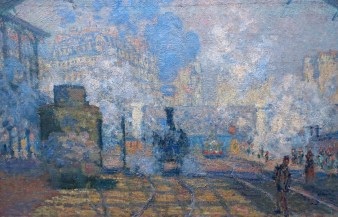
    monet, the gate saint-lazare

    The route to Arcadia was a painting of Georgia O’Keeffe, a famous landscape artist with an eye for authentic beauty: the restive naked beauty of vales and hills covered with rocks and reddish toil would make the flickering amber of any vapid spirit ablaze with prairie fires in the mind’s field. Looking at the panoply of the spectacular landscape from her seat on the train, Iris could not help but think that it resembled her. The untamed nature in its pristine condition looked a lot like her independent spirit, a unicorn whose wings were clipped by the needs of existential life. The nature without the landmarks of civilization betokened its uncorrupted virgin territory that no force could dare violate it. Nature was part of her, it was whole of her. It was wild and innocent and breathtaking, a mysterious reconciliation of ancient esoteric paganism with traditional orthodox Christianity in her. Iris was contemplating all of this, and she was taking all of it in.

    When the train arrived at Arcadia Station, Iris was suddenly seized with her usual brooding premonition that misfortune might happen to her today. She wanted to ignore it, but it was bugging her like a mosquito in the middle of a sizzling summer night. She had to ignore it because today she would be read what the Fates had spun for her. She wanted to come to terms with it and face the Fates whom she wanted to defy and challenge with the help of the wise woman. ‘This will be the day,’ thought Iris as she walked into the sunlit streets of Arcadia. Going to a pagan witch was against her Christian teachings as though by going to Hellfire Club of unspeakable debauchery and ineffable blasphemy. And yet, Iris wanted to get things sorted out for her own clandestine future and humdrum present. When Iris arrived at the door of the pagan, she saw an adumbral shape of face lurking out of the opaque window stained with the debris of dust. It was the face of a beautiful woman smiling at her. She looked ageless as if age could not wither her away, nor could custom stale her magical power. Emboldened by her beautiful welcoming, Iris went into the bungalow and thought to herself that it was a good thing to take a trip to this place, even if the prophecy would be contrary to her already smoldering anticipation.

    “So, you came all the way from Corinth to find a tapestry of your life. Welcome, I was expecting you.” Iris was flabbergasted. ‘How did she know I was coming? She must be genuine.’ Iris was even more gobsmacked when the woman continued. “Iris, the Fates had already told me in my dream a fortnight ago that you would become. And your grandmother Elaine appeared in my dream yesterday to tell me I should be attentive to your needs. Therefore, my dear Iris, do not worry about anything. You were not alone, you have never been alone, and you will never be alone.” Those kind words, those thousand comforts, all flew from her graceful lips and Amethyst crystal eyes that looked deeper than Sea of Jewel. She was irresistible not to answer, she was impossible to be real. Yet she was there, before Iris the doubtful who would not trade the moment of mystic beauty incarnate in this beautiful mystic for anything now. She was already bewitched by the witch, or was she become already one? Or even more so, Iris would be a changeling born of fairy, bred by a human. All this would be known to the unknown today. Iris could not wait any longer.

  • ‘Let Me In (2010)’, by Director Matt Reeves – review

    71wrP9sh2IL._RI_SX300_Love is really everything except what it is.  In the moments of violent delights of the ecstasy, it creates synchronicity of the two minds by surrendering to each other and becomes inseparable from one another. Whether it is erotic or agapeic, everyone regardless of any biological, social, or existential plane deserves this sweet surrender of love. George Sand, the French novelist whose love story with Frederic Chopin is better than a fiction, affirms: “Everyone deserves to love and be loved.” That is everyone, even if that one is a vampire or a misfit.

    “Let Me In” directed by Matt Reeves is a story about this love based upon his Shakespearean interpretation of ‘Love”. It is about friendship that develops into love because the word “Friend” is derived from a Proto-Germanic word “fraendi,” meaning “lover.” As it is a recurring theme of William Shakespeare’s plays, the meaning of friend and love is interchangeably conveyed on screen by the cinematographic recounting of the fateful love in the veneer of friendship between the two main characters, Owen and Abby, who are bound by loneliness and heartaches. In fact, the story of these two very young characters will conjure up the very young figures of lovelorn Romeo and Juliet by the side of the screen lurking in the corner eager to deliver their legacy of love that means to be forever beyond River of Styx. The only difference is that Abby, who is a vampire, never tells her love, but her concealment feeds on her crimson lips by devouring other people’s lives. She only sees Owen, the sensitive boy with a beautiful heart, for none other than a woman’s reason. Abby pines in thought, and with a red and gray melancholy, she watches Owen like Patience on a tree, smiling at grief for what she is.

    There is an original Swedish version of this selfsame film, but this Reeves’ version is more intelligently rendered and is hauntingly riveting with its surrealistic imagery and the stellar performance of the cast beautifully alloyed in the alluring alchemy of cinematography. It is an innovative synthesis of  artistic European neo-realism and a burst of the American no-nonsense realistic pep in the straightforward screenplay. This is a kind of film that makes you walk on the borderline of fantasy and reality, revolt and conformity, fear and courage, and doubt and trust, all of which will make you long for everything that love can come by. Forget Fear. This film is at its most compelling when you follow it with your open mind and let it in.

  • first woman orbits solo in space on 06/16/1963

    hqdefault
    Astronaut Valentina Tereshkova

    Surely, it must have been the Soviet’s ambitious plan to claim superiority of its scientific advance and social progress over the capitalist imperialists. However, in recognition of its achievement, free from bias and embellishment, we should transcend the subjectivity of the political ideology and reach universal truth and applicability, which is a principle of studying history as championed by the ancient Athenian historian and general Thucydides that still reverberates down to date.

    Fifty-six years ago from today was when twenty-six year old Valentina Tereshkova successfully orbited alone in a rocket named “Vostok 6” with her call sign “seagull.” It was two years after Yuri Gagarin had commenced the age of spaceship, and it was the first time of womankind to be in space. Coming from a model proletariat family of a tractor driver father killed in action in the Winter War against the Finns and a textile worker mother, Tereshkova was the “It” poster woman for the Soviet Union’s social and cultural ideological emblem. Raised by her mother, she didn’t go to school until the age of eight and left six years later to work in a local factory. It was during this period Tereshkova discovered a singular hobby of parachuting.

    The Soviet authorities were looking for candidates to become the first woman to go into space two years after Gagarin’s space travel. Goddess Fortuna winked at her and inspired her to apply for the candidacy, which was the job to be had only for the asking, because she was the woman they were looking for: (1) there were relatively few she-pilots to endure the rigorous training requiring mental as well as physical strength; and (2) she was the child of a war hero whose life was sacrificed for a patriotic cause with immaculate proletariat family credentials. That is, Comrade Tereshkova was the Soviet’s ideological manifesto incarnate in all aspects.

    After fifty-eight orbits lasting more than two days, Tereshkova returned to earth and found herself famous. But she deserved such recognition and respect because she demonstrated courage, go-aheaditivess, and strength eloquent of womankind in the most elegantly powerful way without brandishing a banner of feminist screed that the equality of women’s rights must be also exercised in space by orbiting in a rocket. Moreover, her non-elitist social and cultural backgrounds in comparison to those of famous Western European or American woman notables was worth noting that true equality meant for all regardless of rank and meritocracy because it would reveal everyone’s adumbral talent.